
Please watch video above for detailed info:
Hi Guys,
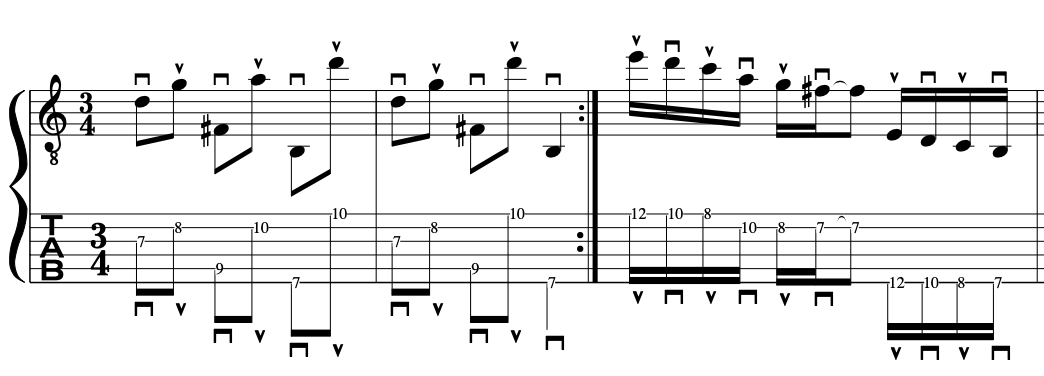
Today, a look at some Fripp style “Intervallic” guitar alternate picking exercise/vamps.
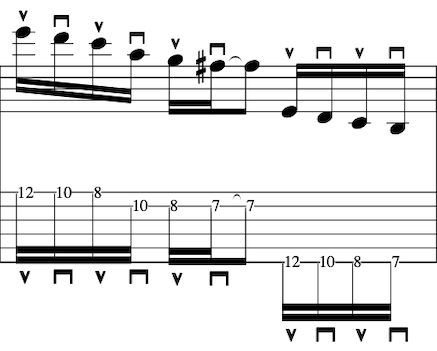
First, we will employ 8th notes and then extend this by adding a double timed bar moving from 8th notes to 16th notes.
EXERCISE1
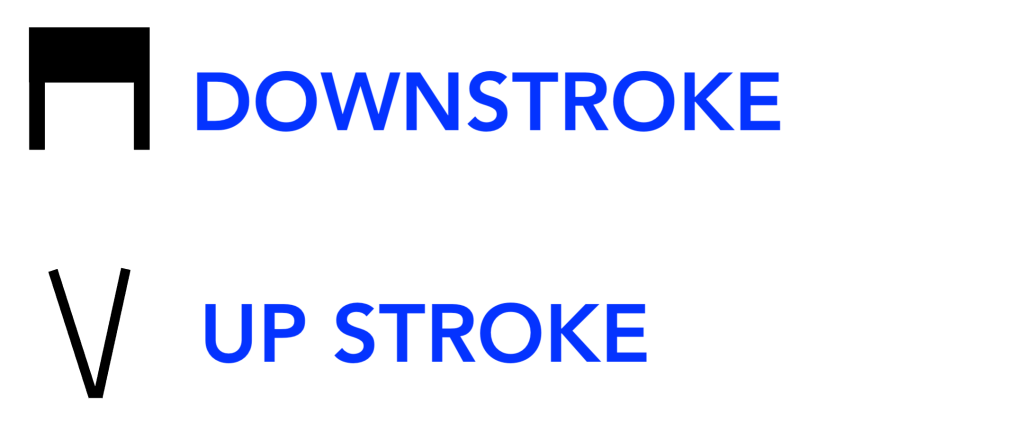
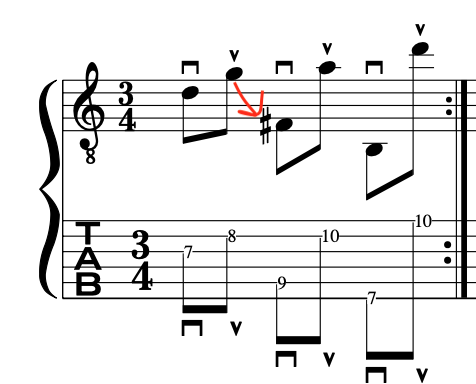
In the first exercise we will perform a repetitive loop or vamp. This will start on a “Downstroke” with strict alternate picking throughout.
In regards to the fretting hand, be aware of the necessary“Pivoting” when string skipping to the F# note. It is only a small movement but it makes all the difference for a clean execution of the exercise. [see video above]
EXERCISE 2
Here we have 2 bars of music. Notice the double/repeated note B natural. This is good for control of your right hand plucking/picking technique.
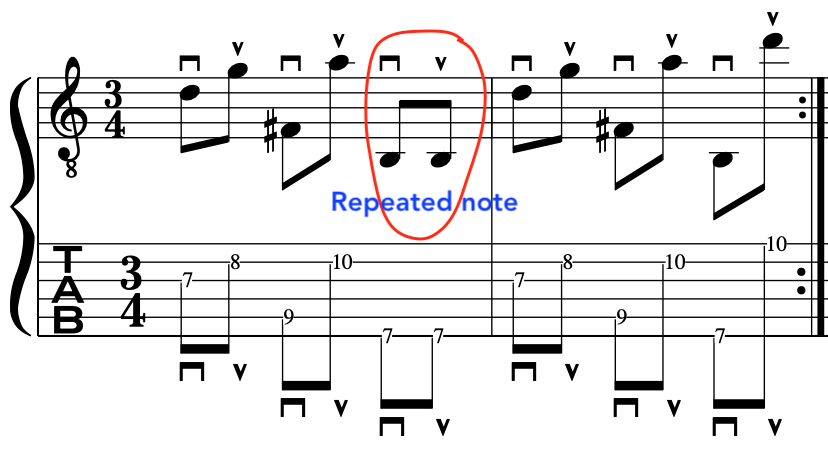
This loop/vamp is great to train alternate picking repetition of notes and right and left hand synchronisation and consistency: [See video above].
EXERCISE 3:
This time we will add 16th notes to double the time and create rhythmic interst and melodic movement. This is also reminiscent of guitarist Al Di Meola’s picking technique.
Part 1-8th notes:
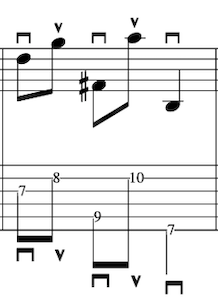
Part 2-16 notes [Double timing]
Variation/Extension:
In this example we move from 2 bars of 8th notes to 1 bar of 16th notes.
Right hand Guitar Technique:
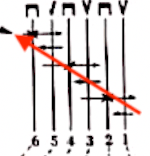
If we look at the above diagram we will see that the strings are being crossed and alternate picked along a “Straight” line.
This ensures that we are always “Aligned” with the string/note that we wish to pluck.
It is not guess work but a relaxed right hand that knows where to pick along that line and hence we can pick complex patterns regardless of time and intervallic distance with confidence and clarity.
CONCLUSION:
These exercises are very good at revealing the right hand picking to the left hand fretting and creating an awareness of “Alignment” and synchronisation.
Following the straight line is so helpful as it means that we can get on with the playing of the music and not concern ourselves with anything outside of that, like “Will I play the correct note”, or “Here is the awkward bit”, etc.
Just align with the string along the straight line, pivot with the fretting hand if needed and just play.
FREE PDF DOWNLOAD:
If this lesson was useful to you, then please SUBSCRIBE to us on Youtube below, Thanks!
