Modern Jazz Fusion Chords:How to create them from scales

CLICK SUBSCRIBE!

Hi Guys,

Today, a look at how to create colourful and interesting jazz/fusion chords:

Because, we are dealing with jazz/fusion we will manipulate a scale in modal form. This will be C Mixolydian:

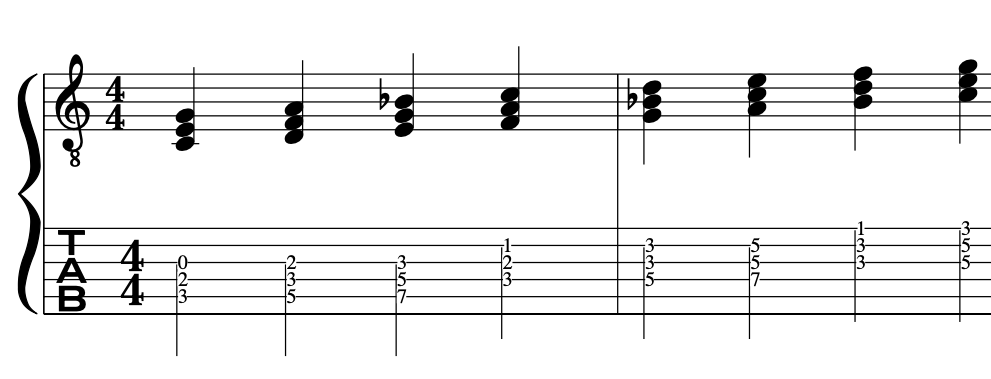
Now, let’s add one note above each note of the mode and create 3rds. [Here we can hear the mode in double stops].

Now, we will add another note a 5th above the root and create triads.
jazz-fusion-chords-lesson

We have now harmonised the Mixolydian mode.

As you will hear it doesn’t sound very jazzy or have a fusion-esque sound.

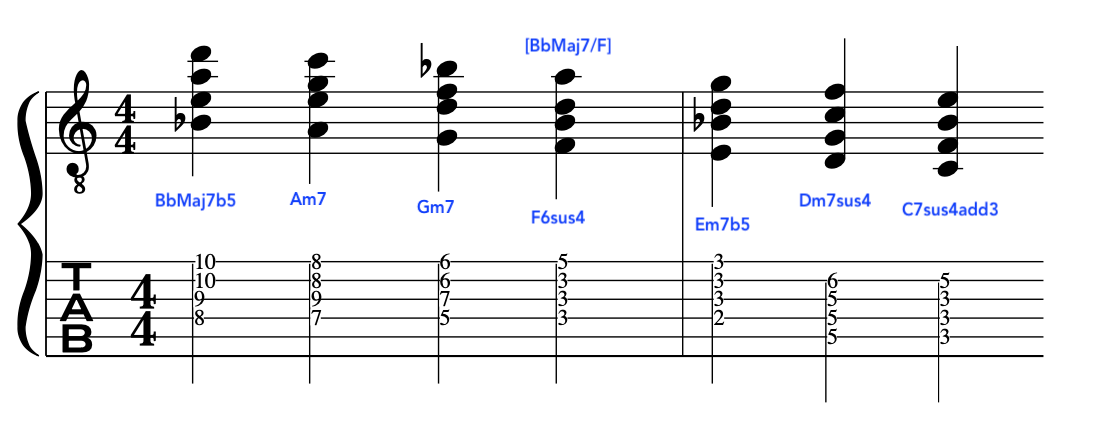
Well, we will add another note and manipulate the chord “Voicing’s”. Let’s exploit 4ths, flattened 5ths and Major 3rds.

Ascending Chord Scale:
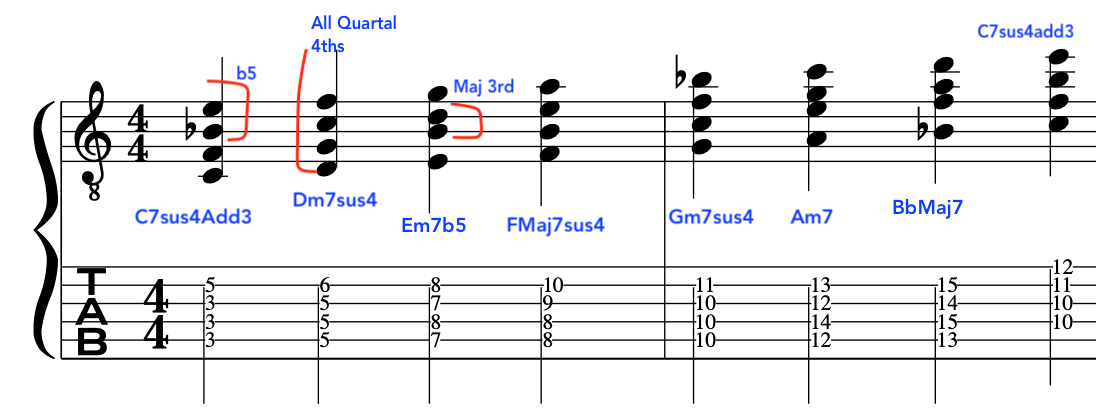
jazz-fusion-chords-lesson

Descending chord scale:

jazz-fusion-chords-lesson

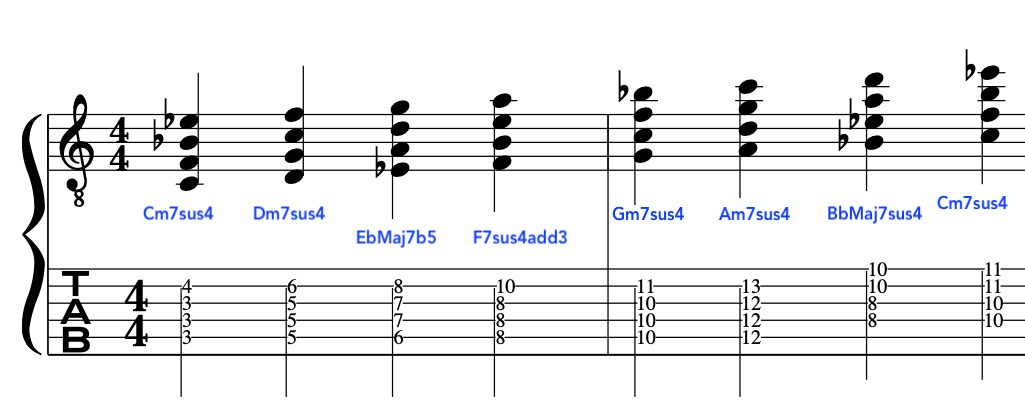
Now, we will apply this to the C Dorian Mode which has another flat note, this being Eb.
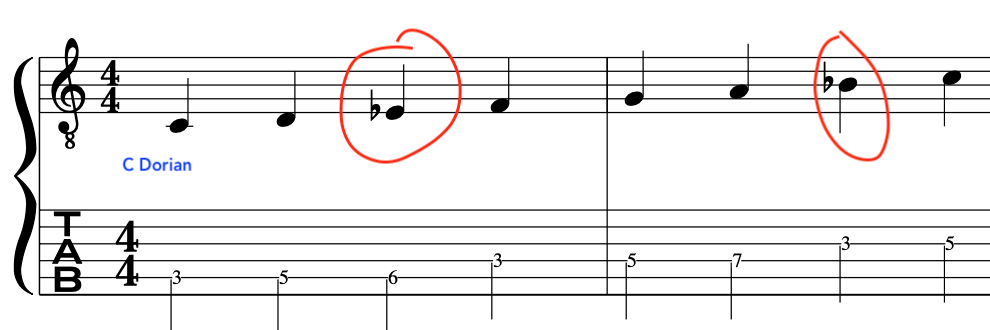
jazz-fusion-chords-lesson

C Dorian Chord Scale : Harmonisation idea:
jazz-fusion-chords-lesson

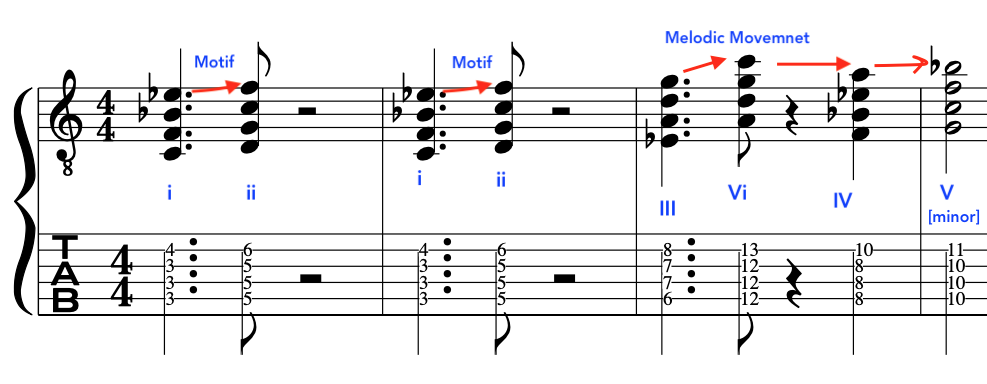
Now, let’s play these chords in a sequence and make a bit of music from them:

EXAMPLE: Notice-Motifs and melodic movement from the chord voicings:
jazz-fusion-chords-lesson

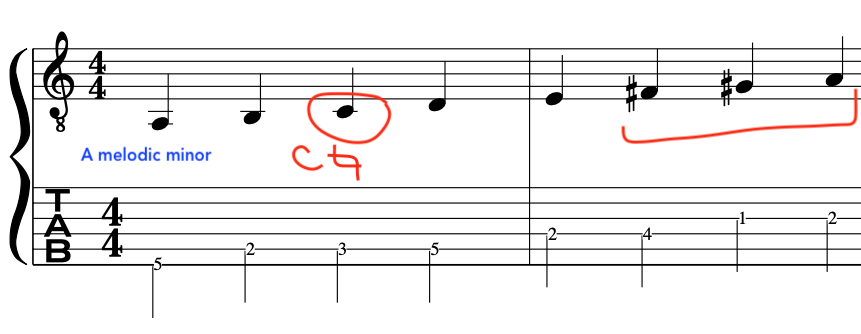
Finally, to really get that “Fusion” exoticism let’s now exploit the melodic minor scale:

Below, we have the A melodic minor scale: Notice it’s just like the A Major scale but with the 3rd flattened: [In this case C natural]
jazz-fusion-chords-lesson

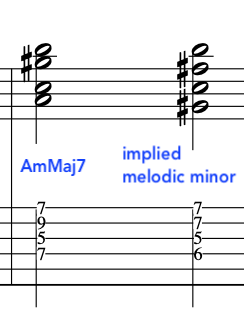
Again, we will try out some ideas to harmonise the scale with some interesting chord voicing’s:
jazz-fusion-chords-lesson

Here is a really nice set of chords built from from the scale.
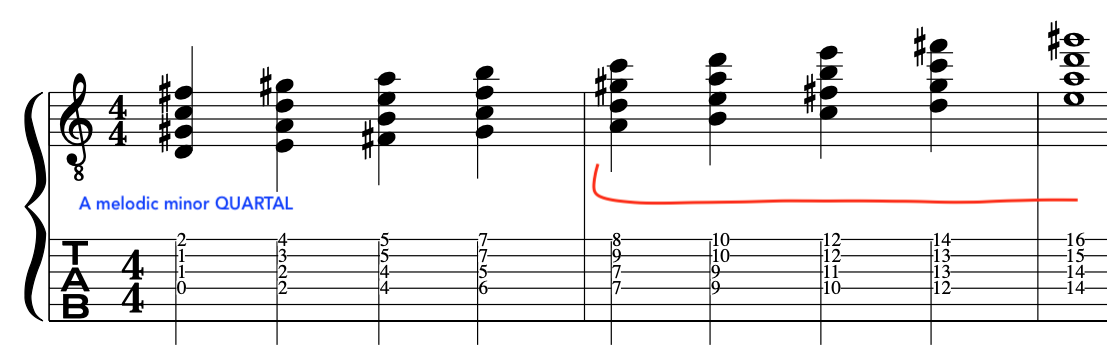
jazz-fusion-guitar-chords-lesson-melodic-minor

From here it’s a good idea to play re-harmonised chords from chord scales in sequences like:

ii V7 I

Vi ii V I

iii Vi ii V7 I

This was just a basic look at how to create interesting chords from scales and modes and how to create interesting and unique voicing’s.

At the end of the day it really comes down to your own ears and imagination and sense of creativity. But, this is how easy it is to create chords from scales and then put them into sequences for composition and re-harmonisation.

Modern Jazz Fusion Slash Chords: John McLaughlin Chords

CLICK SUBSCRIBE!

Modern Jazz Fusion Chords [Slash Chords]

IMPORTANT: Please watch video above for detailed info:

Hi Guys,

Today we will look at Modern Jazz Fusion Chords. These are mainly based around a Triad over a different bass note commonly called “Slash” chords.

Here are the main common slash chords employed in reharmonisation.

The fist chord is C/F# and creates a colurful tri-tone timbre. This is a triad of C Major over an F# bass note.

modern-jazz-fusion-slash-chords

Next we have the most common slash chord type. Here it is C/D or a 7 Sus 4 chord. This type of chord is heard a lot in pop songwriting, but is also highly prominent and best known in Herbie Hancocks composition “Maiden Voyage”.

[These chords can also function as substitutions for a dominant, e,g F/G to CMaj]

modern-jazz-fusion-slash-chords

The next chord is a Dominant 7th 3rd inversion. In this case it is D/C. Generally in Fusion these chords do not resolve and/or are played in succession.

modern-jazz-fusion-slash-chords

Here we have one of John McLaughlin’s favourite Slash Chords. This is an Eb triad over an E [up 1/2 step] bass. [This is also known as a13b9 that works well with the diminished scale].

modern-jazz-fusion-slash-chords

This next chord is a favourite of the late great jazz guitarist Pat Martino. With the open E note resonating in the bass this produces an extremely beautiful set of tone colours in one chord.

modern-jazz-fusion-slash-chords

Here we have another John Mclaughlin voicing. This is a B Major triad over a C Bass. This also works well with the open E string ringing out.

modern-jazz-fusion-slash-chords

Lastly another tri-tone voicing:

modern-jazz-fusion-slash-chords

Okay, you might ask. What do we do with these chords? How to we compose with them? Re- harmonise with them? Actually use them?

Firstly, lets take a chord sequence: This will be,

iii Vi ii V7 I

modern-jazz-fusion-slash-chords-example

For the first chord we will employ a C6/9 but just use the E A D G tones to create a “Quartal” sound.

Next we will move a tri-tone away from Am7 chord and employ Eb. In the bass we will use the 5th note of Am7, the note E.

For the chord ii [Dm7] we will have a C triad over an F bass note acting as a First inversion Dm7 chord. [You could also think of this as having an added 9th and 11th]

The dominant chord will have the dominant root in the bass with a Db Major triad, a flat 5th [tri-tone] away in the treble.

Finally this returns to the CMaj 6/9 tonic chord

Below is another example:

Notice, the reharmonisation and how the basic chords are exploited with colourful slash chords.

modern-jazz-fusion-slash-chords-lesson-chart

THE BLUES

To complete this look at slash chords let’s put them into a blues 12 bar structure [turn around] so that you can clearly see how to create composition from them:

modern-jazz-fusion-slash-chords-blues

From the above chart notice that the first 4 bars are more of a long drawn out affair in the tonic key. Next, this is repeated in a similar fashion [or a variation] with chord IV of the key.

But, now we have the last four bars of the blues and this is where the harmonic rhythm picks up.

Firstly, with 1 chord per bar for two bars and then 2 chords per bar for two bars.

modern-jazz-fusion-slash-chords-turn-around

Lastly, notice the “Reharmonisation” of the blues turn around. This is where you employ all of those slash chords that you’ve learnt.

BLUES CHART: Example,

modern-jazz-fusion-slash-chords

IF THIS LESSON WAS OF USE TO YOU THEN PLEASE SUBSCRIBE TO US BELOW ON YOUTUBE, THANKS!