Here, are the two licks from the latest Youtube video!
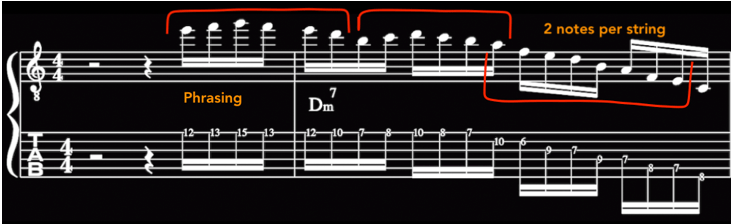
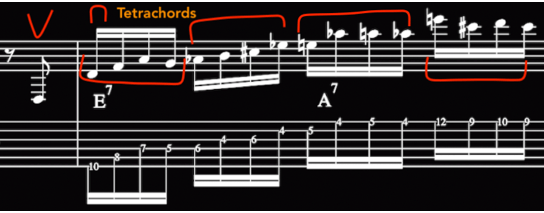
Guitar Line #1
I am starting this phrase on an “Up” stroke with strict alternate picking guitar technique.
The phrasing of this line feels like two groups of sextuplets. It’s a sort of juxtaposed phrasing as it is picked in 4 note tetrachord groupings starting on an up beat.
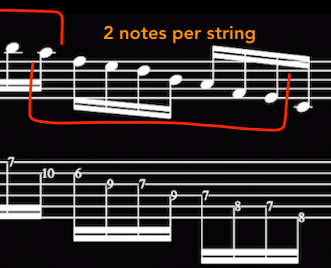
In the second part of the first bar, the fretting is simplified as it works into basic 2 notes per string pentatonic style phrasing:
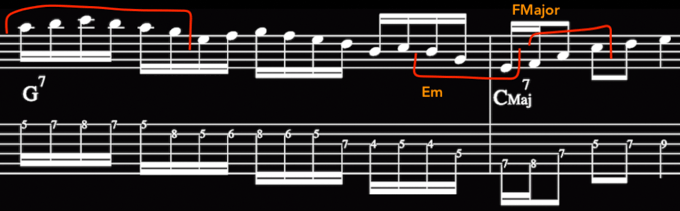
In the last bar we are playing over the Dominant 7th chord with the the same mixed phrasing as the first bar:
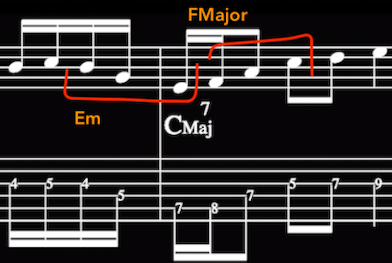
Finally, we finished with 2 triads of Eminor and F Major:
Guitar Line #2
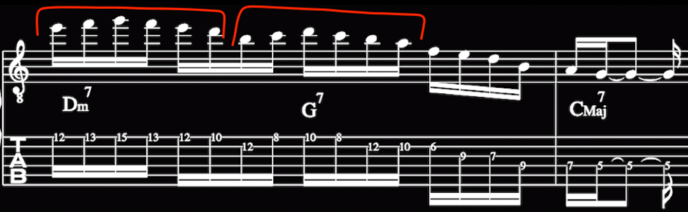
This line, once again employs strict alternate picking guitar technique.
I am starting with an upbeat on the open E string. I am also starting my alternate picking on an upstroke.
As you will see, the “Up” stroke on the “Up” BEAT means that the 1st beat of the next bar will be on a Down Stroke.
From here, we can connect the Tetrachords[4 note groupings] together:
Finally, we have the same juxtaposed notes/groupings as in the first exercise. This line comes to rest on the tonic chord of C Maj7:
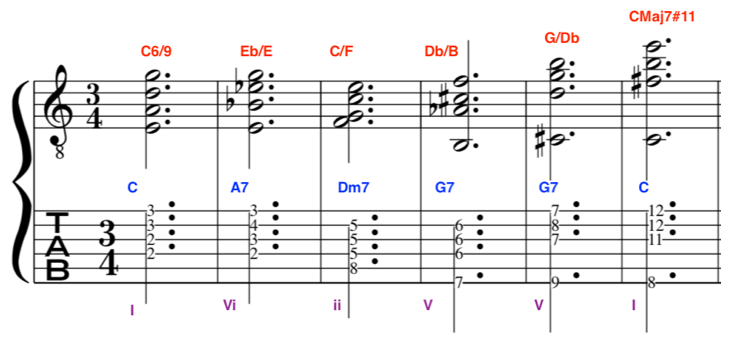
Today, we will take a I Vi [VI] ii V V I cadence and re-harmonise it with fusion chordsubstitutions/slash chords
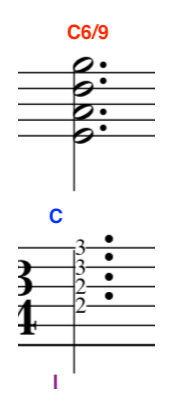
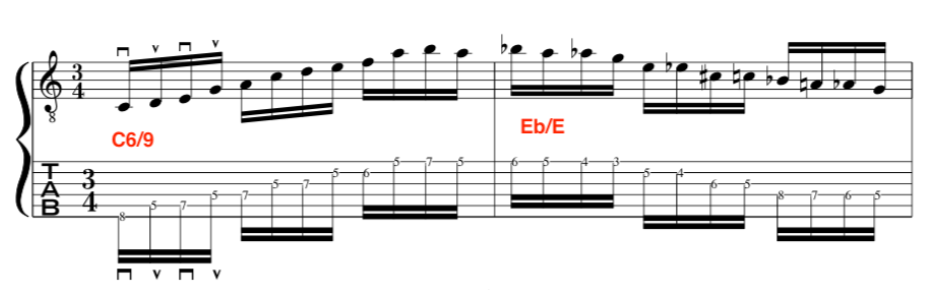
To begin with, we will make the chord of C Major into a C6/9 voicing that will resonate well on the guitar.
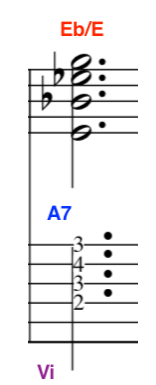
We, will now employ a slash chord for A7. Here, we will move a flattened 5th away and employ an Eb Triad over an E natural bass.
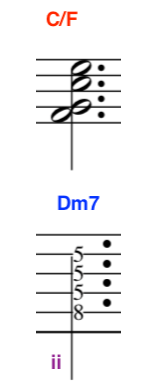
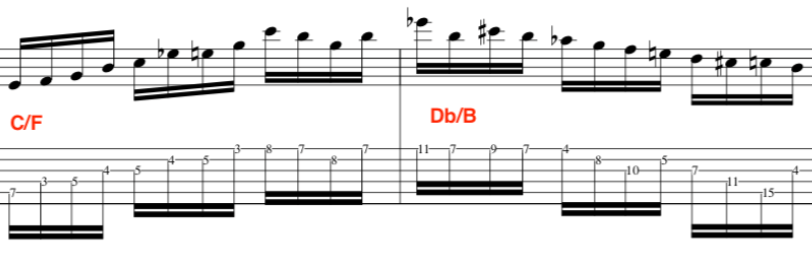
Let’s now exploit the Dm7 chord. For this we will use a 2nd inversion C Major triad over an F bass note. [Dm9 with an 11th in 1st inversion]
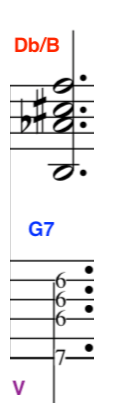
Now, let’s take the first Dominant substitution and go a flat 5th away once again. We will employ a Db Triad over a B bass: [as in an altered 1st inversion]
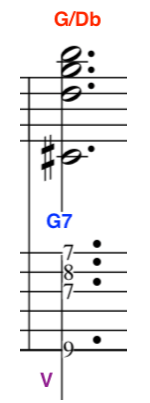
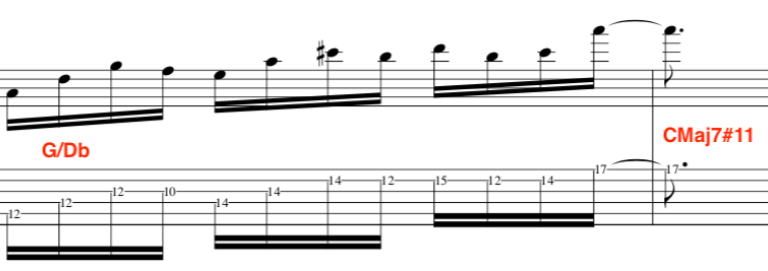
To manipulate this next Dominant chord we will put the flattened 5th [Db] in the bass and exploit a G triad on top:
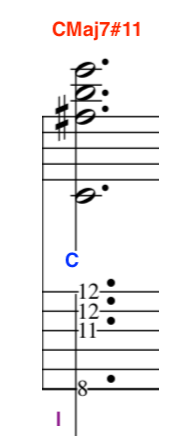
To complete the sequence we will resolve back to the tonic chord of C Major but colour it with an F# to make it C Maj7#11
In terms of improvisation we can weave in and out of the re-harmonisation. Here, is an example for an improvised line:
Pat Martino’s Minor Conversion Jazz Technique: Chromatic Devices and Examples
PLEASE Watch Video above for detailed info:
Hi Guys,
Some of you have said “How do we make Pat Martino’s minor conversion technique actually sound jazzy?”
Okay, let’s take a closer look!
CHROMATIC JAZZ TECHNIQUES FOR MINOR CONVERSION
There are 5 essential devices to employ for this:
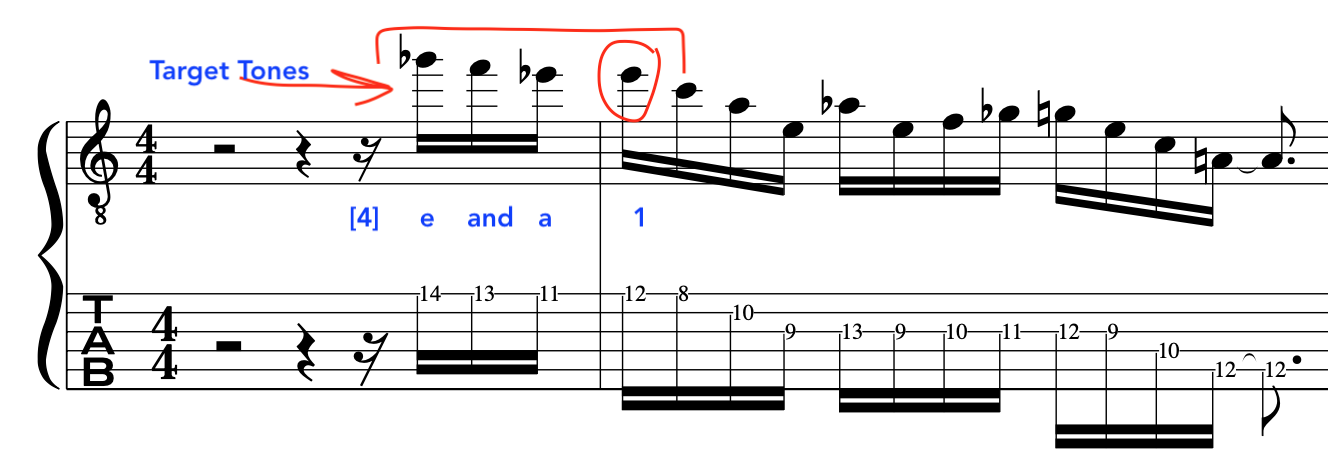
1] Target tones:
These are employed to target a specific note. In this case E the 5th note of Am.
The use of an anacrusis/upbeat works best with target tones as this also sets up the jazz phrasing.
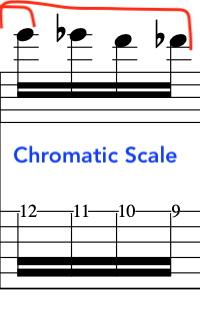
2] Chromatic scale.
This is usually delivered in fragments:
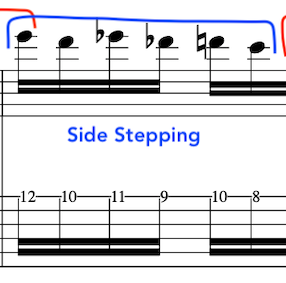
3] Side stepping:
In this case we are moving the interval of a tone down a semitone:
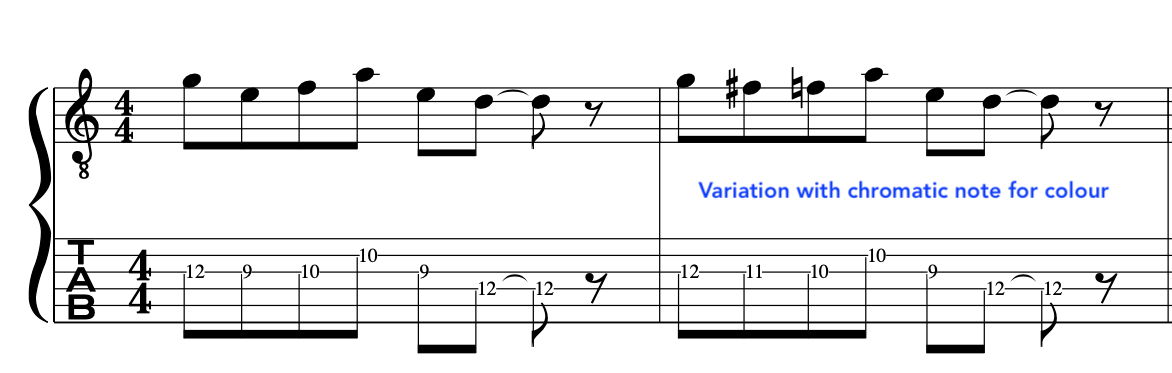
4] “Classic” Jazz passing melody/MOTIF:
This is heard a lot in Charlie Paker’s playing as well as Pat’s improvisations.
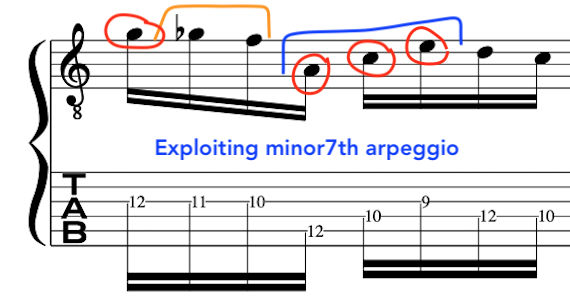
5] Minor arpeggio/min7th:
This is really useful and simple melodic tool for improvisational manipulation:
PART 2:
Analysis/Example- Pat Martino’s ii V7 I
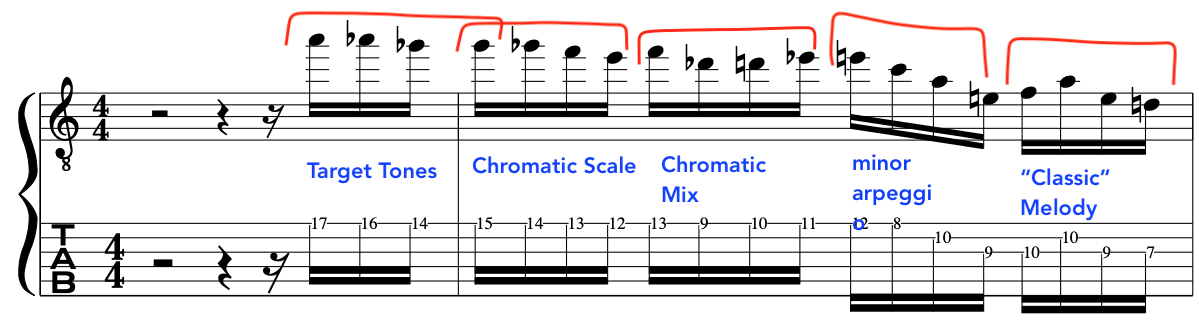
In this example we can clearly see Pat’s exploitation of chromatics and how fluid they are in creating a long phrase.
We can see the target tone set up with an upbeat. Next we can see the manipulation of the chromatic scale, also, with a chromatic mix of scale and target tones. The minor arpeggio descends easily whilst the classic jazz motif/melody comes into play to round the phrase off .
This creates a very convincing jazz line in the “Minor conversion” Martino jazz guitar style/approach.
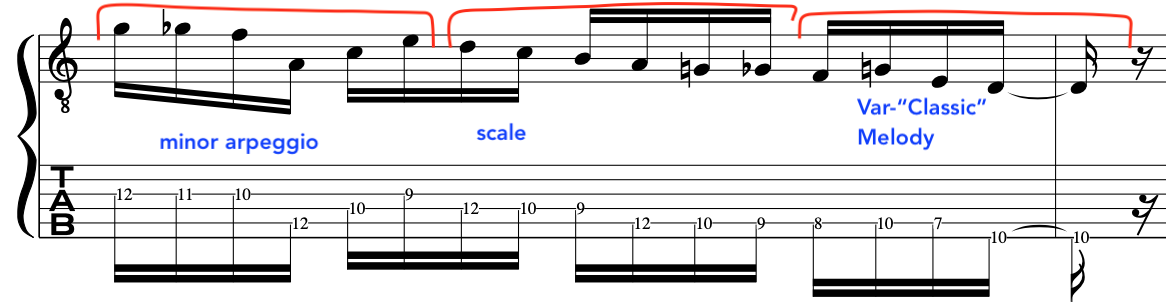
To complete this ii V7 I minor conversion we will exploit the minor7 arpeggio. From this, notice, the use of simple scale movement that finishes with a variation of the “Classic” jazz melody/motif:
Minor conversion: Sequence/Juxtaposition
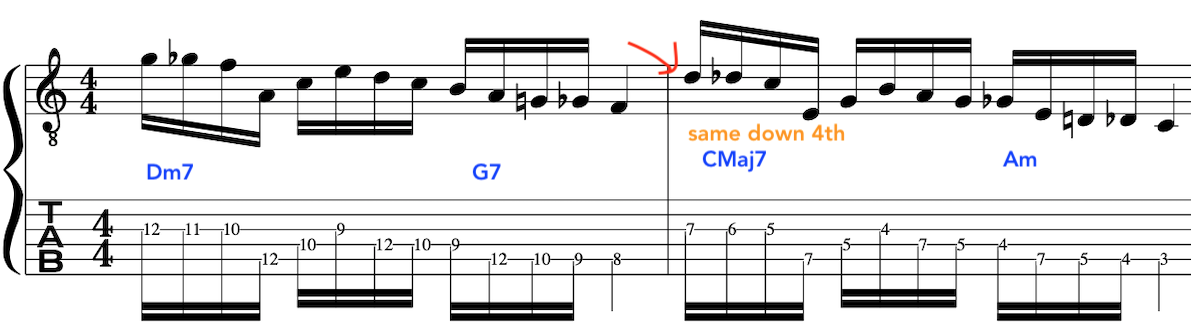
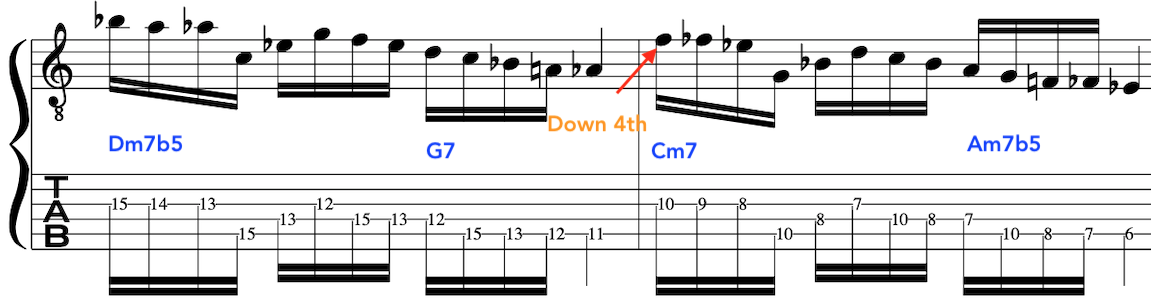
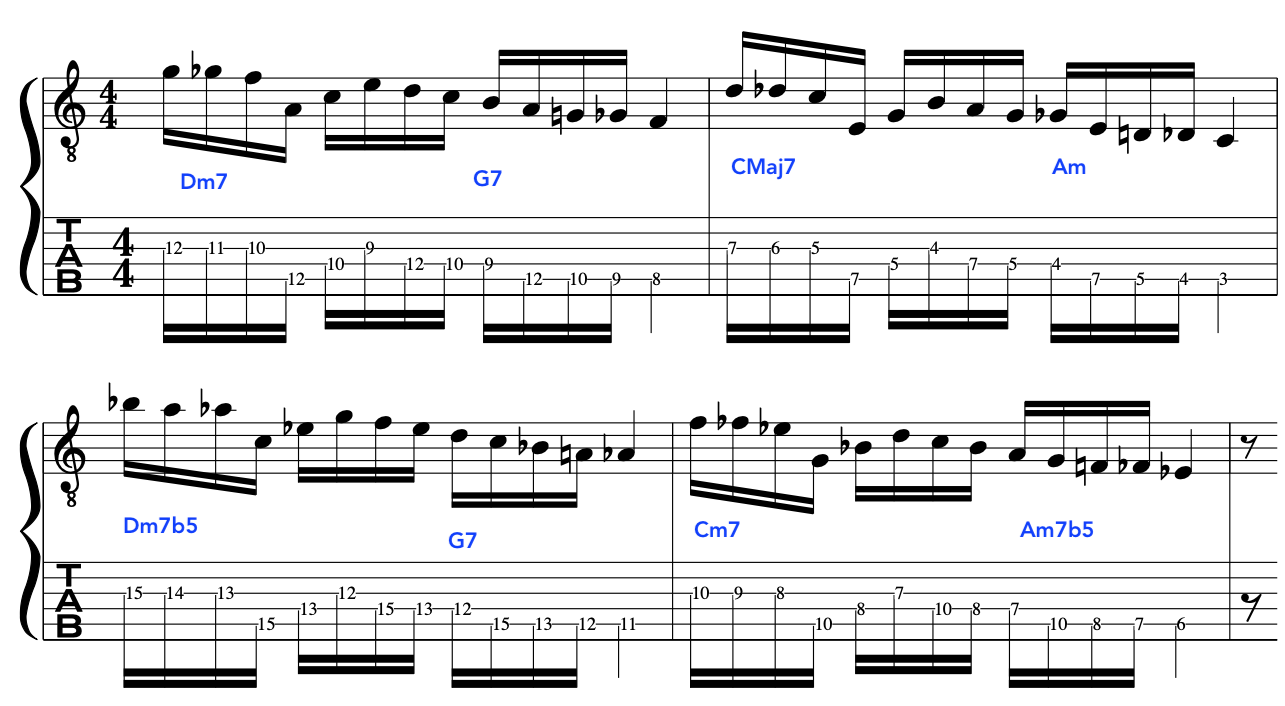
As an exercise to display the brilliance of Pat Martino’s minor conversion jazz technique we will take the minor 7th arpeggio from the previous bar in the previous example and sequence/juxtapose this to play through both major and minor ii V I’s
1] Example 1: “MAJOR”– the same line moves down a fourth to play a ii V7 I Vi
2] Example 1: “MINOR”– the same line moves down a fourth to play a ii V7 i Vim7b5
Shown in Full:
IN CONCLUSION:
This was a look at the essential devices any jazz guitar improviser needs to know and use for creative improvisation with the minor conversion, or minorisation technique.
As, I stated in the previous blog this simple method can save you 20 years of hard slog! Why? Because, Pat Matino’s minor conversion technique can be appliedimmediately!….
With these 5 musical improvisation tools anyone can create confident musical lines with strong and fluid jazz guitar phrasing.