The Practice Notebooks Of Michael Brecker: Book Review

CLICK SUBSCRIBE!

The Practice Notebooks Of Michael Brecker: Book Review

IMPORTANT: Please watch video above for detailed info:

Hi Guys,

Today I am reviewing the amazing collection of entries from Michael Brecker’s practice notebooks. With over 700 entries there is a lot to choose from.

Okay, let’s get started.

This book goes through the different decades of Michael Brecker’s musical life, starting from 1967 through the 70’s, 80’s, 90’s and up to 2002.

There are six books within this:

brecker-practice-notebooks-book-review

In order to do justice to this collection of entries I will analyse a few.

From this it is revealing and in many cases surprising because Michael Brecker starts with such a simple seed, an almost childlike simplicity which is then expanded on with many of his trademark improvisational techniques.

This in turn opens the door to Michael Brecker’s improvisational mindset, self study and developmental nature:

EXAMPLE/ENTRY 1:

michael-brecker-practice-notebooks-book-review-examples

Here, we can see a ii V7 I which becomes a turnaround: [Notice the employment of Dominants]. The Am7 chord slides up a semitone to the Bb7 chord which then moves in the cycle of 4ths to Eb7 to Ab7 which then slides down a semitone again to the tonic key G.

But, what makes this line unique is the connecting of the solo line: Because the harmonic rhythm is moving at such a fast rate [1 chord per beat] the solo line needs to connect seamlessly.

michael-brecker-practice-notebooks-book-review-examples

And so it does. Above we see the G to Ab to G back and forth employing the same smooth semitone connection which finally resolves an octave lower.

Joe Henderson Line

The next example is from an entry that Michael Brecker took from Joe Henderson:

michael-brecker-practice-notebooks-book-review-examples

This example is interesting because we see one of Brecker’s trademarks, “Sidestepping”.

michael-brecker-practice-notebooks-book-review-examples

This little line starts off with a simple piece of scale that then incorporates side stepping,

michael-brecker-practice-notebooks-book-review-examples

This then connects to a scalic bebop style lick which then cadences beautifully with a minor 6th interval.

michael-brecker-practice-notebooks-book-review-examples

MODULES

The next example demonstrates Michael Brecker’s use of 4 note modules.

michael-brecker-practice-notebooks-book-review-examples

This module is exploited in a short line.

michael-brecker-practice-notebooks-book-review-examples

Below we can see the module that then connects to a simple minor 7th arpeggio.

michael-brecker-practice-notebooks-book-review-examples

This then slides down a semitone to connect the module again. Finally, finishing with a lick

michael-brecker-practice-notebooks-book-review-examples

COUNTDOWN

The last example is a phrase from the classic jazz repertoire “Countdown”.

michael-brecker-practice-notebooks-book-review-examples

This again is unique due to its structuring with simple triads and motifs/modules:

Below we see the modules/motifs repeated, but, moving down in Major 3rds.

michael-brecker-practice-notebooks-book-review-examples

Next, we see the filling out with the simplistic employment of basic triads:

michael-brecker-practice-notebooks-book-review-examples

Below, we see the minor 7th arpeggio, triads and final rudimentary cadential lick.

michael-brecker-practice-notebooks-book-review-examples

CONCLUSION

This was just a quick look at a few entries that Michael Brecker would expand on, play in all 12 keys and use a as basis for extemporisation, composition and improvisation.

This book is for the serious student of improvisation, wether a beginner or pro and anyone seeking to get into Michael Brecker’s mind and understand his ways of working/practicing as an improviser.

Lastly, I would like to thank all the people at Sher.co music for putting me on to this amazing book!

Click Book Cover For Link

brecker-practice-notebooks-book-review

THANKS FOR VIEWING!…IF THIS LESSON WAS OF USE TO YOU THEN PLEASE SUBSCRIBE TO US BELOW ON YOUTUBE, THANKS!

McLaughlin-esque ii V7 I Alt Guitar Line [140 Bpm]

CLICK SUBSCRIBE!

John McLaughlin-esque ii V7 I Alt Guitar Line [140 Bpm]

Please watch video above for detailed info:

Hi Guys,

Today, a quick ii V7 I McLaughlin-esque lick

This is at 140 Bpm with an altered approach to harmony with strict alternate picking guitar technique.

The chords are as follows.

For the ii minor chord I employ a minor chord with a Major 7th and an added 9th.
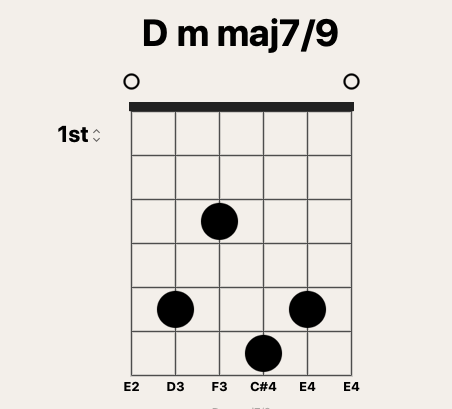
mclaughlin-altered-harmony-guitar-theory

For the V7 chord I raise the 5th [#5] and add a flattened 9th note.
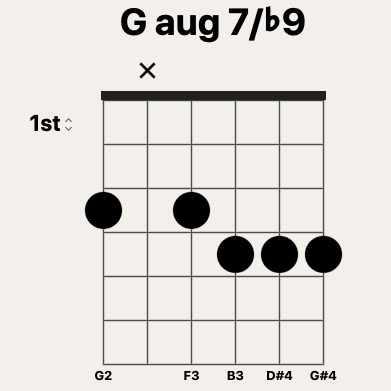
mclaughlin-altered-harmony-guitar-theory

And for the I chord I make this augmented by raising the 5th.
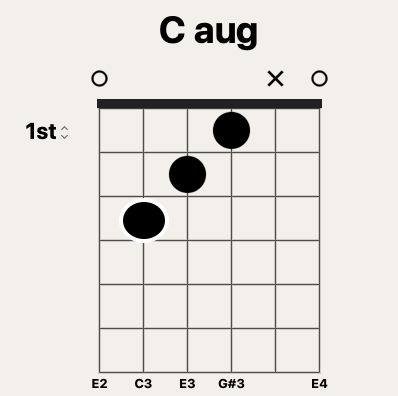
So, the ii V7 I becomes harmonically altered and creates an interesting sound
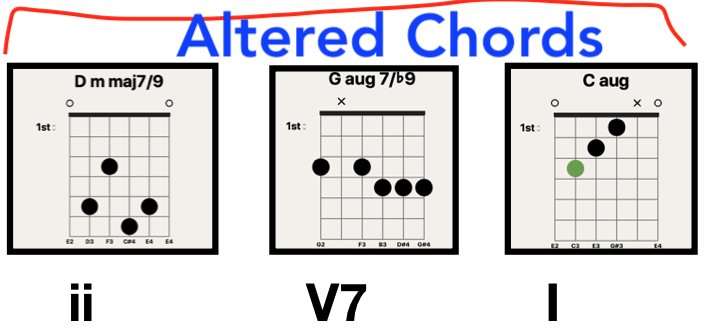
john-mclaughlin-altered-harmony-guitar-theory

Guitar Line

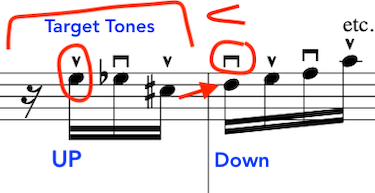
The line starts on an upbeat with 3 target tones that deliberately set up the 1st note of bar one. This adds forward momentum and adds a colourful chromatic set-up.
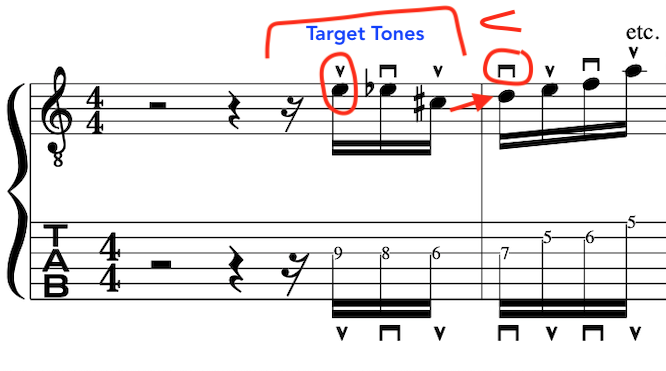
mclaughlin-altered-harmony-guitar-chromatics-lesson

The target tones start on an “Up stroke” so that on the first beat of bar one you will land and start a “Down stroke”
mclaughlin-alternate-picking-guitar-how-to

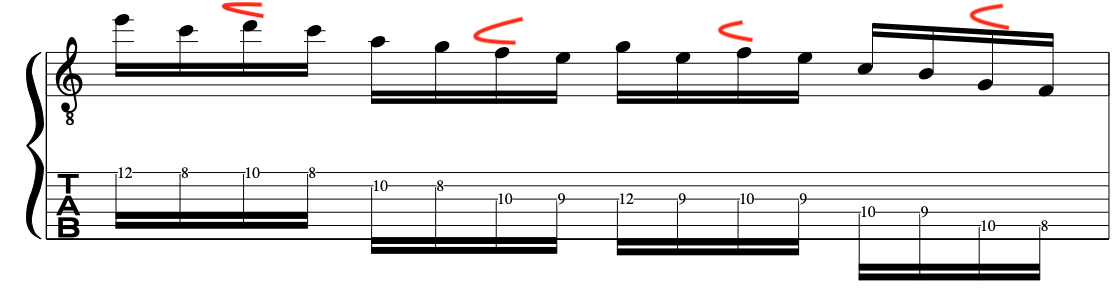
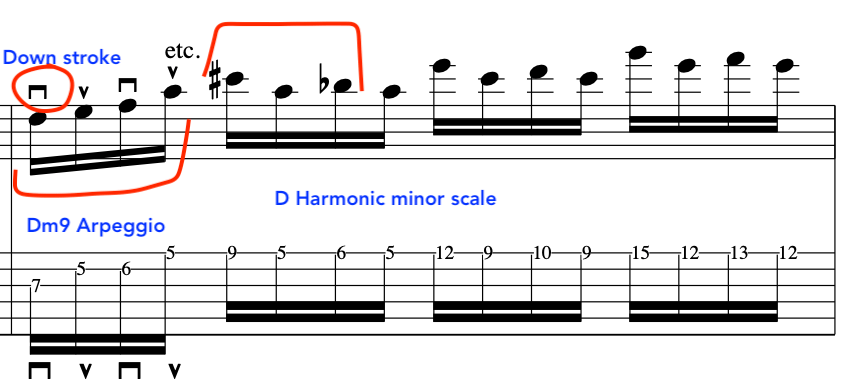
Over the DmMaj7/9 chord I start with a Dm9 arpeggio and then exploit the D Harmonic minor scale by ascending in fragments.
mclaughlin-altered-harmony-guitar-improvisation-theory

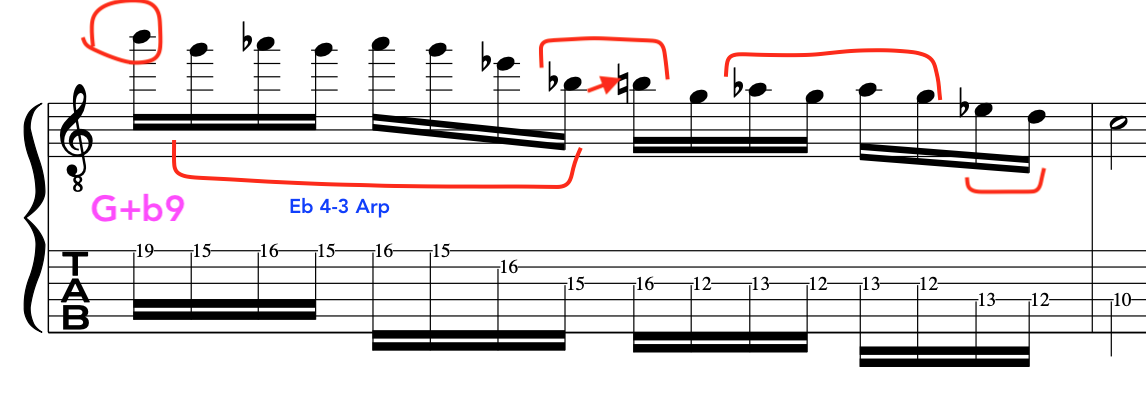
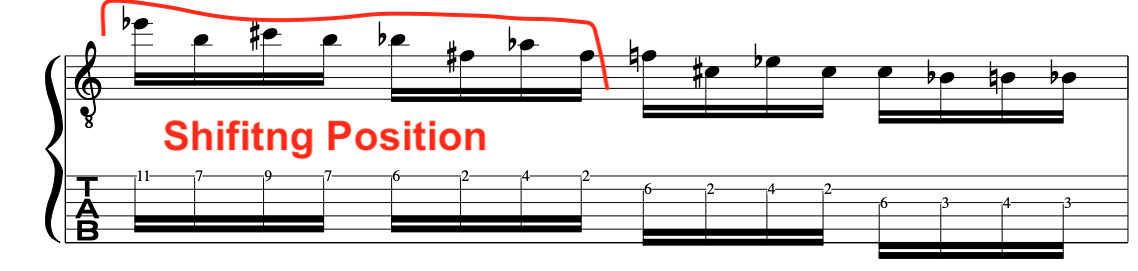
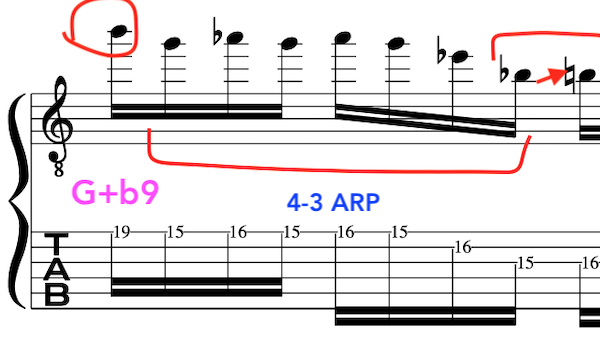
Over the G+b9 chord I start on the third note B and then play an Eb 4-3 arpeggio.
mclaughlin-guitar-music-theory-improvisation

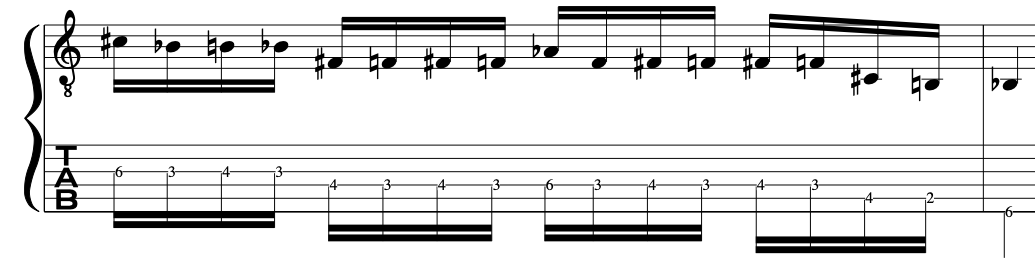
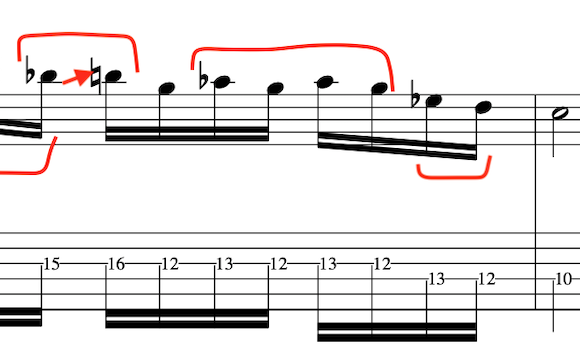
The Bb from this arpeggio then moves up to the B natural and then I play the b9 to tonic and #5 to5 which then finally moves down to the note C for the tonic of the next chord C+.
mclaughlin-guitar-music-theory-improvisation

Whole Bar:

John-mclaughlin-altered-dominant-guitar-improvisation-theory

PDF DOWNLOAD:

IF THIS LESSON WAS OF USE TO YOU THEN PLEASE SUBSCRIBE TO US BELOW ON YOUTUBE, THANKS!
Creating “Scales” from Scales Tetrachords [C melodic minor]

yt_logo_rgb_light

CLICK SUBSCRIBE!

Creating “Scales” from Scales Tetrachords [C melodic minor]

PLEASE WATCH VIDEO ABOVE FOR DETAILED ANALYSIS:

Hi Guys,

The key to making scales from scales wether they be Triadic, Tetrachord, Pentatonic or Hexatonic is to highlight the key notes that give that scale its unique flavour/sound:

Below we can see this in the C melodic minor scale.

how-to-create-scales-jazz-music

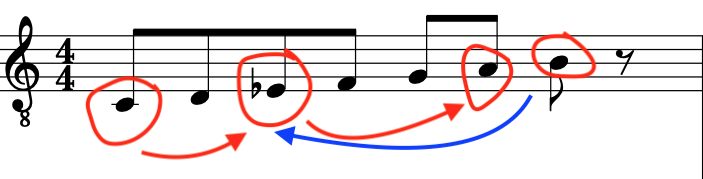
The crucial Eb note and B natural note against the C root note tells us that this is not major and that it has a specific vibe/atmosphere to it.

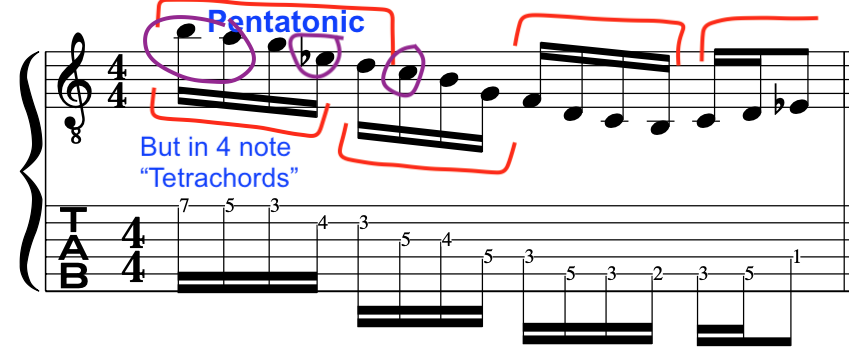
In this first example we will employ 3 notes and 2 notes for highlighting: This employs alternate picking starting on an upstroke:

how-to-create-scales-jazz-music

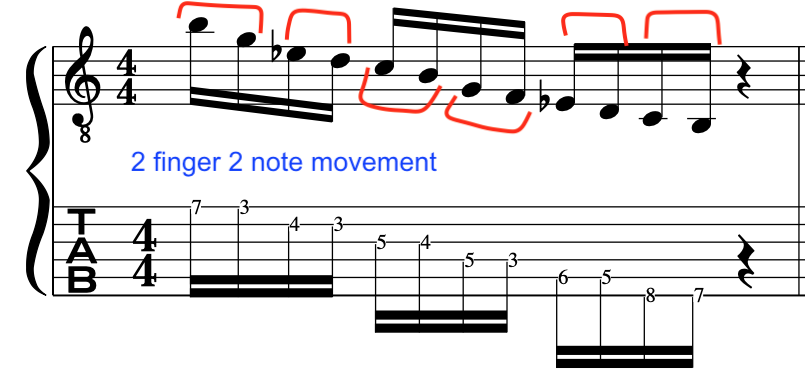
This next example starts on a “Downstroke” and is even simpler. This is a simple 2 note fingering into a 2 note scale.

how-to-create-scales-jazz-music

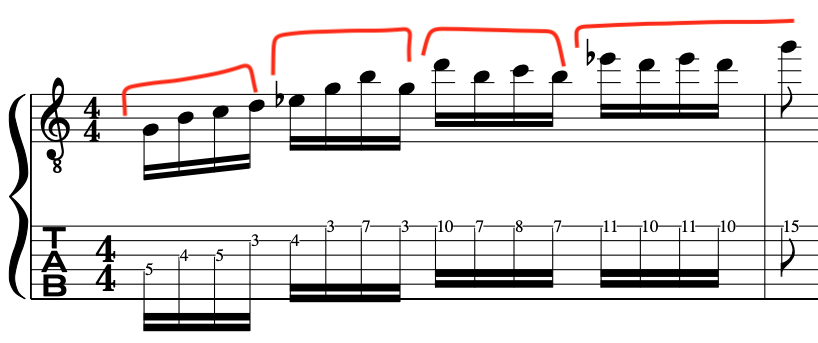
Now let’s create an ascending line:

how-to-create-scales-from-scales

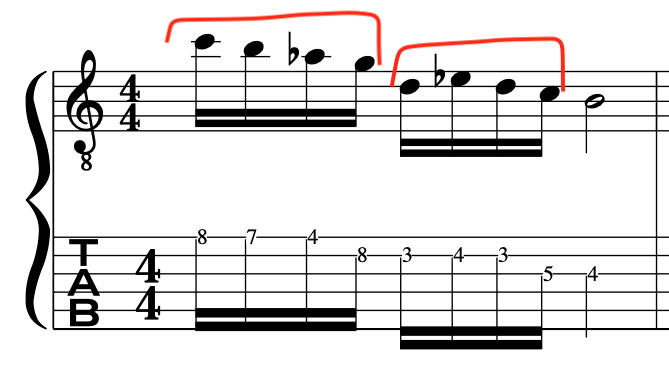
HARMONIC MINOR

Next we will add an Ab and make 2 Tetrachord scales from C Harmonic minor and create a little run:

how-to-create-scales-tetrachords-example

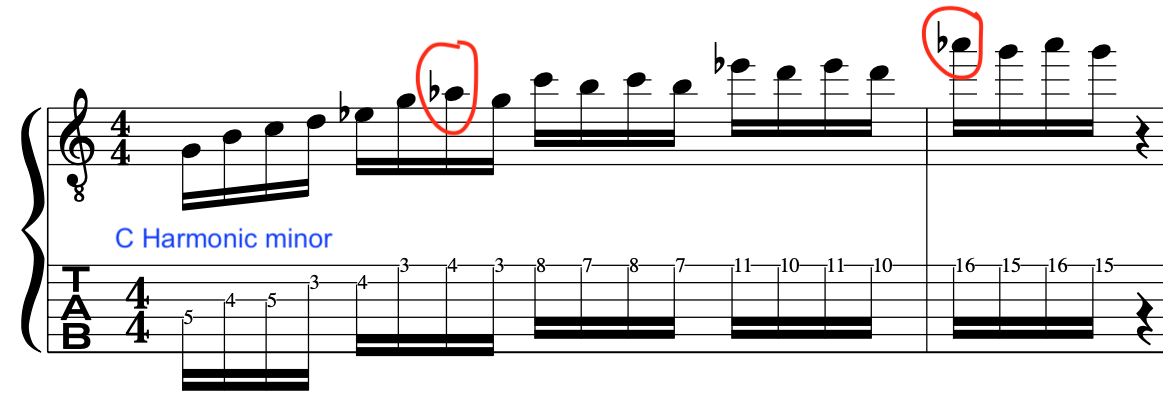
This time we will ascend with the C Harmonic minor scale:

how-to-create-scales-jazz-guitar

LASTLY

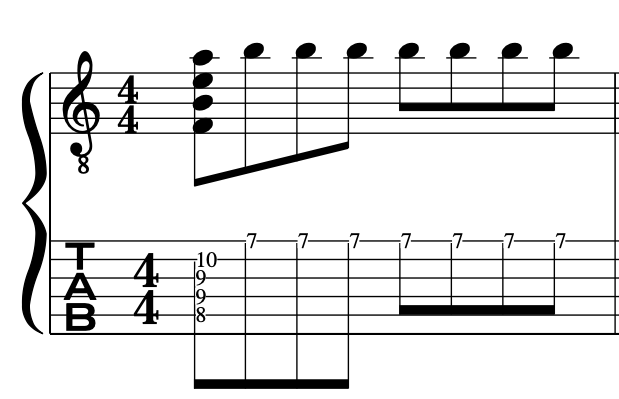
It’s also a good idea to play the key chord of a scale and then pluck the key note or notes that give that scale it’s unique flavour.

For example below is an F Maj7#11 chord that when you pluck the B natural it really stands out as Lydian:

how-to-create-scales-jazz-guitar

IF THIS LESSON WAS OF USE TO YOU THEN PLEASE SUBSCRIBE TO US BELOW ON YOUTUBE, THANKS!