Musical Analysis of Messiaen’s 5th and 6th Modes

yt_logo_rgb_light CLICK SUBSCRIBE!

Hi Guys,

Today, a look at Messiaen’s mode 5 and 6 as a musical analysis and as compositional and improvisational music techniques.

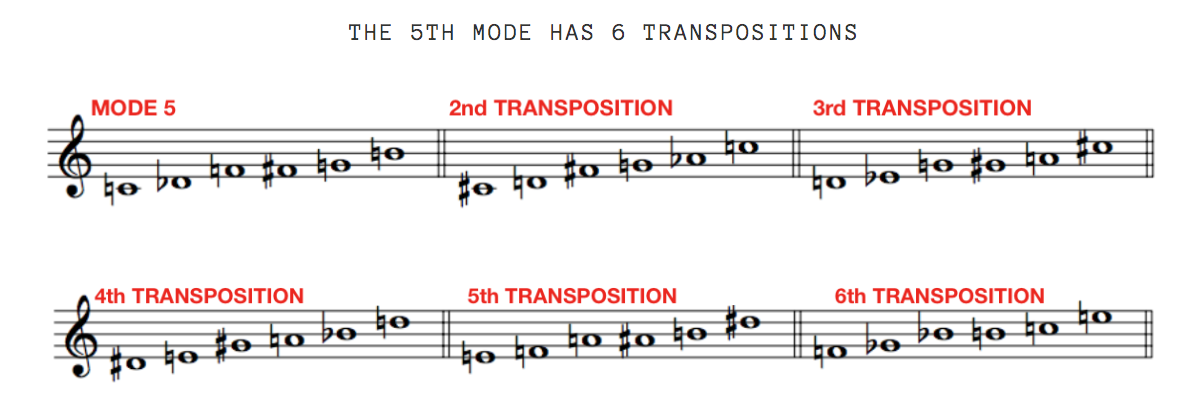
Messiaen’s 5th Mode [of limited transposition] is well known for its semitones, two major 3rds and its tritone possibilities.
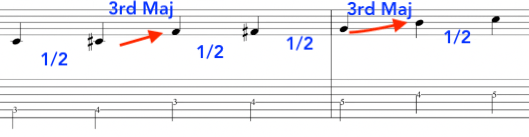
Messiaen mode5 sheet music diagram and example with music notation and guitar tablature.

Messiaen Mode 5 [5th mode 6 transpositions]

Messiaen’s 5th mode for our Examples:
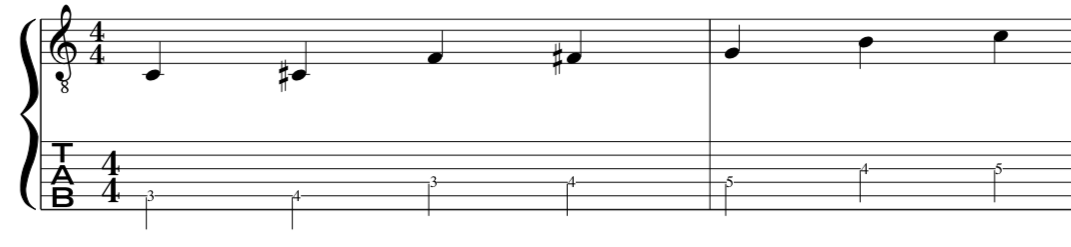
Messiaen Mode 5 [5th mode of limited transposition]

Messiaen’s 5th Mode Extended

A sheet of music displaying Messiaen mode 5 with standard notation and tablature for guitar.
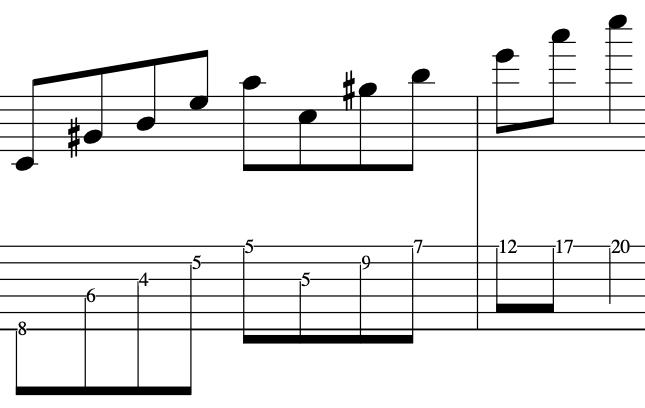
Illustration of Messiaen’s 5th mode showing scale runs and patterns for descending passages.

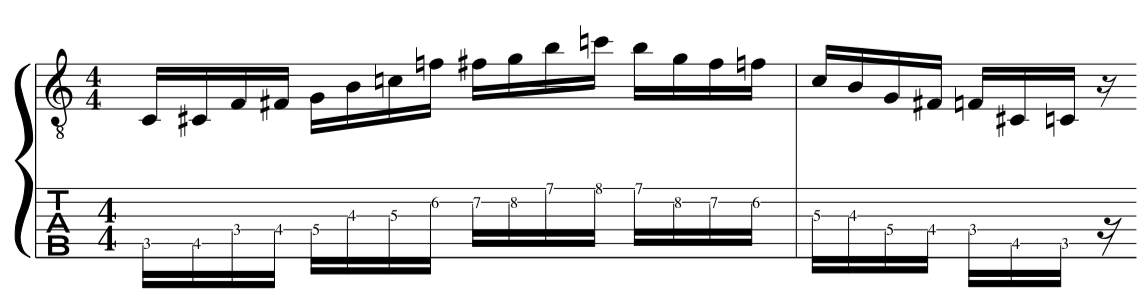
Making Scale runs: Messiaen mode 5:

Descending
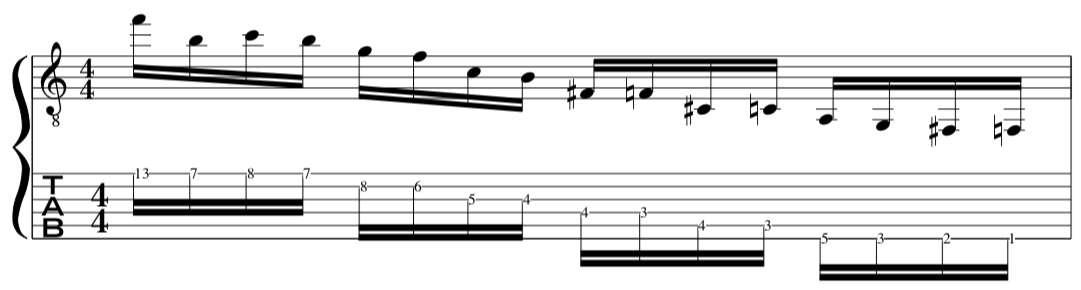
A sheet of music notation with treble clef, displaying Messiaen's 5 mode of limited transposition.
Descending Messiaen Mode 5

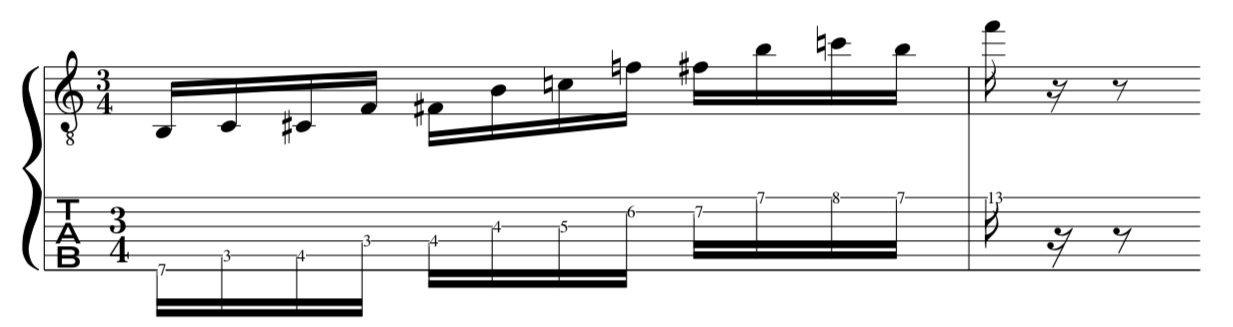
Ascending

A sheet of music in 3/4 time signature featuring both standard notation and tablature for a guitar playing Messiaen mode 5.
Messiaen 5th mode Ascending

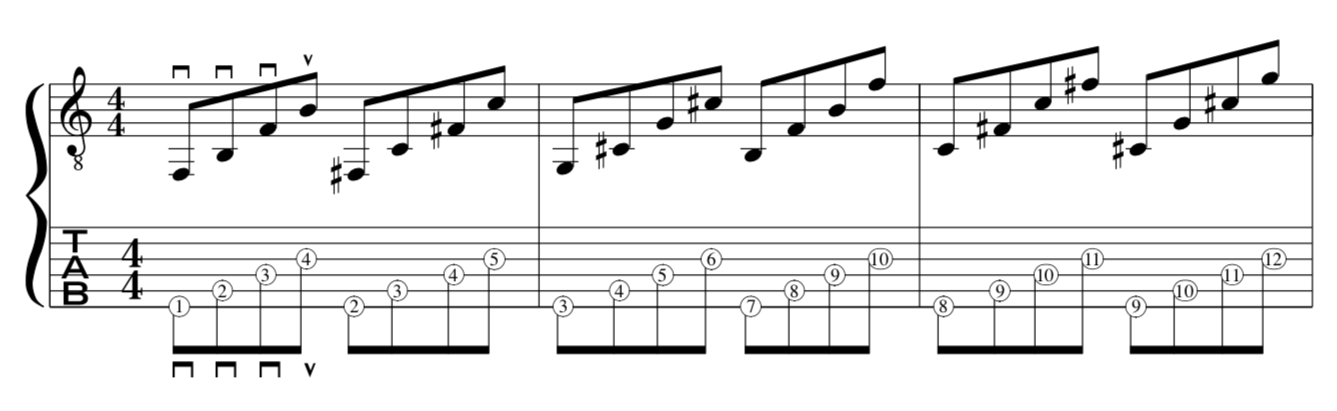
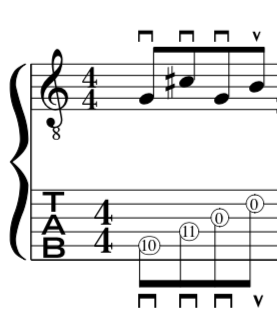
The next concept that works really well at the guitar is to employ chordal picking technique.

Most of these are based around the “Down Down Up” picking pattern.

Notice the use of Tritones.

Picking pattern = “Down Down Up”
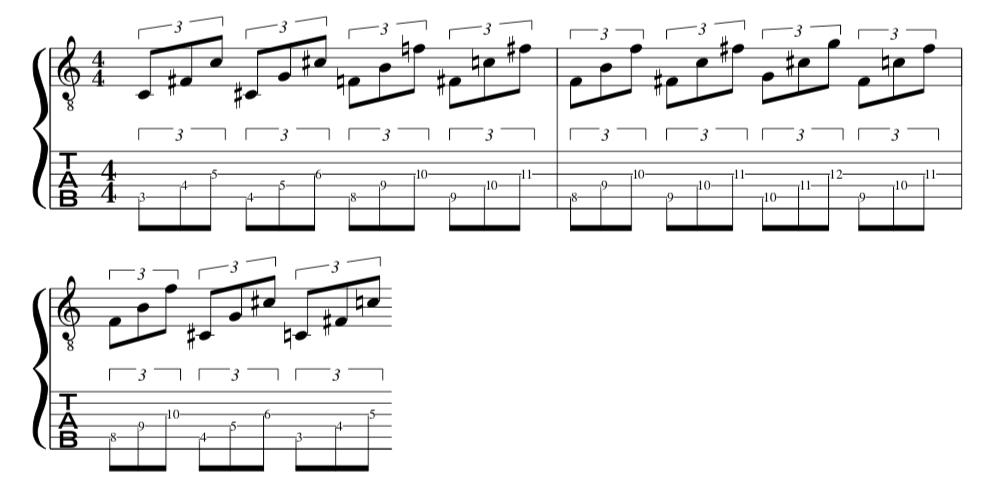
Sheet music displaying a Messiaen musical composition with standard notation and tablature for guitar, featuring various notes and finger positions.
Messiaen 5th mode Cross Picking

Cross Picking/ Chordal Picking: With an open G string.
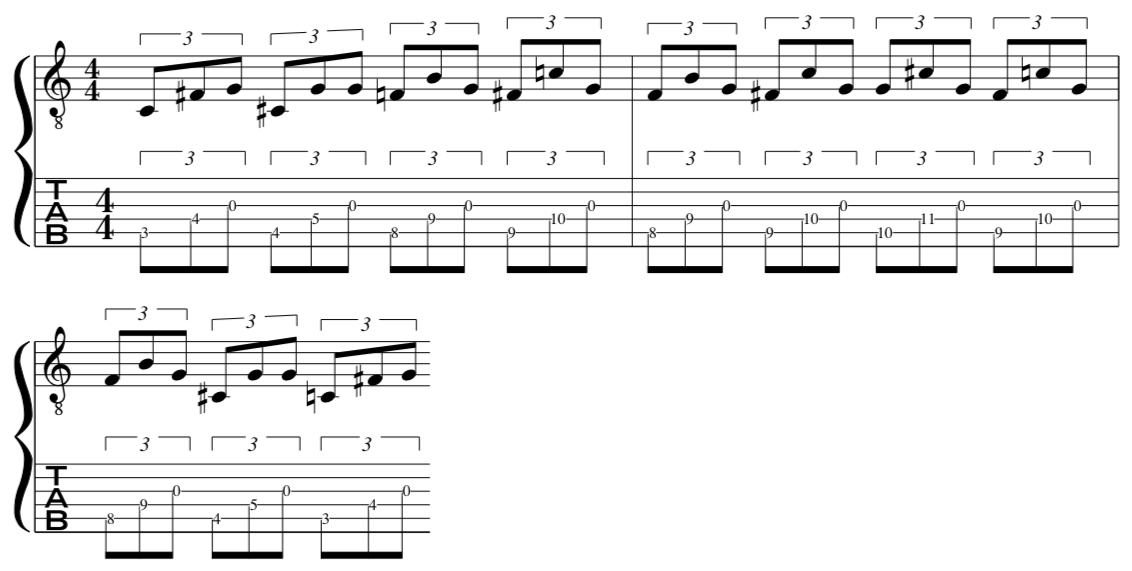
Messiaen mode 5 sheet music displaying guitar tablature with notes in 4/4 time signature, featuring various fingering positions and chords.
Messiaen 5th mode Cross Picking/ Chordal Picking:

Messiaen 5th Mode: Scale to chord Imitation device.
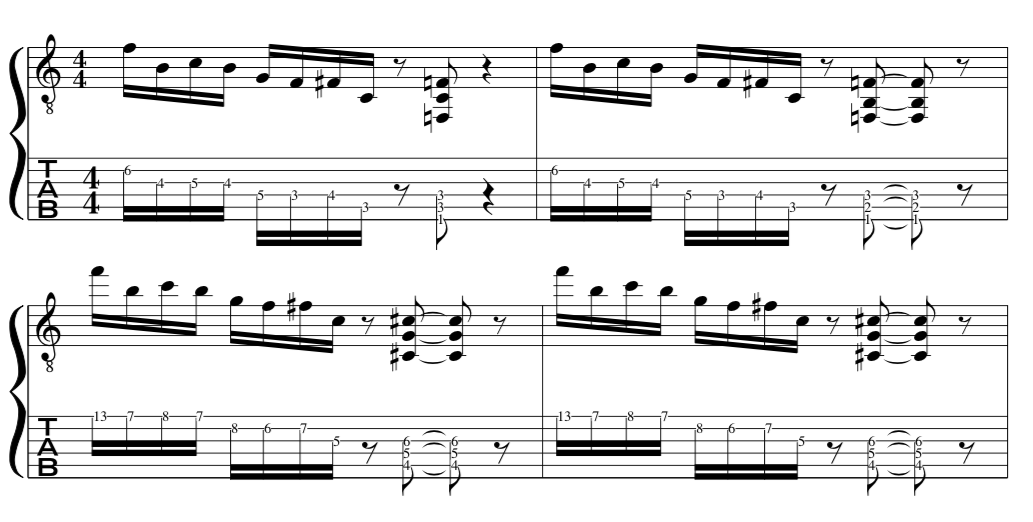
Messiaen mode 5 sheet music displaying notations for a musical piece, including treble and bass clefs, with notes and tablature for guitar.
Messiaen 5th Mode: Scale to Chord Imitation Compositional device.

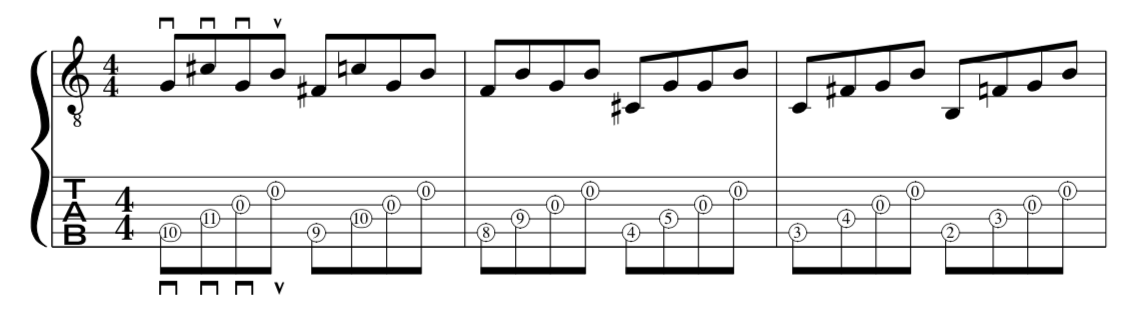
Messiaen 5th mode: 3 octave scale imitation descending line
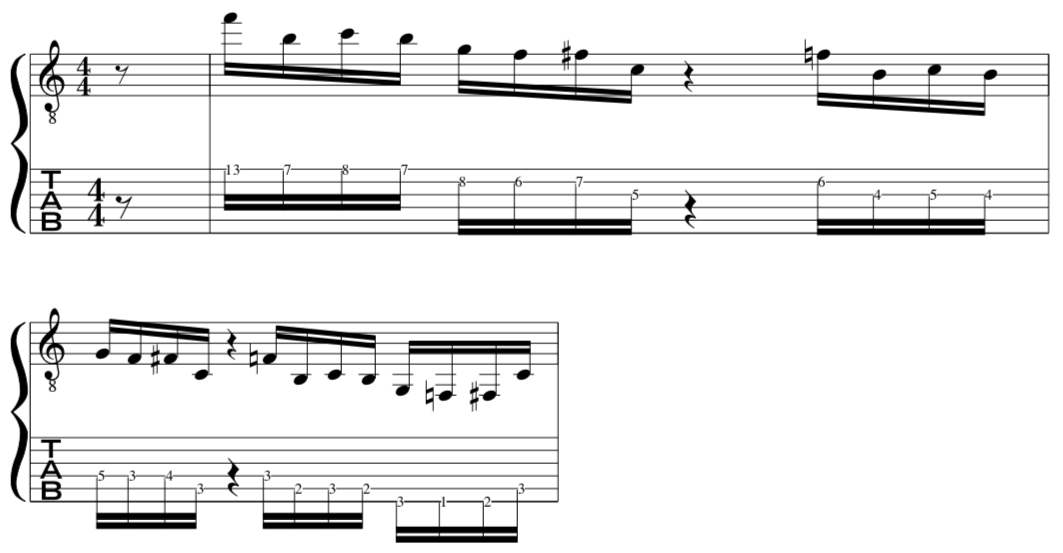
Messiaen's 5th mode of limited transposition sheet music featuring guitar tablature and standard notation in 4/4 time signature.
5th mode Messiaen Descending Run [Immitation]

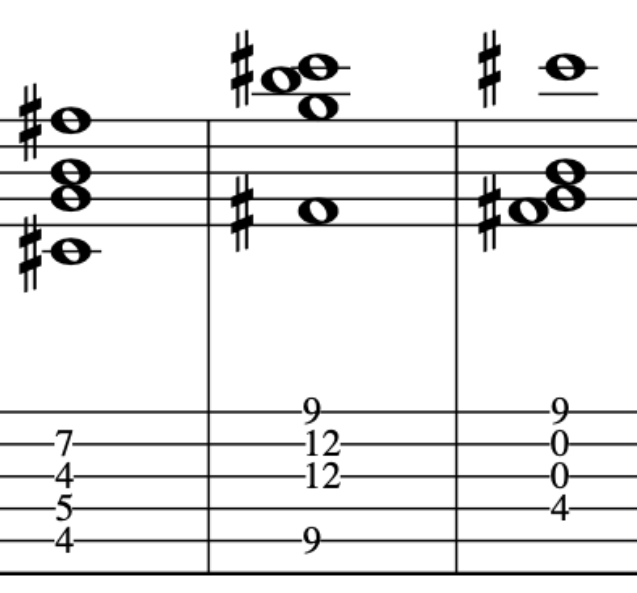
Cross Picking part 2: Using 4 note tritone chords.

Picking pattern =”Down Down Down Up” Cross
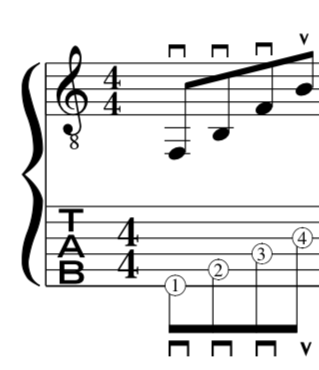
Messiaen guitar musical notation showing a treble clef in 4/4 time with a series of notes, accompanied by tablature for guitar, indicating finger positions.
Messiaen Mode 5 D D D U Cross Picking Tritone guitar
Messiaen guitar  sheet of music notation with a 4/4 time signature, showing a melody on the treble clef and corresponding tablature below, indicating finger positions on a string instrument.
Messiaen Mode 5 Cross Picking Guitar Tritones

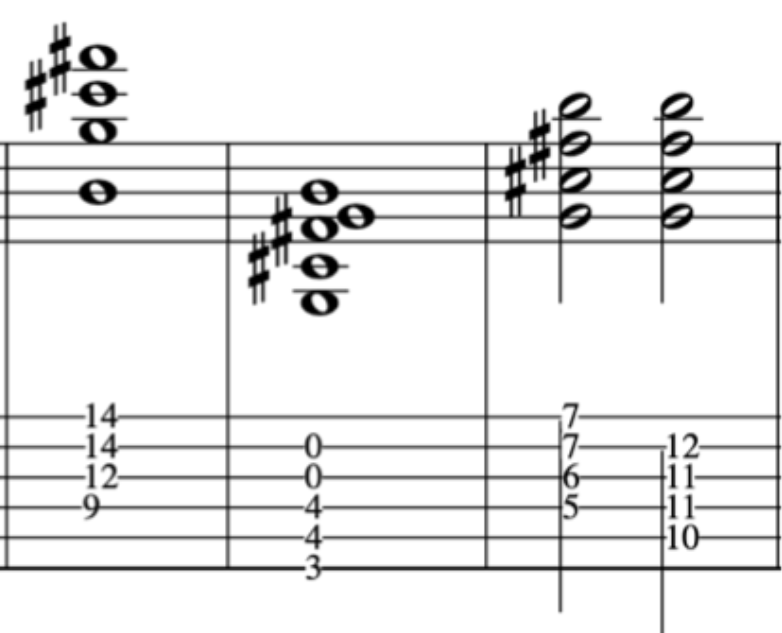
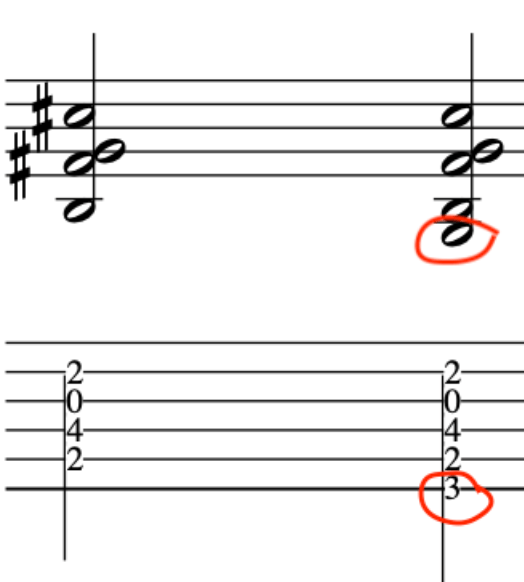
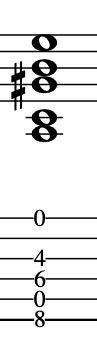
Notice the two open strings :

Open Strings Messiaen chords Mode 5 Guitar

Messiaen mode 5 sheet music displaying a series of musical notes in 4/4 time signature along with tablature for guitar.
Messiaen Mode 5 Cross Picking Guitar Tritones Open Strings

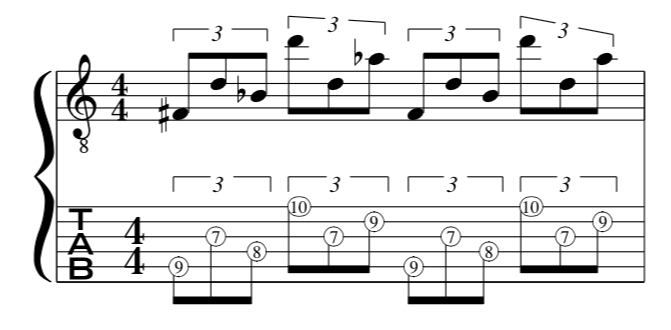
PART 2 MESSIAEN MODE 6

Messiaen mode 6 as used for this presentation.
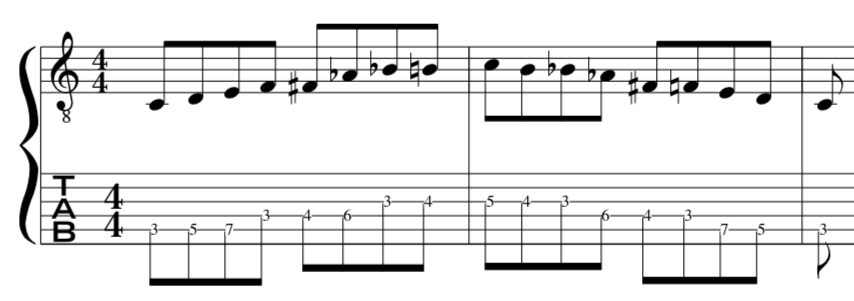
Messiaen mode 6 sheet music displaying a melody in 4/4 time, featuring notes and tablature for guitar.
Messiaen mode 6 notation and guitar tab
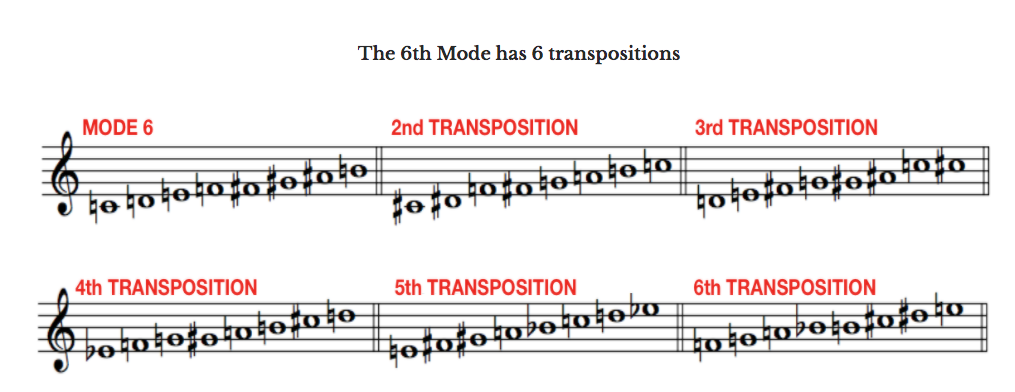
Messiaen mode 6 with six transpositions

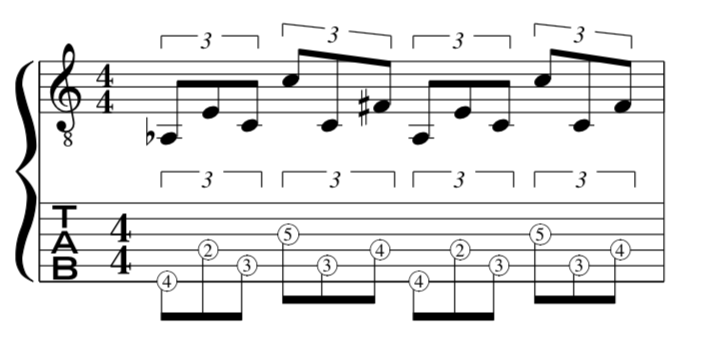
Messiaen’s 6th mode is great for manipulating “Diminished” and “Augmented” intervals.
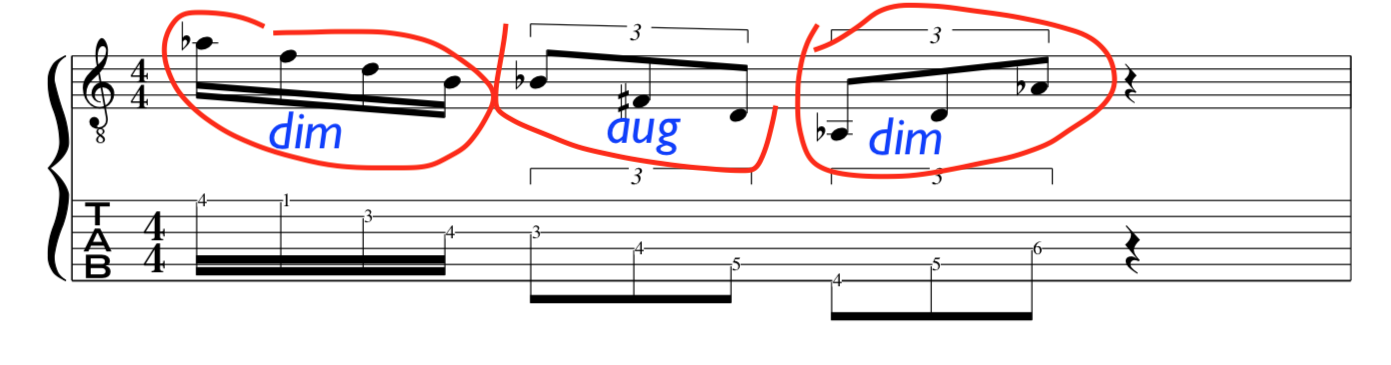
Messiaen mode 6 musical notation with segments marked 'dim' and 'aug', showing various notes and chord symbols in 4/4 time signature.
Messiaen mode 6 notation and guitar tab

Mode 6 allows for this to be sequenced easily
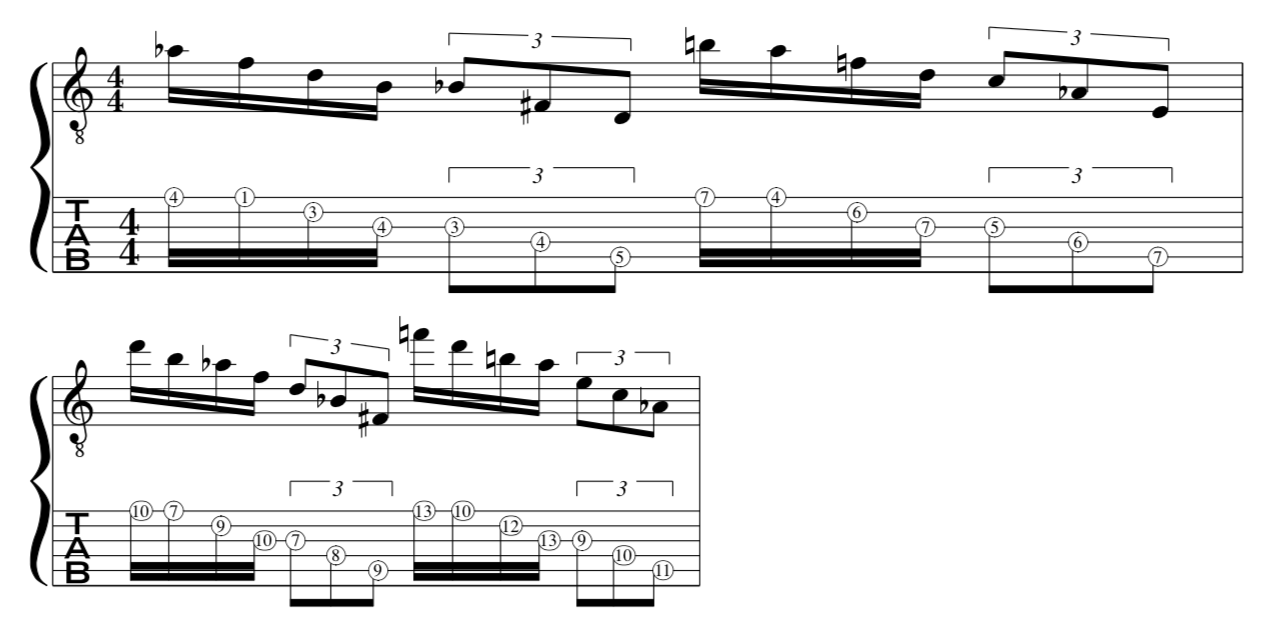
Messiaen mode 6 sheet music notation for a guitar piece, featuring both standard notation and tablature, in 4/4 time signature.
Messiaen mode 6 Diminished and Augmented Sequences

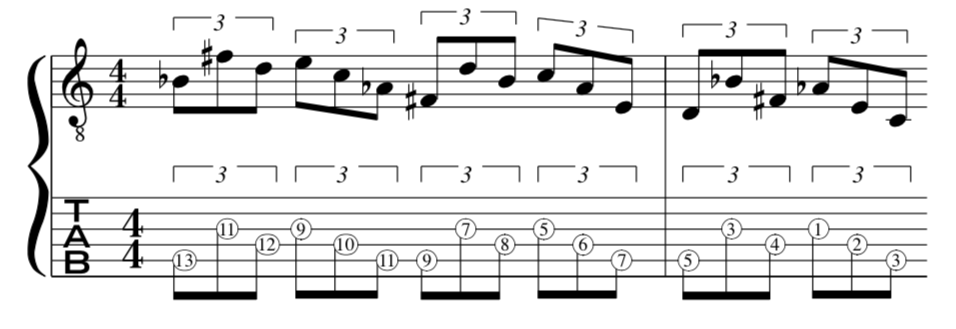
Below is a descending Augmented sequence
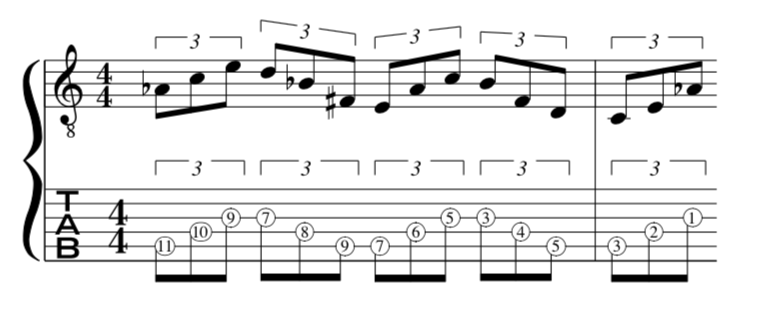
Messiaen mode 6 musical score with sheet music notation and guitar tablature, displaying notes in 4/4 time signature and various finger positions.
Messiaen mode 6 Augmented descending sequence

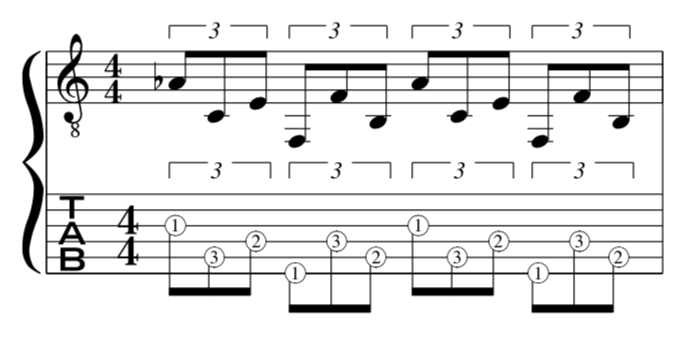
For common sequences: The Augmented sequences move in tones whilst the Diminished sequences move in minor 3rds.

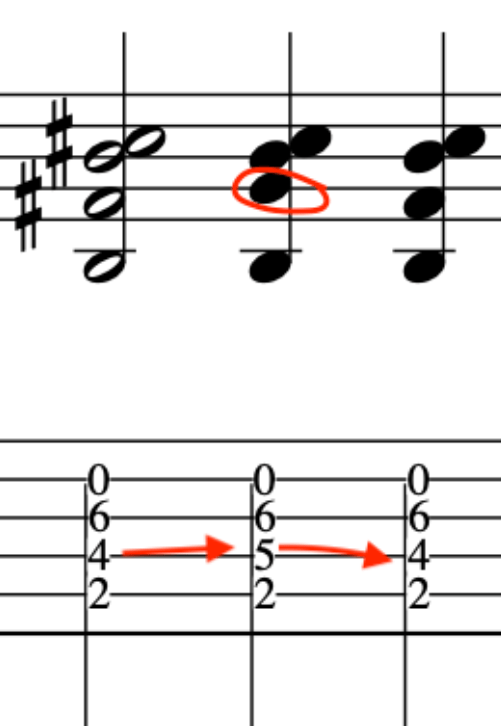
Although, Diminished intervals can move in semitones and tones. For Example:
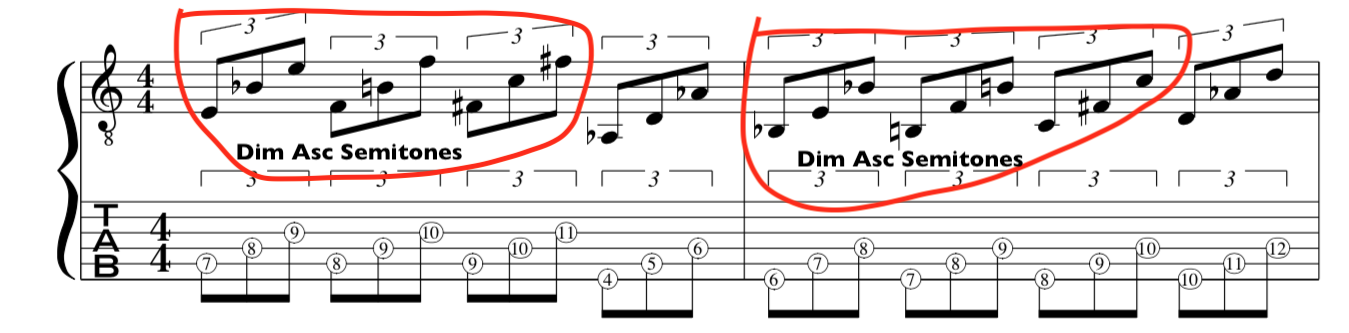
Messiaen mode 6 musical notation displaying ascending diminished semitones, highlighted in red.
Messiaen Mode 6 Diminished intervals in Semitones

Messiaen mode 6 musical sheet with treble clef and guitar tablature in 4/4 time signature, featuring notes and finger positions.
Messiaen 6th mode

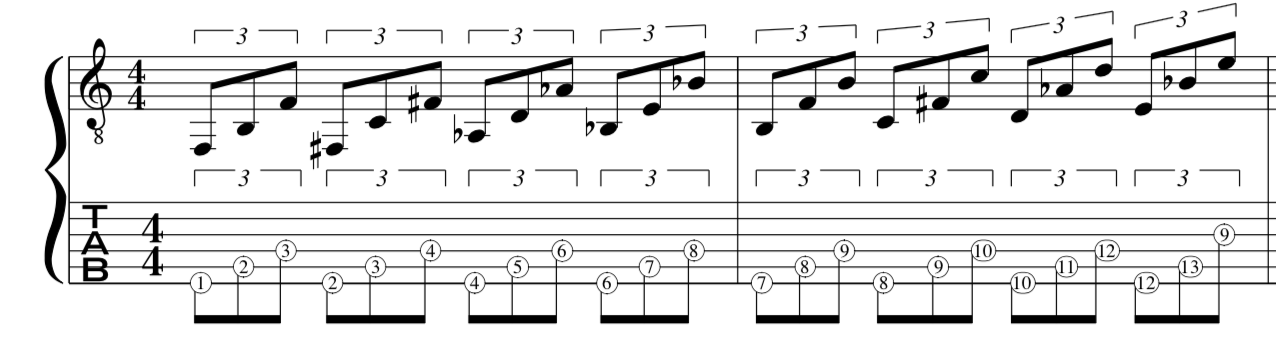
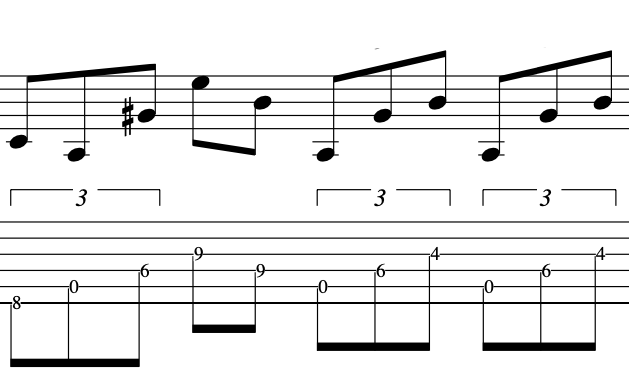
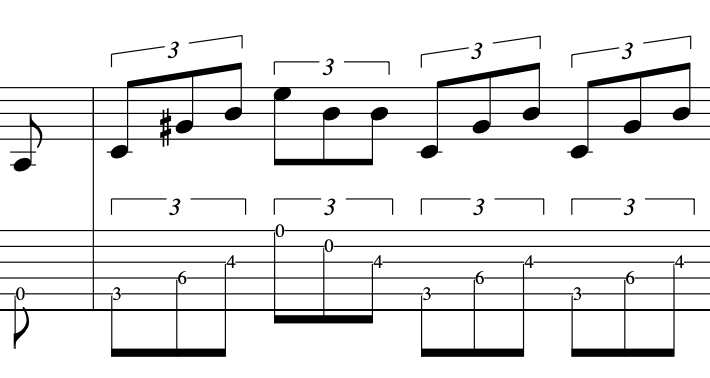
Getting back to our common sequences we can see below the brilliance of diminished intervals moving in minor 3rds with the employment of the simple triplet figure.
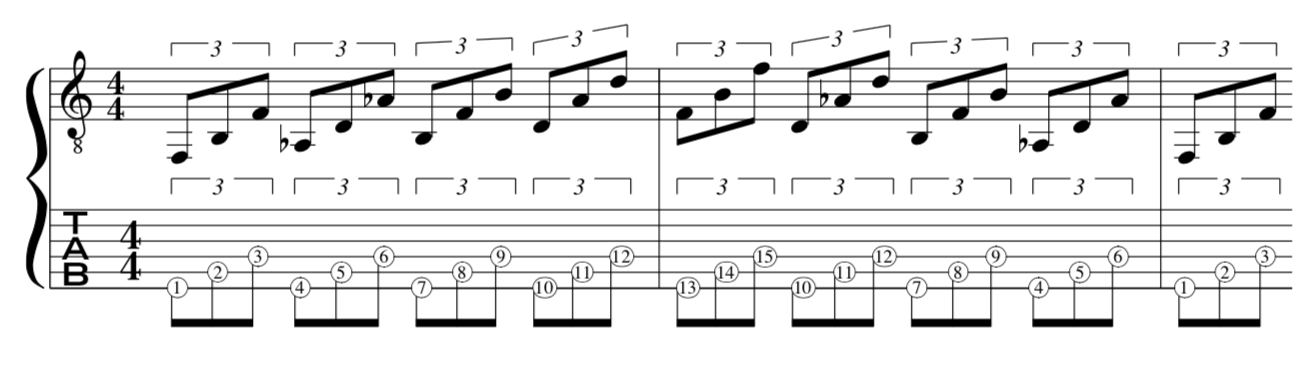
Messiaen mode 6 sheet music notation and guitar tablature displaying a musical composition in 4/4 time signature.
Messiaen mode 6 Diminished sequence

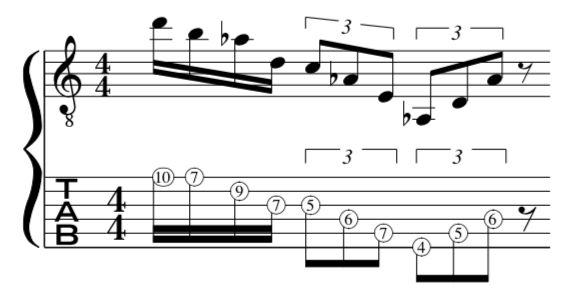
More examples of mixing up the Augmented and Diminished ideas to avoid the cliches and develop something fresh sounding
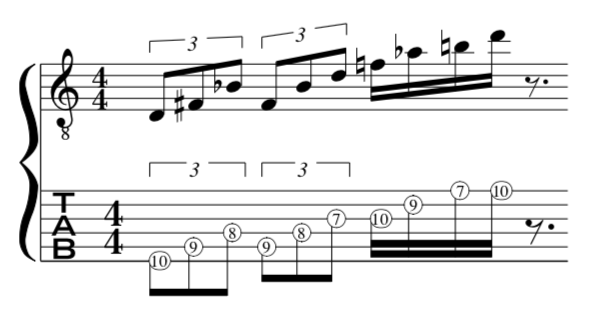
Messiaen mode 6 sheet music featuring a melody in 4/4 time signature with notes and guitar tablature below.
Messiaen mode 6 diminished and augmented mix
Messiaen mode 6 sheet music showing a melody in 4/4 time signature with guitar tablature underneath, including notes and finger positions.
Messiaen mode 6 diminished and augmented mix

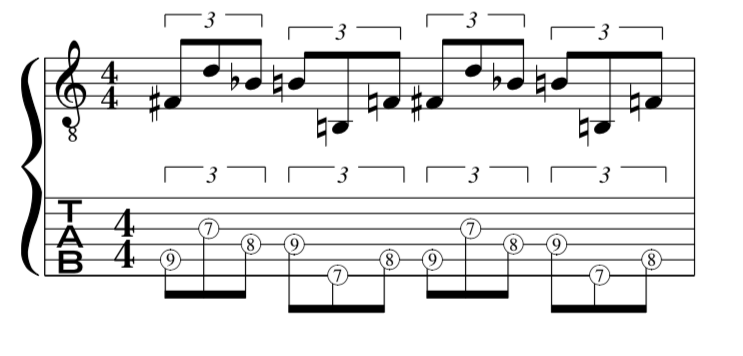
We can also make interesting intervallic motifs from the notes of the Messiaen mode 6
Messiaen mode 6 music notation with a treble clef, featuring notes, rests, time signatures, and tablature for guitar.
Messiaen mode 6 intervallic sounds
Messiaen mode 6 musical score sheet displaying notes in standard notation and tablature for guitar, featuring a 4/4 time signature.
Messiaen mode 6 intervallic sounds
Messiaen's 6th mode of limited transposition sheet music notation with a treble clef in 4/4 time signature, featuring quarter notes, eighth notes, and various rhythmic groupings, accompanied by guitar tablature below.
Messiaen mode 6 intervallic sounds
Messiaen's 6th mode sheet music and tablature for guitar, displaying notes in 4/4 time signature with finger positioning indicated.
Messiaen mode 6 intervallic sounds
Messiaen 6th mode musical score featuring standard notation and tablature for guitar, including notes and finger placements.
Messiaen mode 6 intervallic sounds

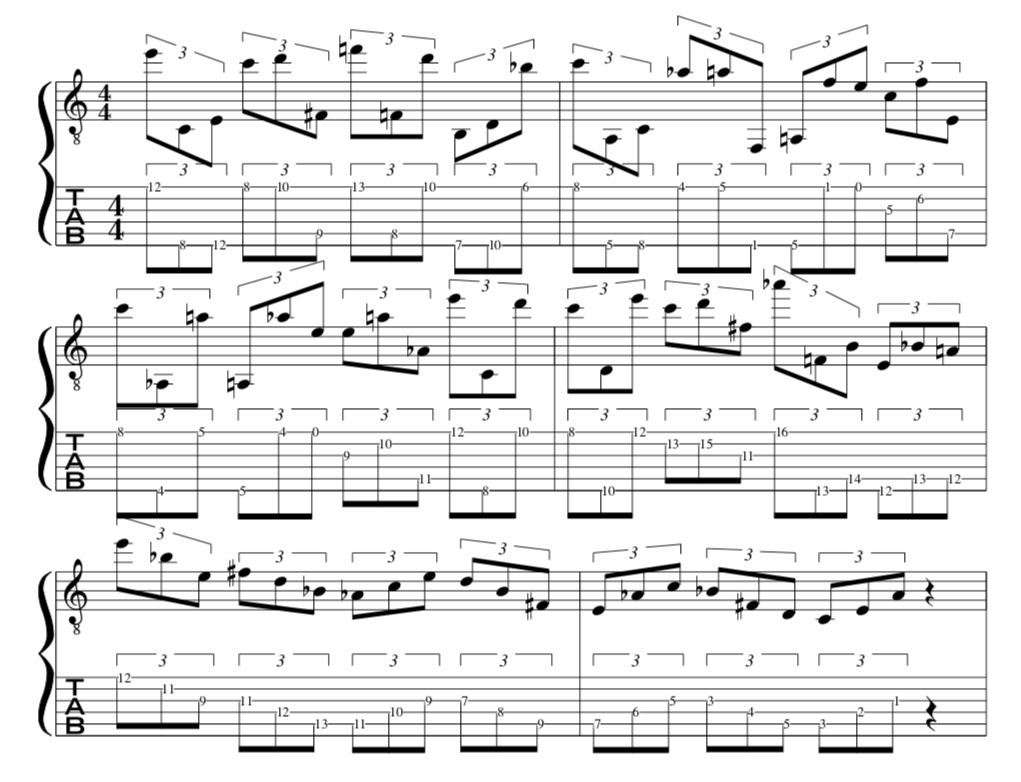
Finally, we can employ a contrapuntal counterpoint “Mirror” compositional device to really manipulate this brilliant 6th mode of Messiaen.
Messiaen's 6th mode sheet music displaying musical notes and tablature for guitar, organized across multiple staves in standard notation.
Messiaen mode 6 Contrapuntal Mirror Compositional device

If you enjoyed this blog/vlog then please SUBSCRIBE to us on YOUTUBE below! Thanks!
yt_logo_rgb_light CLICK SUBSCRIBE!

Understanding the Maj7#11 Chord for Guitarists

Hi Guys,

Today, a look at the Maj7#11 chord, a favourite of guitarist John McLaughlin.

This is really a lydian chord due to the sharpened 11th note.

In our example and analysis, we will look at the harmonic implications through the tonality of G Major.

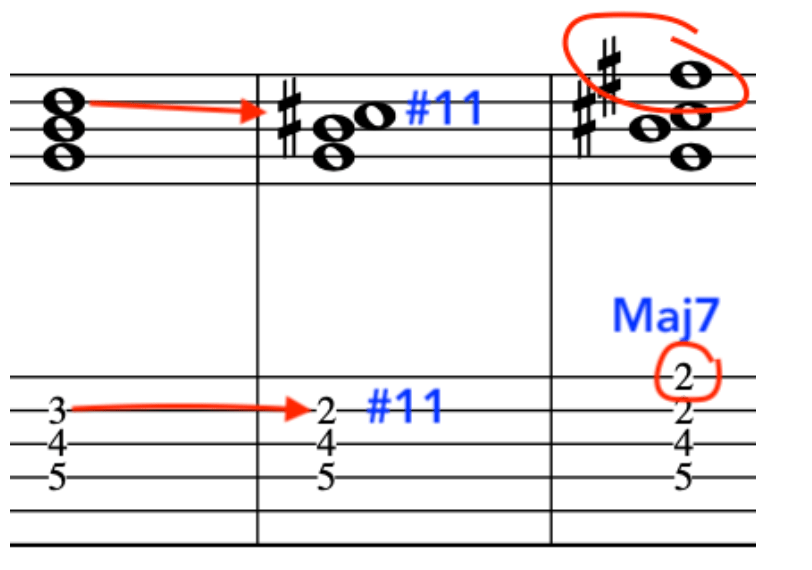
Below, we can see the 5th of G Major, the note D moves down a semitone to the note C# [the sharpened 11th]. On top of this we will place the Maj7th note in G Major. This is the note of F#.

Sheet music depicting the Maj7#11 chord with annotations for G Major tonality, including note positions and symbols.
Musical notation illustrating the G Major – Maj7#11 chord features/Construction.

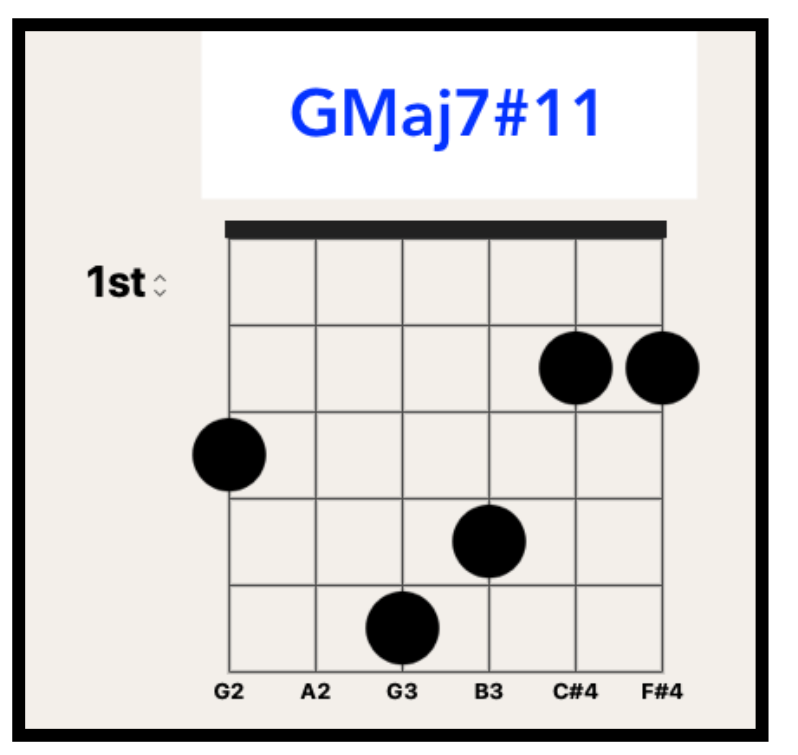
Here, is a classic guitar shape/voicing with the tonic note of G in the bass:

Diagram showing the Gmaj7#11 chord for guitar, with labeled fret and string positions.
G Major 7 Sharp 11 Chord Diagram with Fingering [GMaj7#11]

Let’s now create an arpeggio outline of the chord:

Sheet music showing a musical notation example for a Maj7#11 chord and arpeggio voicing, with specific notes and finger positions highlighted.
Musical notation illustrating an arpeggio in the context of a Maj7#11 chord.

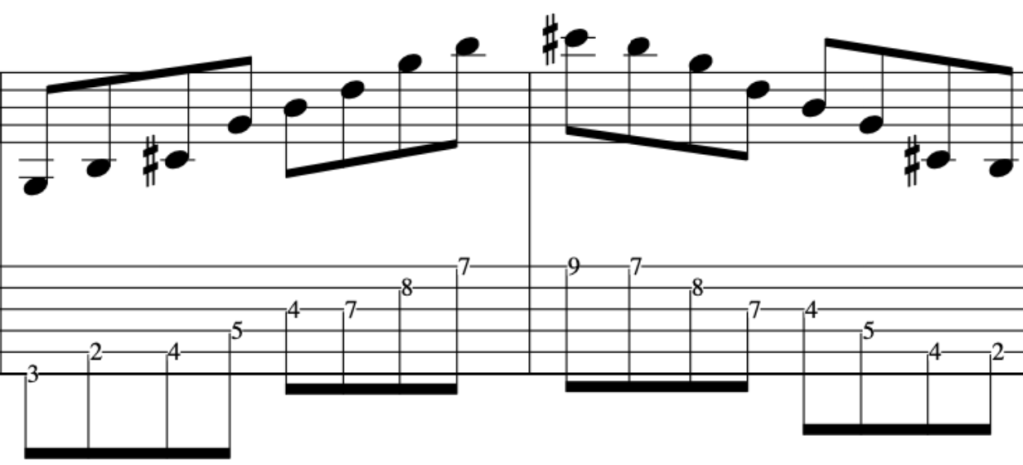
We will now ascend and descend the arpeggio outline, as this will give us control over the harmony when improvising on the solo line.

Musical notation displaying a sequence of notes and chords, illustrating an arpeggio pattern for the Maj7#11 chord.
Arpeggio exercise featuring the Maj7#11 chord in the context of G Major.

Below, are examples of various voicing’s and variations for all instruments, but, especially the guitar.

This is because certain voicing’s resonate extremely well on the guitar, whereas, others can become muddy in sound.

The voicing’s below offer quite a few possibilities,

Musical notation for a Maj7#11 chord on guitar, showing frets and strings and chord voicing's.
Various chord voicings for the Maj7#11 chord on guitar.
Musical notation displaying a Maj7#11 chord with highlighted notes.
Musical notation for a Maj7#11 chord, depicting various notes and finger positions on a guitar.  As used by John McLaughlin Al di meola and Pat Martino
Musical notation illustrating the Maj7#11 chord voicing.
Sheet music showing a G Major scale with indications for a Maj7#11 chord, along with guitar tablature highlighting finger positioning.
Sheet music illustrating the Maj7#11 chord with guitar tablature, showing notes and finger positions.
Sheet music showing a Maj7#11 chord with notes and tablature for guitar.

We, will now make a ii V7 I cadence with this chord, in order to see, hear and understand how to apply it to composition.

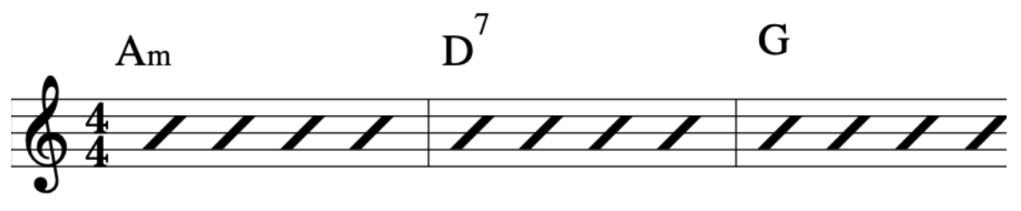
Firstly, let’s take a simple ii V I in G major.

A musical notation showing a ii-V-I chord progression in the key of G major, featuring Am, D7, and G chords.

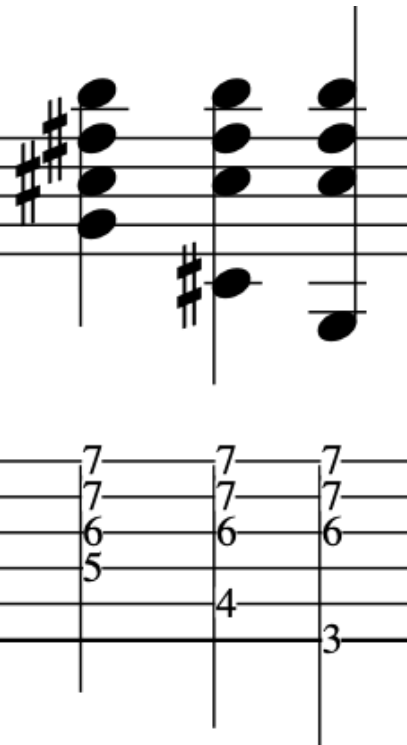
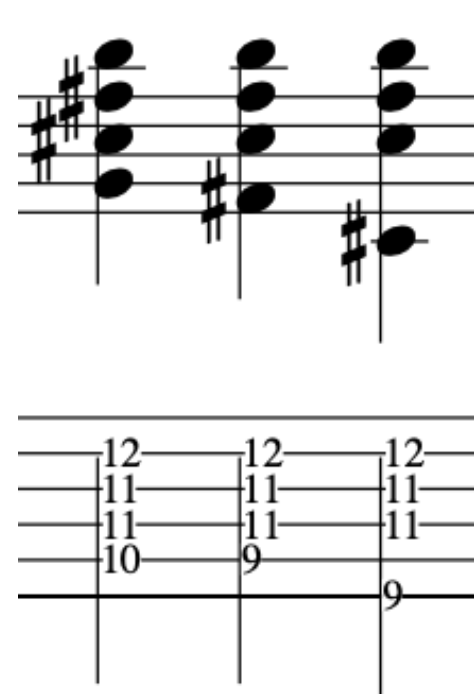
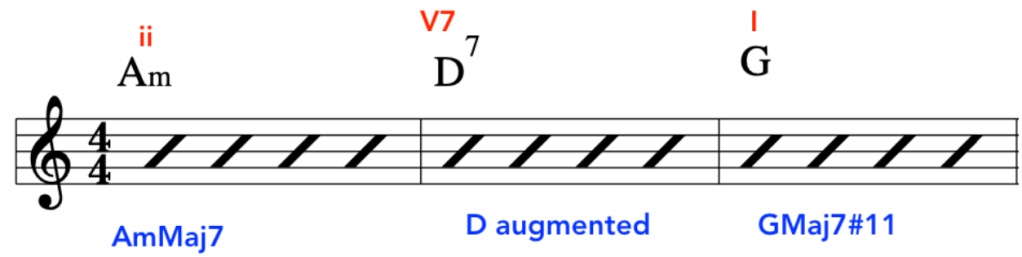
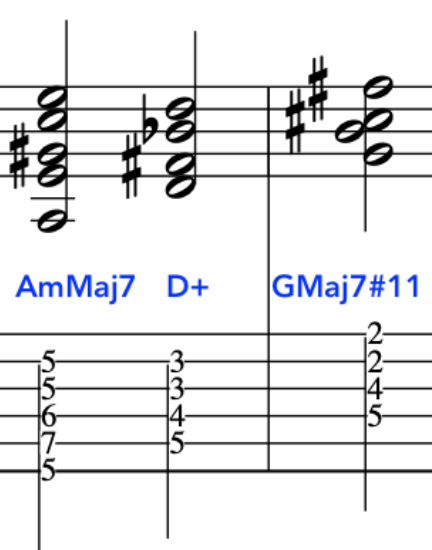
Now, we will substitute the Am for AmMaj7 and the dominant chord D7 for D Augmented. This will allow us to finally rest on the Gmaj7#11 chord. [A sort of ethereal rest]

A sheet of music notation displaying a substitution of a ii V7 I cadence progression in G major, altered as AmMaj7, D augmented, and Gmaj7#11 chords for jazz reharmonisation.
Musical notation illustrating the ii V7 I cadence substitution featuring AmMaj7, D augmented, and G Maj7#11 chords.
Musical notation diagram displaying the chords AmMaj7, D+, and GMaj7#11, with corresponding finger positions for guitar jazz chord substitution.
Chord diagram showing substitution AmMaj7, D+, and GMaj7#11 chords for guitar.

Let’s, now create a solo line from this Maj7#11 chord:

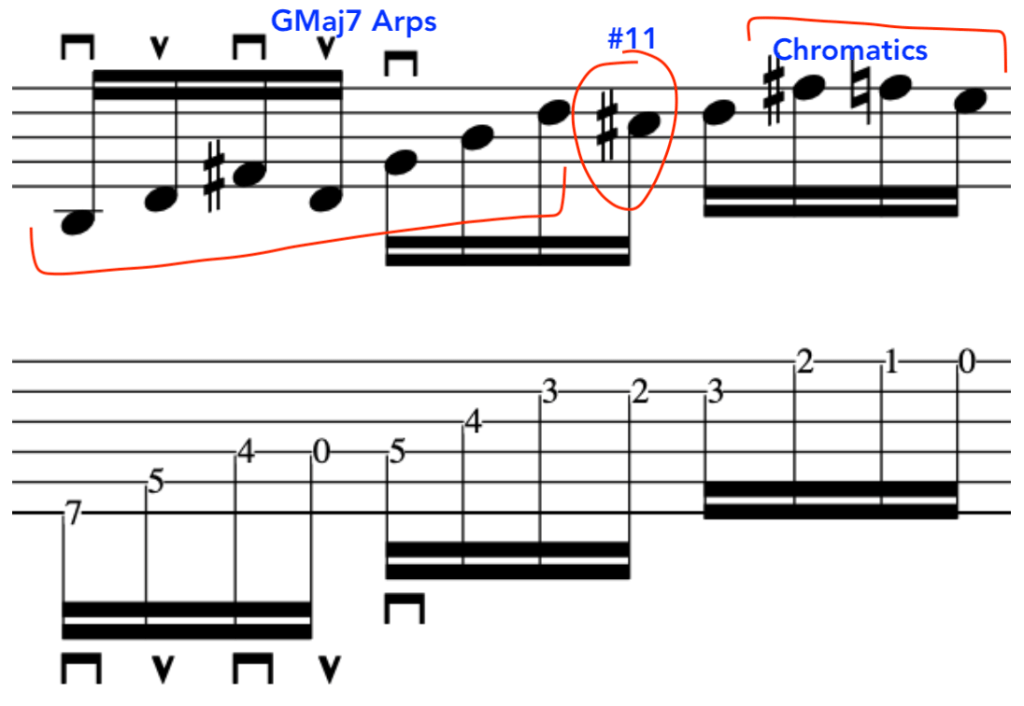
Below, we can see the use of simple arpeggio inversions.

Firstly, we have a Bm arpeggio [implying a 1st inversion GMaj7] connecting to a 2nd inversion G Major triad. This, then resolves down with simple chromatic application.

Sheet music illustrating G Major 7 arpeggios with chromatic notes, including the sharp 11th note highlighted for lydian guitar solos.
Example of G Major 7 arpeggios showcasing the #11 note and chromatic transitions.

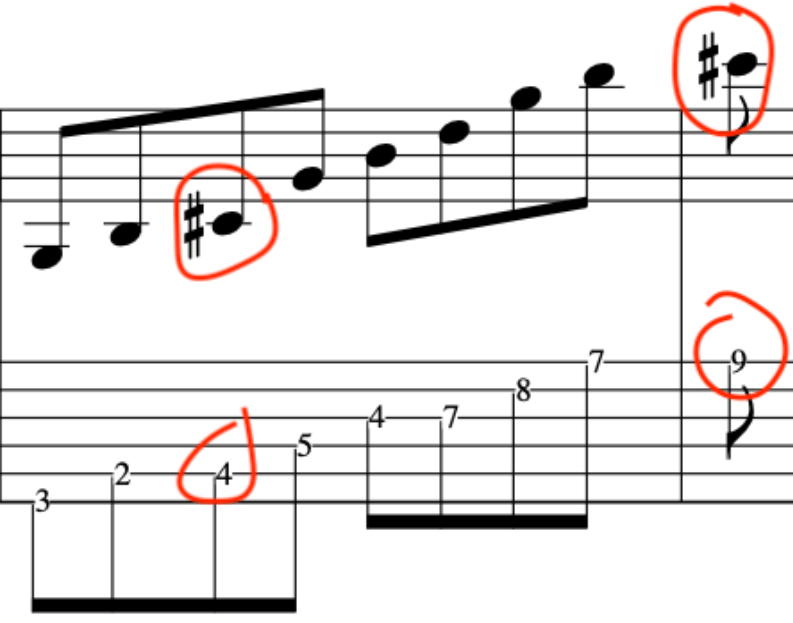
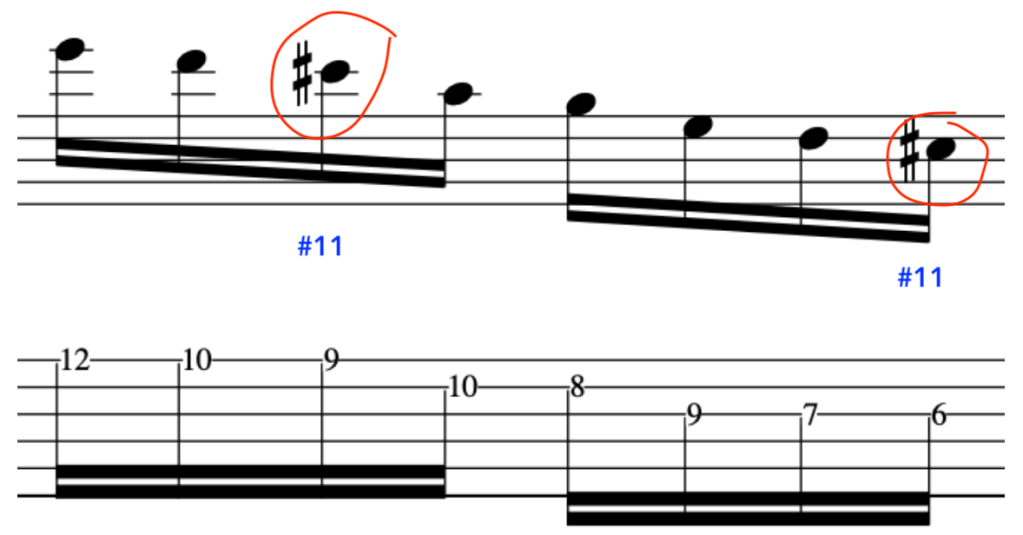
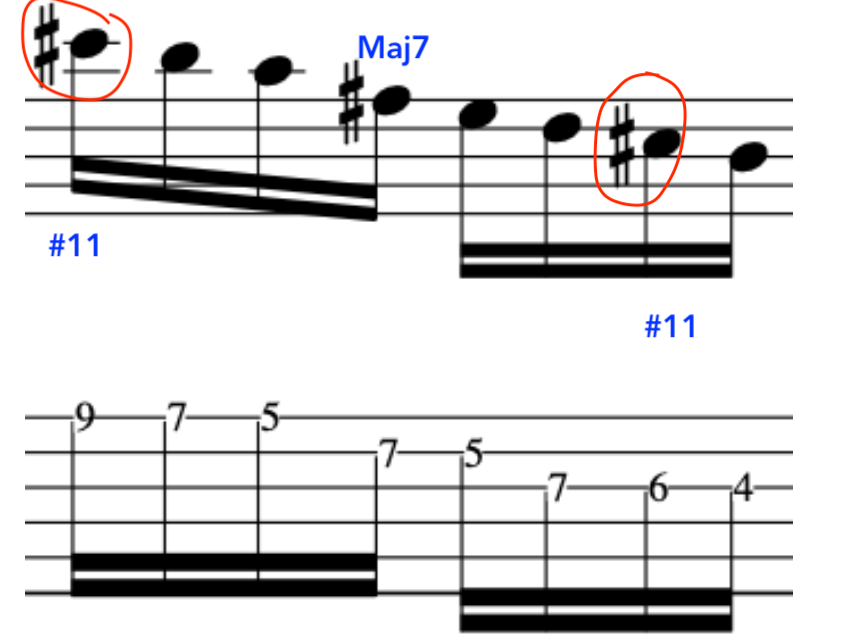
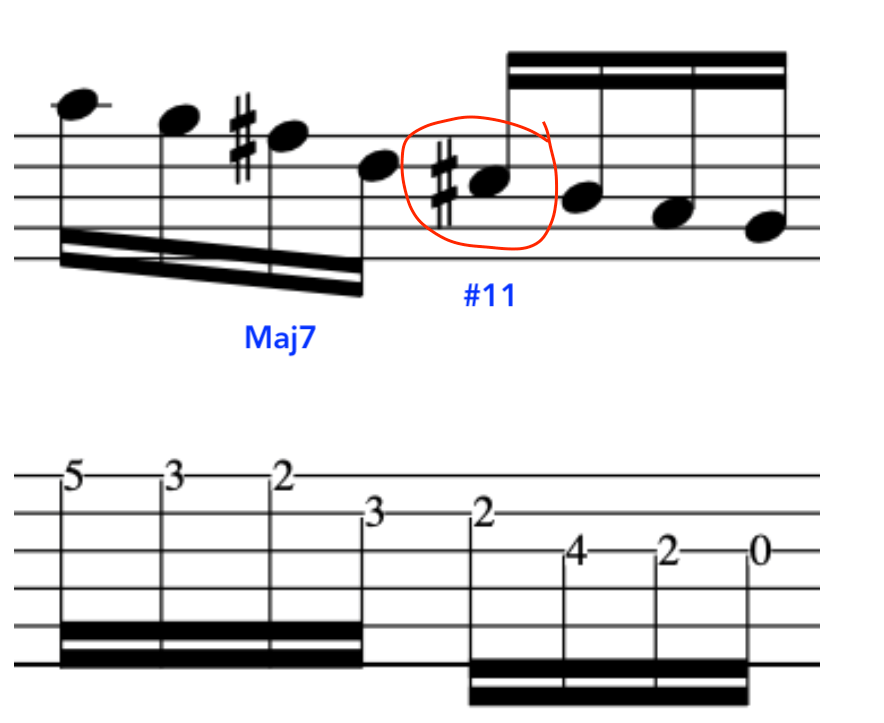
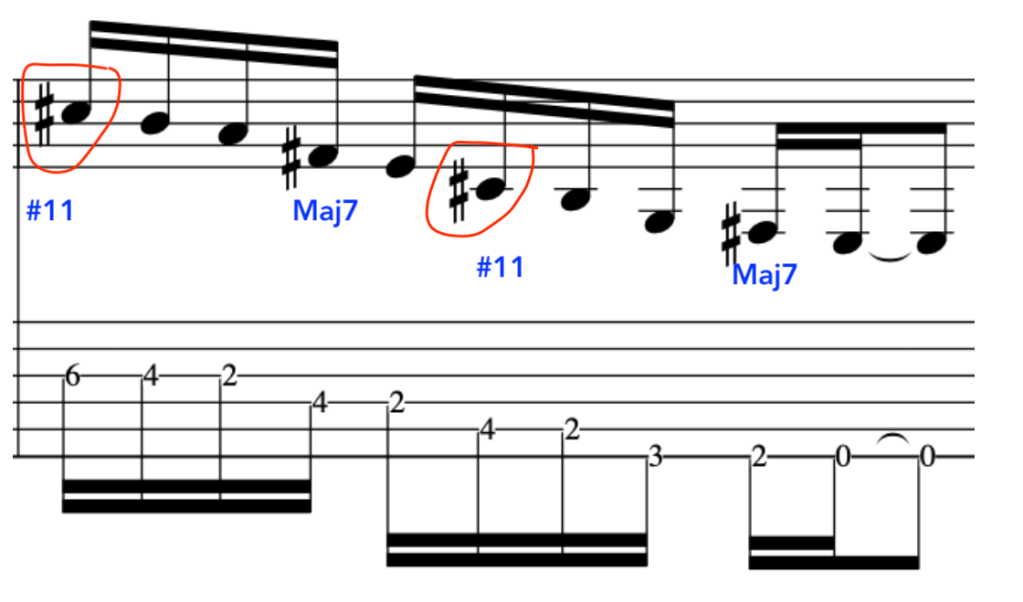
From herein, we will employ G Lydian modal/scale “Fragments” to complete the line,

Musical notation illustrating the Maj7#11 chord with highlighted sharpened 11th notes, including tablature for guitar.

Musical notation for the Maj7#11 chord, including notations for #11 and Maj7 for jazz improvisation.

Sheet music displaying the Maj7#11 chord with the sharpened 11th note highlighted, along with corresponding guitar tablature.
Musical notation showing Maj7#11 chord analysis with highlighted #11 and Maj7 notes.

Understanding the Farben Chord in Music: Schoenberg’s Chord:

Hi Guys,

Today, a look at the mighty “Farben” chord from Arnold Schoenberg’s five pieces for orchestra.

This a C Augmented chord with a Maj7th and a 13th [or 6th].

The way that the notes are spaced/voiced creates a unique and dramatic flavour.

Below, is a quick piece of orchestration that I composed to display this.

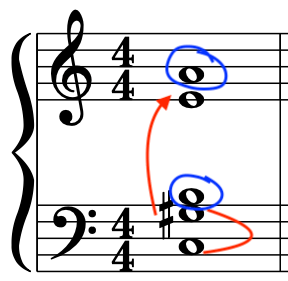
Here, is the Farben chord voicing:

Musical sheet notation illustrating Schoenberg's 'Farben' chord with specific notes highlighted in blue and red.
Diagram illustrating the voicing of the Farben chord, showcasing the unique spacing and dramatic flavour.

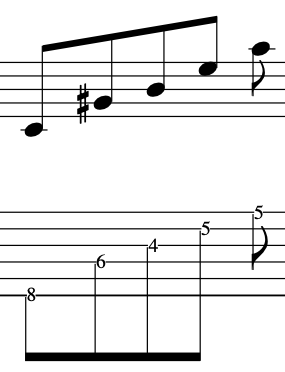
Now, let’s play this as an arpeggio outline:

Sheet music showing a musical staff with notated Farben chord above and a tablature section for guitar below.
Arpeggio outline showcasing the Farben chord voicing.

This time we will extend it to two octaves.

Sheet music notation displaying schoenberg's "Farben" chord  featuring a C Augmented chord with a Maj7th and 13th. The notes are arranged across multiple staves, showcasing various voicings and articulations.
Sheet music illustrating two-octave arpeggio of the ‘Farben’ chord.

From here, we will create a chordal picking guitar vamp from this chord voicing. [Careful, with your fingers as the intervals require a bit of a stretch]

A guitar tab showing a chord diagram for the C augmented chord with a major 7th and 13th, designed for educational purposes.
‘Farben’ chord guitar voicing

Here, is the vamp.

Sheet music showing musical notes and guitar tablature for a chord progression.
Sheet music representation for a guitar vamp based on the ‘Farben’ chord voicing.

Here, is another vamp idea:

Sheet music depicting a guitar tab and notation for an arpeggio outline of the Farben chord.

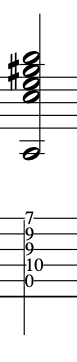
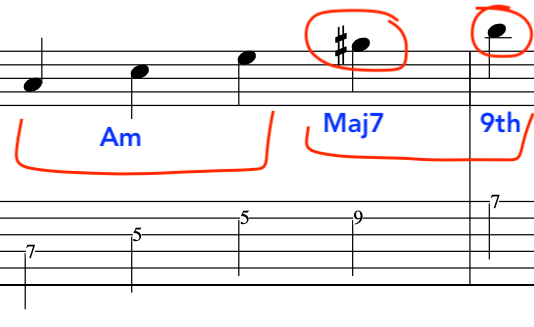
Another, lovely sound that we get [thinking from the relative minor] is AmMaj7/9.

This voicing works beautifully on the guitar creating a colourful resonance:

Diagram showing the notes and finger positioning for the C Augmented chord with a Maj7th and 13th. Fabern chord as minor

Now, let’s play it as an arpeggio outline:

Sheet music displaying annotations for 'Am', 'Maj7', and '9th' chords, with notes positioned on a staff.

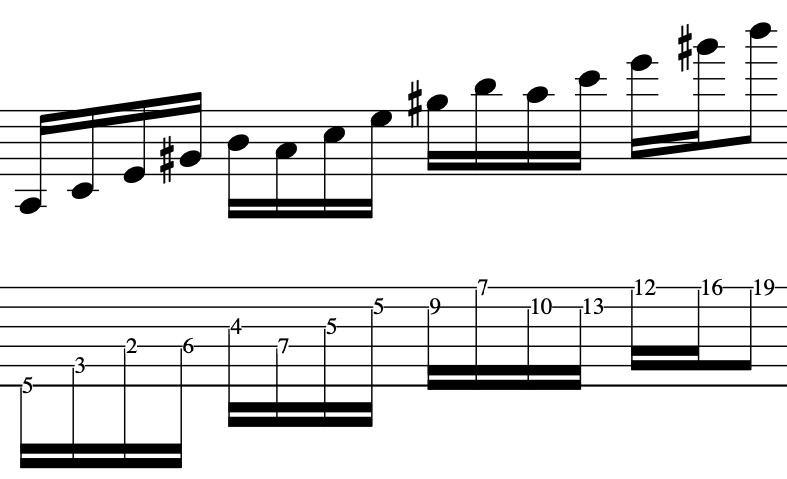
From here, we will extend this to create an ascending line:

Sheet music displaying a musical piece with various notes and rhythms, designed to illustrate the 'Farben' chord by Arnold Schoenberg.

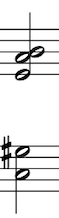
Finally, we will make another voicing.

Musical notation showing the C augmented chord with a major 7th and 13th intervals.
Diagram of chord voicing illustrating the unique structure of the Farben chord variation.

If we take the top part, we can create a nice lick from it. This gives a sort of modal improvised line impression.

[Side thought: Unordered 01348: s Forte number is 5-z17, in the taxonomy of Allen Forte].