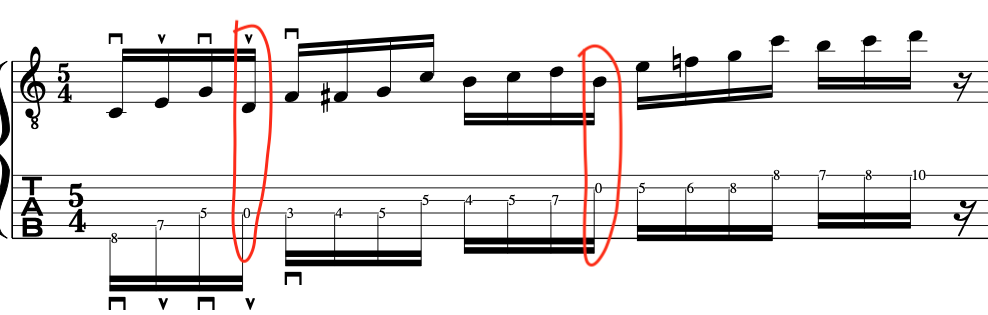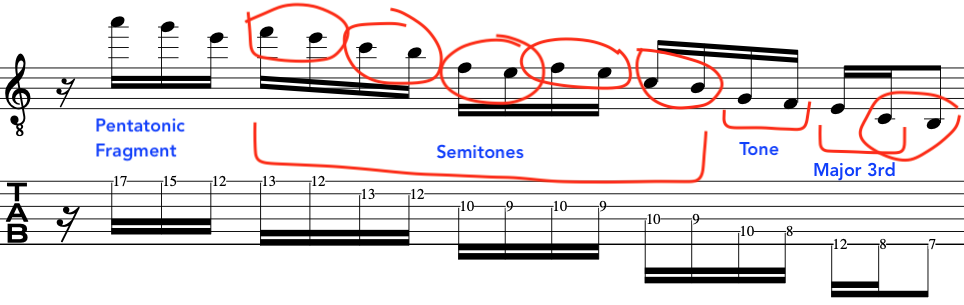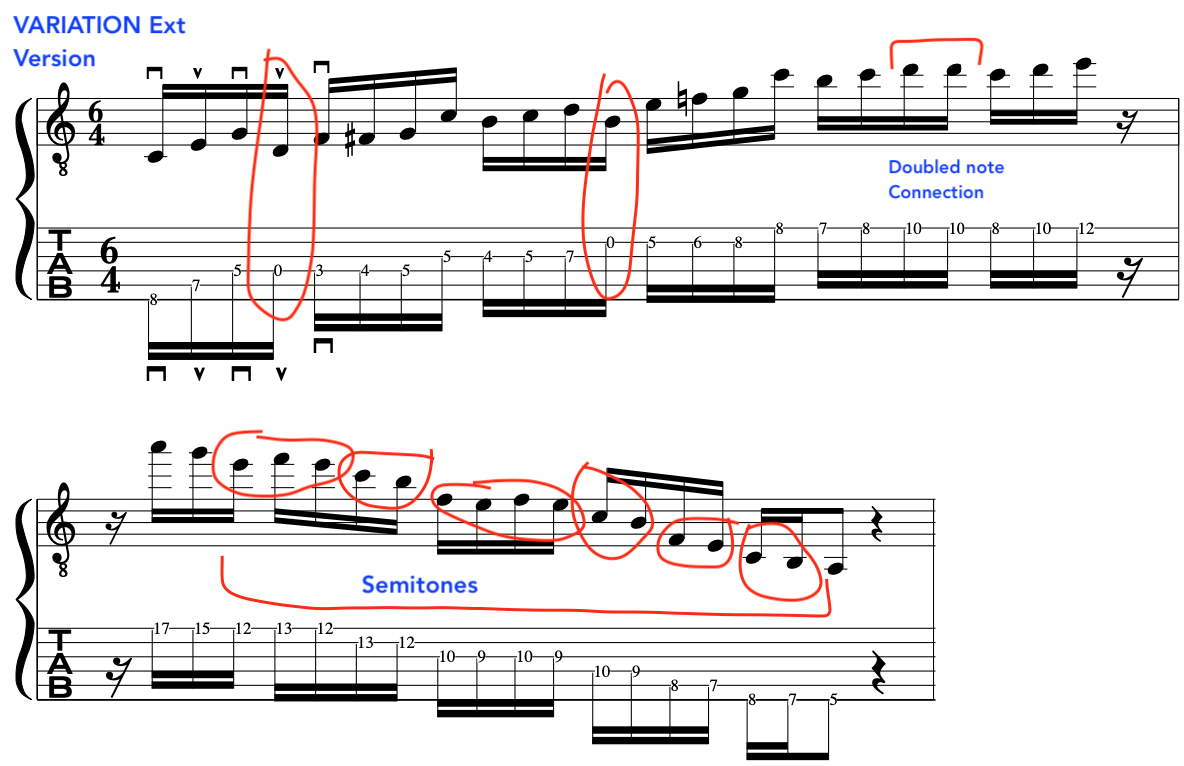
Dennis Sandole Polytonal Guitar Scales: Lesson:

Hi Guys,

Today, a look at the unique scale formations/superimpositions of Dennis Sandole.

We will take three examples from a handwritten page of polytonal scales by Dennis Sandole and apply them to the guitar:

Dennis Sandole’s Handwritten Polytonal Scale:

dennis-sandole-polytoanl-scales-blog

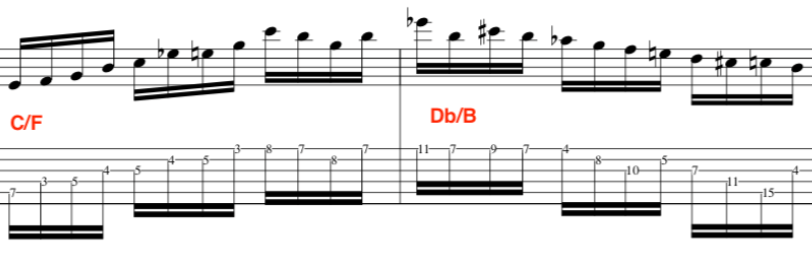
Same scale applied to the Guitar:

dennis-sandole-polytonal-guitar-scales-blog

In this example notice how the different major scales connect via semitones creating a unique chromatic connection.

dennis-sandole-polytonal-guitar-scales-blog

Now, let’s apply a descending version with a more pentatonic/fingering guitar format:

Again, notice the half step chromatic connections that make this run smoothly.

dennis-sandole-polytonal-guitar-scales-blog

Dennis Sandole’s Handwritten Polytonal Scale:

dennis-sandole-polytonal-guitar-scales-blog

Same scale applied to the Guitar:

dennis-sandole-polytonal-guitar-scales-blog

Here, we have whole tone connections as well as half step connections creating a colourful set of sounds:

Let’s now create a descending version:

dennis-sandole-polytonal-guitar-scales-blog

Dennis Sandole’s Handwritten Polytonal Scale:

dennis-sandole-polytonal-guitar-scales-blog

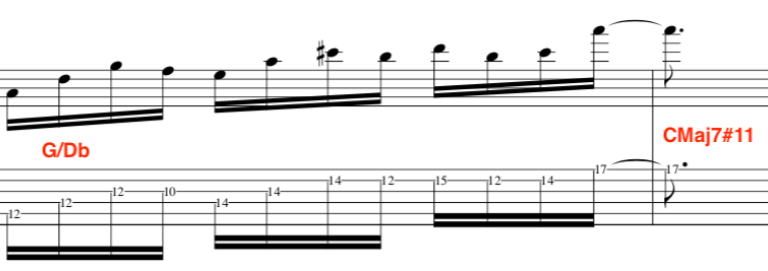
Same scale applied to the Guitar:

dennis-sandole-polytonal-guitar-scales-blog

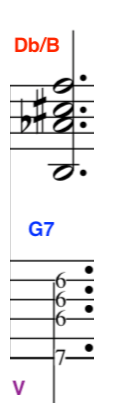
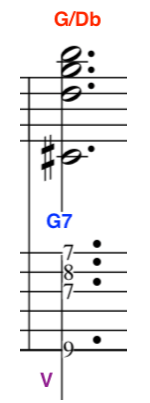
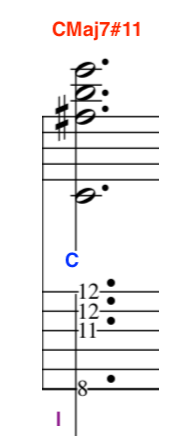
In this example we have a full C major scale connecting to a full Db major scale via the halfstep of C to Db. And finally, up another half step to the note D.

Finally, let’s descend:

dennis-sandole-polytonal-guitar-scales-blog

There are also many concepts that you can make out of these polytonal scales:

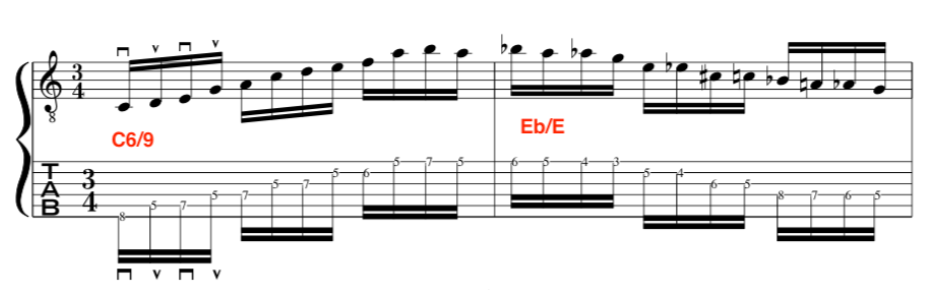
For instance, we can imply triads/arpeggios with dyads and create little licks, motifs and hook lines.

dennis-sandole-polytonal-guitar-scales-blog

dennis-sandole-polytonal-guitar-scales-blog

This was just a very brief look at Dennis Sandole’s concept of polytonal scales.

In terms of the guitar these are very useful for creating a mixed harmonic palette and creating seamless lines where any scale can connect to any other scale regardless of non diatonicism and ambiguity.

Master the Robert Fripp Cross Picking Technique | Guitar Lesson

Robert Fripp Cross Picking Guitar Technique Lesson

Hi Guys,

Just a short blog to explain what I mean by employing the “Down Down Up” guitar picking technique.

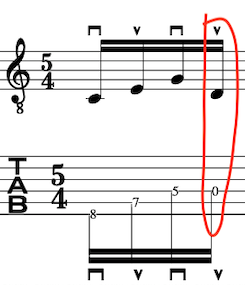
If we look at the patten below we can see the “Down Down Up” Picking pattern:

fripp-guitar-cross-picking-lesson-example

This is a very useful picking pattern/device that will hold you in good stead: But the key is to employ it sparingly.

Why is this?

This is because sometimes the rhythms we see and sometimes feel can be different than our natural inclinations when picking/plucking the strings.

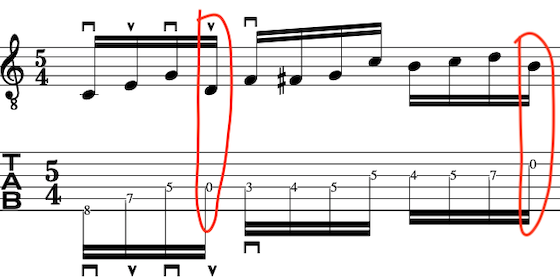
So, if we look below we will see that the picking hand/subconcious wants to pluck a group of 5 notes and 3 notes to make up the 4 and 4 groups of 16th notes.

This is because of the “Crossing” of the strings, the order of the notes or the way the actual groups of notes on the guitar fingerboard work out:

fripp-guitar-cross-picking-lesson-example

fripp-guitar-cross-picking-lesson-example

The other reason to put this “Down Down Up” into what would otherwise be an alternate picking pattern is because:

This can be because of one note that has to be played on a down or upstroke specifically otherwise the whole passage is awkward to play. So, to execute “Down Down Up” for that one part makes sense.

Below, is the full exercise that deliberately mixes up “Down Down Up” and “Down up” Alternate Picking”. It’s only an exercise [Larks Tongues in Aspic III Style] but, hopefully it gets the point across.

fripp-cross-picking-lesson-guitar-technique-tab
fripp-guitar-cross-picking-lesson-example-tab
fripp-guitar-cross-picking-lesson-example

This technique can also be found in Al Di Meola’s REH video from the 1980’s. Al di Meola employs this for chordal/Arpggeio Picking, [as does Fripp sometimes].

Again, if used sparingly this right hand picking pattern/technique is absolutely essential for this type of art/creative style guitar music.

Lastly, picking one note per string is way more difficult and precise than plucking standard 3 notes per string as there’s so much string crossing going on.

FREE PDF DOWNLOAD:

Fripp Intervallic Guitar Alternate Picking Exercise: Right Hand Technique

Fripp Intervallic Guitar Alternate Picking Exercise: Right Hand Technique

Hi Guys,

Today, a look at some Fripp style “Intervallic” guitar alternate picking exercise/vamps.

First, we will employ 8th notes and then extend this by adding a double timed bar moving from 8th notes to 16th notes.

In the first exercise we will perform a repetitive loop or vamp. This will start on a “Downstroke” with strict alternate picking throughout.

In regards to the fretting hand, be aware of the necessary“Pivoting” when string skipping to the F# note. It is only a small movement but it makes all the difference for a clean execution of the exercise. [see video above]

robert-fripp-king-crimson-guitar-lesson

Here we have 2 bars of music. Notice the double/repeated note B natural. This is good for control of your right hand plucking/picking technique.

robert-fripp-king-crimson-guitar-lesson

This loop/vamp is great to train alternate picking repetition of notes and right and left hand synchronisation and consistency: [See video above].

This time we will add 16th notes to double the time and create rhythmic interst and melodic movement. This is also reminiscent of guitarist Al Di Meola’s picking technique.

robert-fripp-king-crimson-guitar-lesson

In this example we move from 2 bars of 8th notes to 1 bar of 16th notes.

robert-fripp-king-crimson-guitar-lesson

robert-fripp-king-crimson-guitar-lesson

If we look at the above diagram we will see that the strings are being crossed and alternate picked along a “Straight” line.

This ensures that we are always “Aligned” with the string/note that we wish to pluck.

It is not guess work but a relaxed right hand that knows where to pick along that line and hence we can pick complex patterns regardless of time and intervallic distance with confidence and clarity.

These exercises are very good at revealing the right hand picking to the left hand fretting and creating an awareness of “Alignment” and synchronisation.

Following the straight line is so helpful as it means that we can get on with the playing of the music and not concern ourselves with anything outside of that, like “Will I play the correct note”, or “Here is the awkward bit”, etc.

Just align with the string along the straight line, pivot with the fretting hand if needed and just play.

FREE PDF DOWNLOAD: