
Please watch Video above for Detailed Info:
Hi Guys,
Today, two exercises for building jazz fusion 16th note double timed improvised guitar lines.
This is applied in the way that guitar great John McLaughlin exploits his alternate picking guitar technique.
This is a “Line builder” that builds through connecting key concepts together and at the same time creating familiarity with them as you do so.
For Example:
Arpeggios, Chromatics, Pentatonic’s, Motifs, Melodic content, Resolutions and Rhythmic offset.
The key is to connect them together in a melodic single note manner that is musical and at the same time logical for the alternate picking.
EXERCISE #1
This exercise starts with an upstroke with an open E string on an “Up beat” [anacrusis].
This then employs an F Major arpeggio with a C to B note resolution.
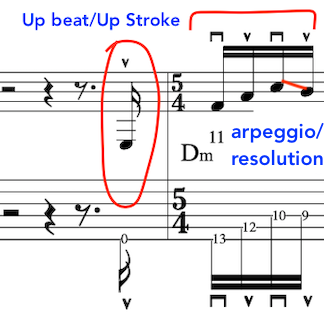
Straight away, it’s easy to hear the melodic content of the wider intervals of an arpeggio and the resolution.
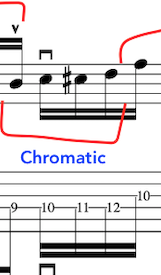
From here we will now add some chromatic colour.
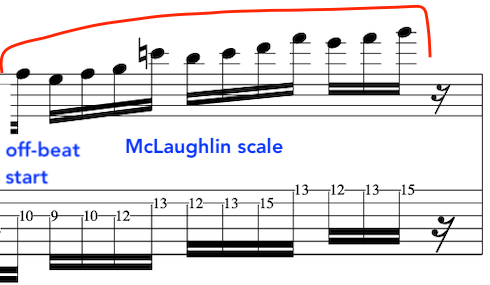
To complete this phrase we will add the John McLaughlin scale. This slots in nicely to the chromatic scale that we’ve just applied.
It’s smooth, quick and creates that very fluid liquid line sound: Also, notice the offset of the rhythm.
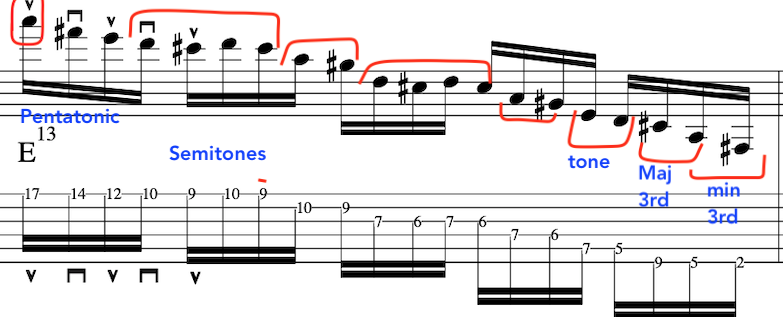
To descend, we will exploit the use of the semitone interval. This is easy for the fretting hand to sequence as it employs repetitive fingering and so is easy to cross the strings with. [The semitones are in the orange marker].
2nd part “Descending”
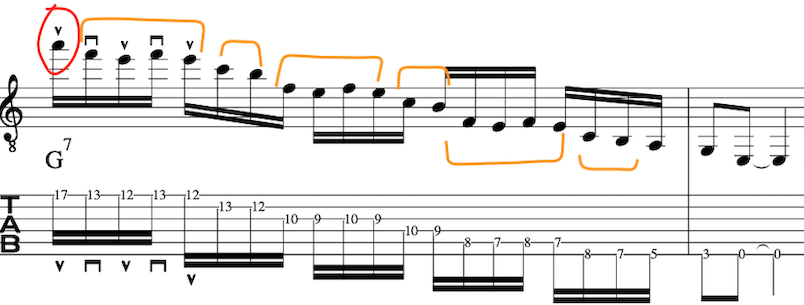
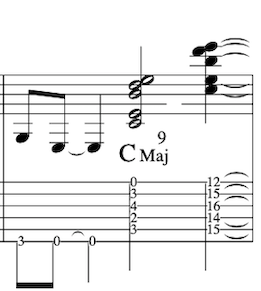
Finally, we finished with a CMaj9 chord that is then shifted up.
EXERCISE #2 VARIATION:
This exercise is similar to the one above, but, in a different key and different chords.
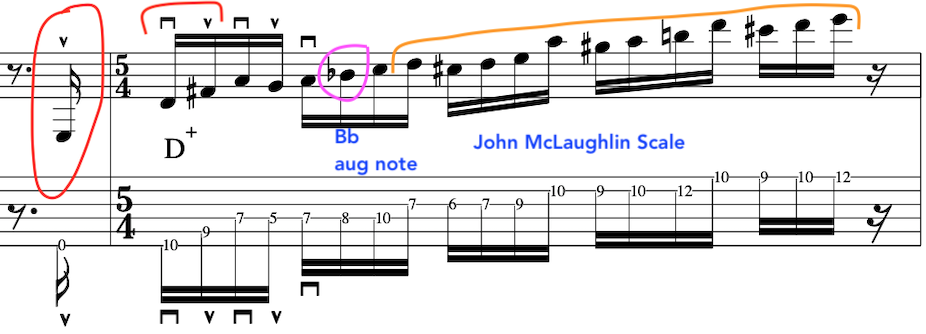
As before, we start on an up beat with an upstroke. We employ the arpeggio, but, this time it is a suspended fourth with the A note moving down to the G note.
From here, we ascend and exploit the Bb note to emphasise the D Augmented chord. This is then rounded off by slotting in a fragment of our old friend the John McLaughlin scale once more .
We descend with a pentatonic fragment this time and once again exploit the interval of a semitone and sequence it. But, this time with the last 5 notes we also have the intervals of a tone a major 3rd and a minor 3rd.
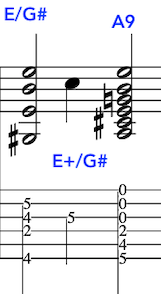
Finally, we cadence with the chords of E/G# [or E 1st inversion] that then raises the 5th to make it augmented. This then resolves to a hanging A9 chord.
IN CONCLUSION:
These are only exercises, but, they do show the melodic/musical nature of the improvised line in regards to alternate picking.
In the jazz fusion style, motifs, melodic content, chromatics, pentatonic’s, rhythmic offset, etc, all work to great effect as they all slot together creating sophisticated double time lines.
FREE PDF DOWNLOADS:
DOWNLOAD #2:
was of use to you then please SUBSCRIBE to us below on YOUTUBE, Thanks!
If this blog/lesson was of use to you then please SUBSCRIBE to us below on YOUTUBE, Thanks!