Exploring John McLaughlin’s Unique Guitar Chordal Harmony

Hi Guys,

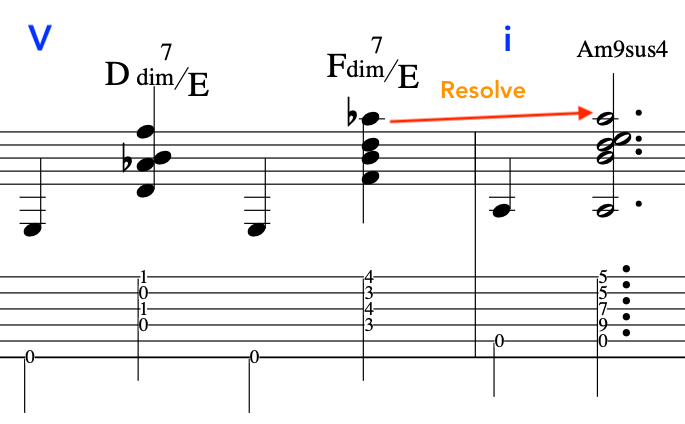
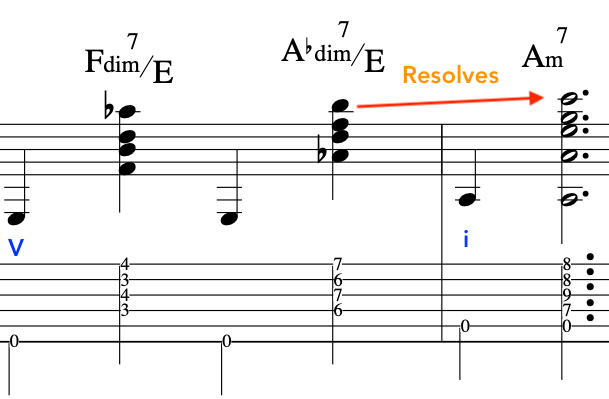
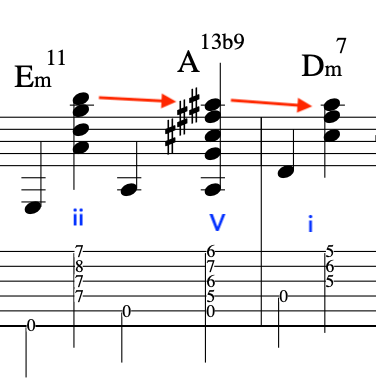
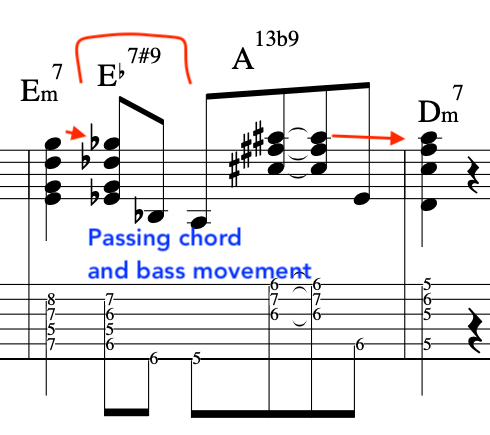
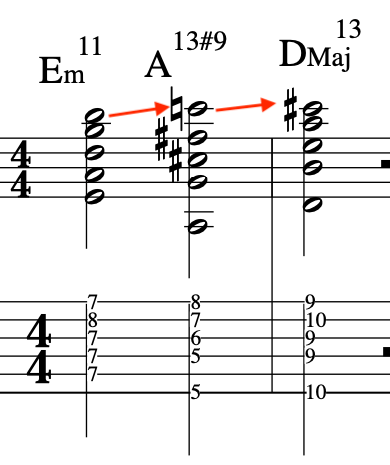
Today, a quick look at some of John McLaughlin’s amazing altered, slash and ambiguous guitar chords.

Johns harmony is a very rich palette indeed.

In the little example above in the video, I play about with some of Johns harmonic movement and colour.

Although, I could employ diminished harmony, I am instead aiming at “Implication”….Why?…This is in order to bring out the big “Rich” resonance of the guitar.

john_mclaughlin_guitar_chord_example_lesson

It is an ethereal sound where the natural harmonics and overtones can ring out of the guitars sound hole harmoniously.

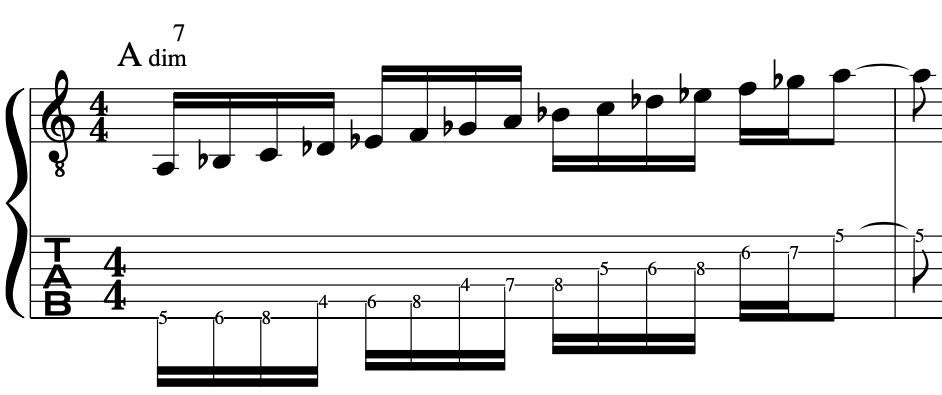
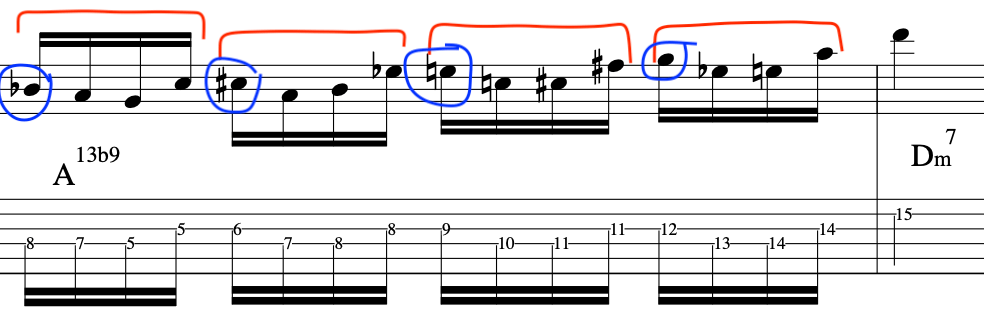
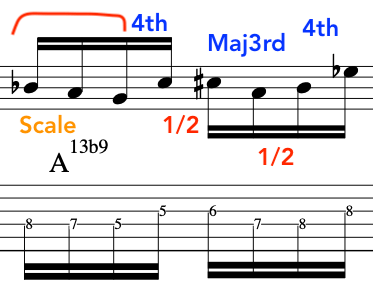
Next, we employ a Bb Major run with a few chromatic notes. These being, the B natural and the E natural chordal tones.

john_mclaughlin_guitar_chord_example_lesson

Now, let’s add two more resonant chords,

john_mclaughlin_guitar_chord_example_lesson

We will now connect to the next part together.

This will be with an arpeggio of Ebm mostly [or D#m] implying BMaj7. [Although there is an implied resolution to B7 also].

This juxtaposition, creates another ambiguous move that opens up a fresh and unique sounding harmony.

john_mclaughlin_guitar_arpeggio_example_lesson

From here, we can manipulate and resolve into the Bb minor full barre harmony:

john_mclaughlin_guitar_chord_example_lesson

Now, let’s create a sequence. This will be, C#7sus4 to C7 with a sharpened 4th and a Maj7th.

Notice, the chromatic movement in the bass as we sequence this.

john_mclaughlin_guitar_chord_example_lesson

Finally, this resolves from CMaj7#11 to CMaj7 with open string guitar chords.

john_mclaughlin_guitar_chord_example_lesson

In conclusion, this was just a quick look at Johns unique take on harmony and how to apply some scale and arpeggio movement to connect it all together.

John’s harmony is a lovely combination of ambiguity and resonance with a sense of calm.

The magical ethereal tone opens doors to really interesting solo applications that exploit implied harmonies and dissonances. These I find are met with with lingering resolutions that are never quite met.

It’s a sort of pairing of opposites that you can’t quite put your finger on that give it that alluring yet elusive quality.

Counting Rhythms for Alternate Picking Guitar “Right Hand” Technique:

Hi Guys,

Here are a few of the Rhythms that I like to count and/or practice when alternate picking:

These are based around Indian Konokol: But: I am using them to INTERNALISE patterns. This could be Ta ka di mi but felt/internalised as du du du du

These, I find help me enormously with the right hand picking, as I can connect phrases together from the internalised beats/syllables.

These are NOT cast in stone and are only a few ideas that I use personally, and are not aiming at strict Indian classical music technique, but, are employed as reference points/patterns/beats in the way that they are enunciated.

1] Ta ka di mi [1 2 3 4]

2] Ta ki ta Ta [more as 123 1]

1] Ta ka di mi thom [1 2 3 4 5]

2] Ta ka di mi Ta [1 2 3 4+1]

3] Ta ki ta Ta ka [1 2 3 1 2]

1] Ta ka di mi Ta ki ta [4+3]

2] Ta ka di mi thom Ta ka [5+3]

1] Ta ka di mi Ta ka di mi [4+4]

1] Ta ki ta Ta ki ta Ta ki ta [3×3]

2] Ta ka di mi Ta ka di mi Ta [4+4+1]

1] Ta ka di mi Ta ka di mi Ta ki ta [4+4+3]

1] Ta ka di mi Ta ka di mi Ta ka di mi Ta [4+4+4+1]

1] Ta ka di mi Ta ka di mi Ta ka di mi Ta ka di mi [4×4]

These are only ideas that I personally find useful, and, as I say they are not for strict Indian classical music. But, they do function well as reference points and a way of enunciating beats for the picking hand to pluck at a fast [alternate picking] tempo.

McLaughlin “Belo/Music spoken here” Style Guitar Chord/Scale Techniques

Hi Guys,

Today, a quick look at how John McLaughlin moves from chord to scale or scale to chord on the nylon string guitar.

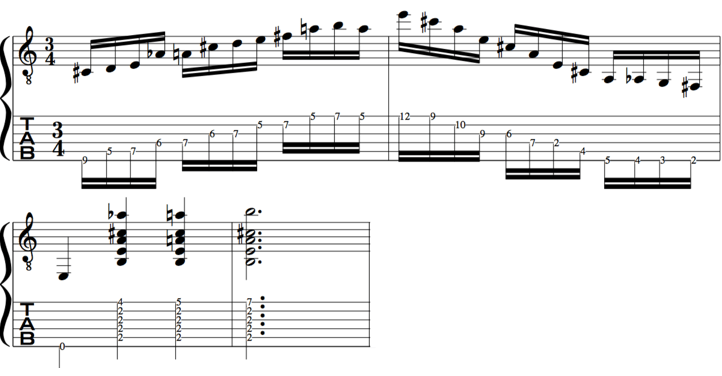
In this lick we can see John exploit the 3/4 time signature with rapid fire alternate picked tetrachords!

This is classic “Music spoken here” style in regards to the application of pentatonic scale fingerings and melodic arpeggio shapes that connect together to create a fluid improvised line.

john_mclaughlin_acoustic_guitar_techniques_lesson

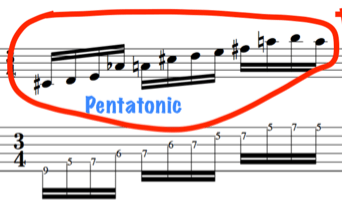
Here, we can view the exploitation of a quick pentatonic fingering that ascends,

john_mclaughlin_acoustic_guitar_techniques_lesson

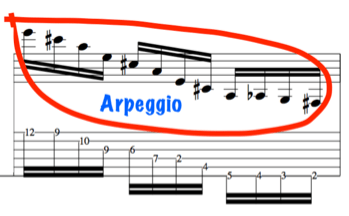
Now, we go the opposite way and answer the phrase with a descent. This employs the A Major Arpeggio shape/fingering:

john_mclaughlin_acoustic_guitar_techniques_lesson

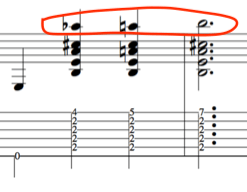
Finally, we have a little melodic rise in the top line over a barred static chord. [Mind the stretch!]

john_mclaughlin_acoustic_guitar_techniques_lesson

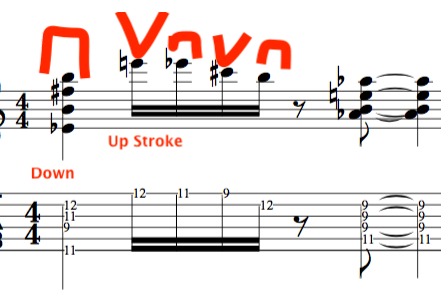
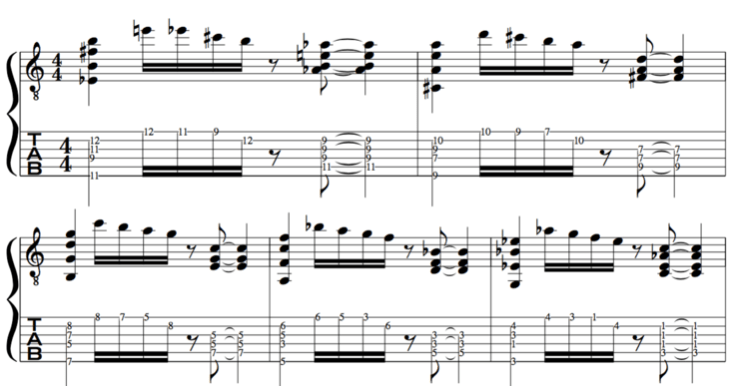
In the next example, we will apply the concept of a chord to scale fragment that anticipates to the next chord in 4/4 time.

Technically, I am playing the chords on a downstroke and the scale on an upstroke. [This employs alternate picking guitar technique once more].

john_mclaughlin_acoustic_guitar_techniques_lesson

What makes it work so well on the guitar is that this concept employs 1st Inversion chord voicing’s- E,g B/D# to E/G# to A/C# to D/F# etc

Also, as a compositional device, this works brilliantly because it employs the cycle of Vb to Ib.

john_mclaughlin_acoustic_guitar_techniques_lesson

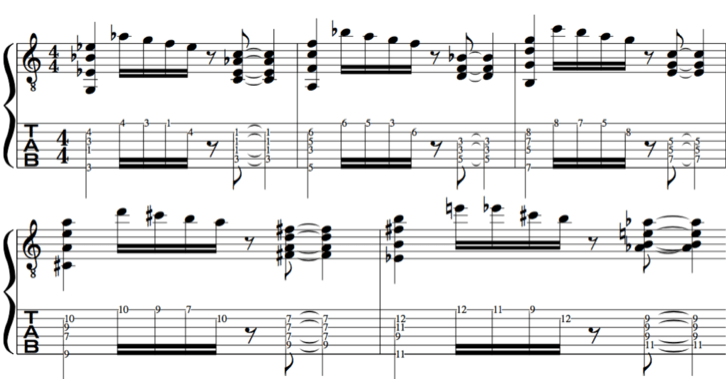
Notice: this is the same, but, this time we are ascending with the same concept.

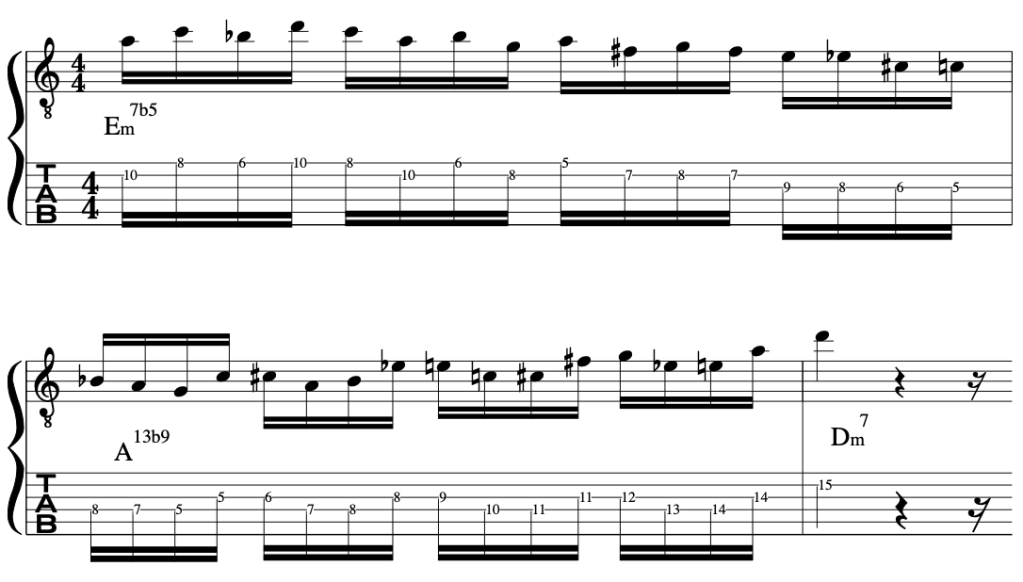
Musical notation and tablature sheet depicting a guitar lesson focusing on chord to scale transitions and alternate picking techniques from John McLaughlin's Belo Herozonte Album.
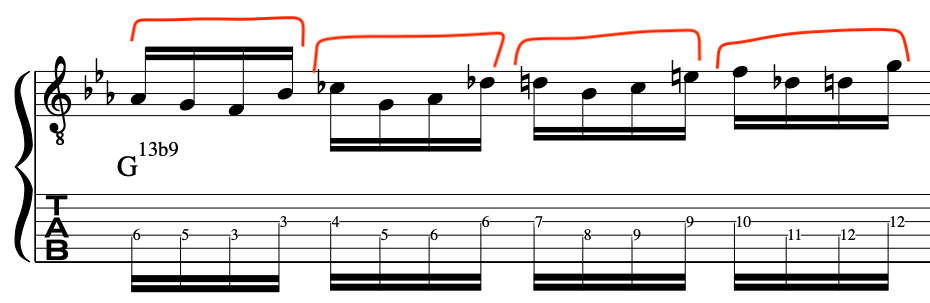
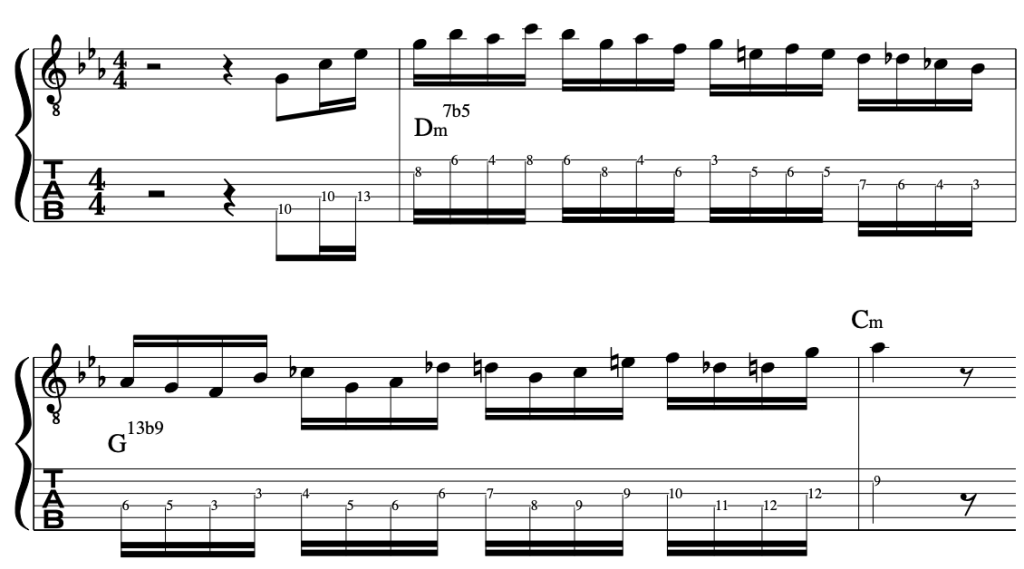
Musical notation illustrating a John McLaughlin chord to scale technique, demonstrating ascending and descending patterns.