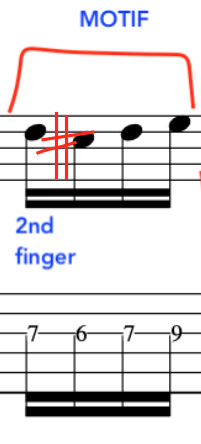
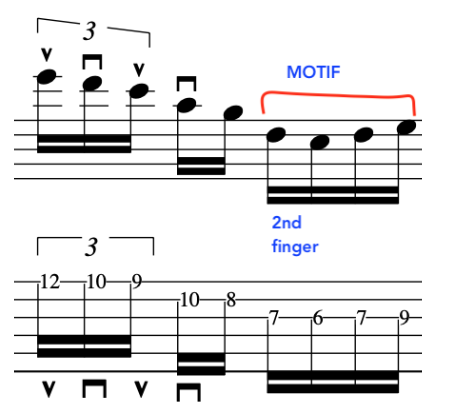
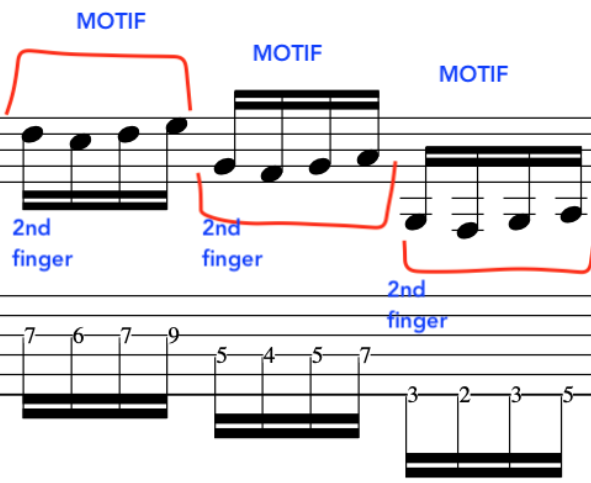
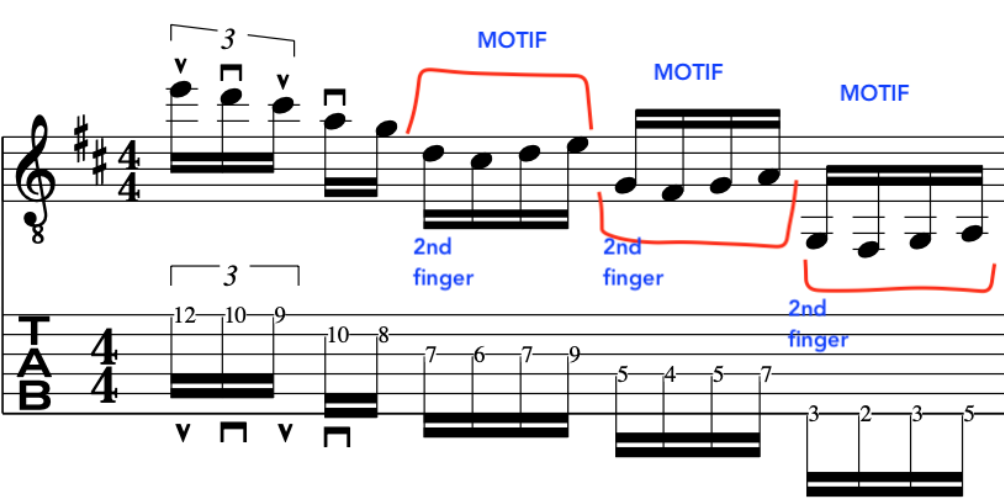
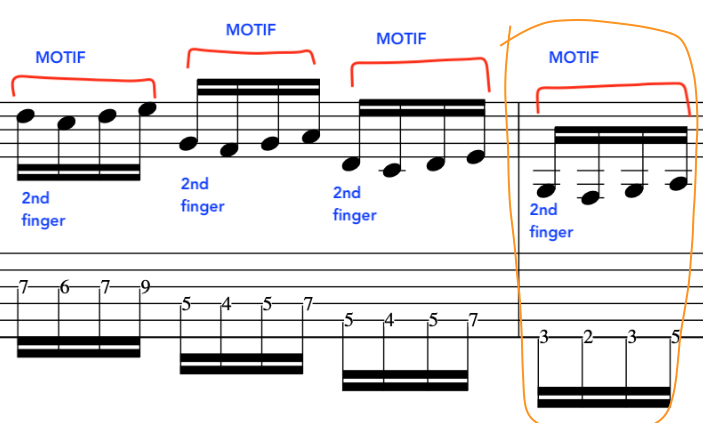
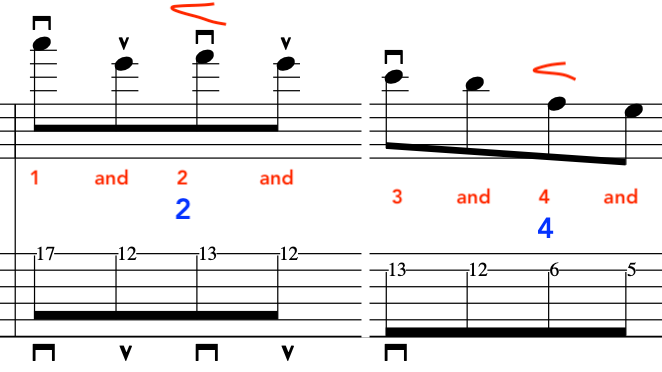
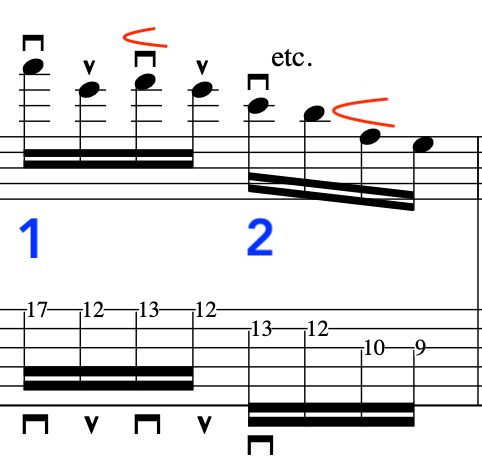
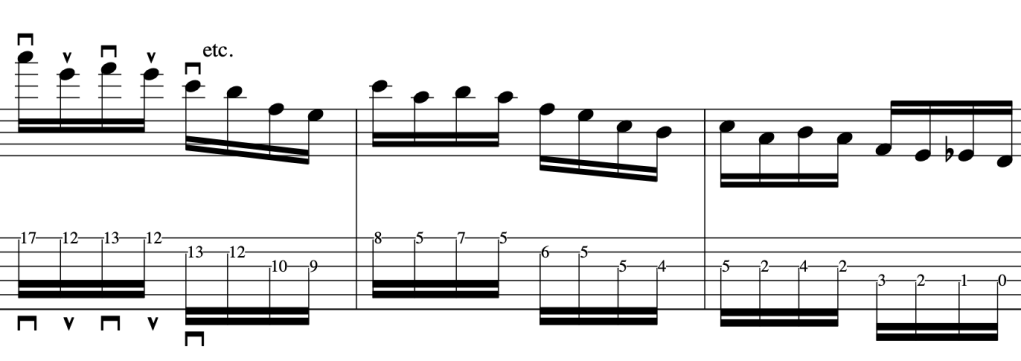
Here, is the extended version for the 2nd finger John McLaughlin motif:
MOTIF:
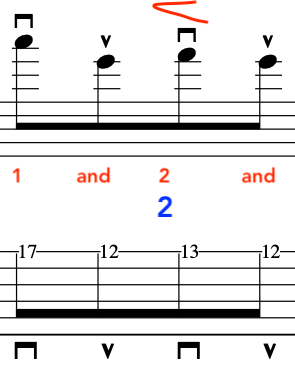
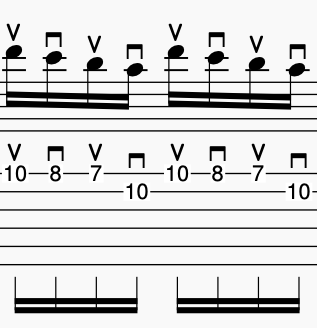
The motif is a 4 note [Tetrachord] in 16th notes- D C# D E
Notice that this starts with the 2nd finger on the first note:
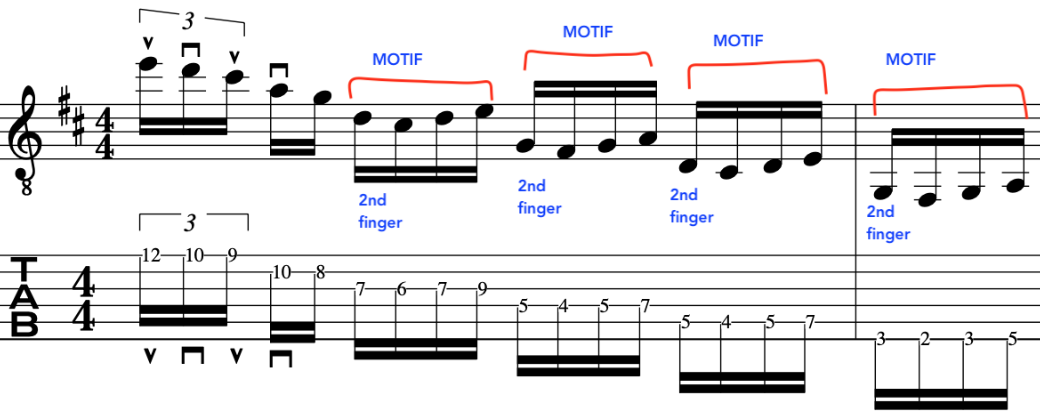
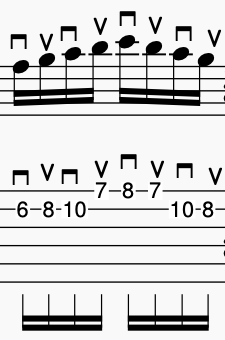
Now, let’s extend this and add a “set up” by employing the Mixo-lydian mode to create a more Indian/Shakti flavour to the phrase:
I am starting this on an upstroke with strict alternate picking guitar technique:
This time, we will replicate/imitate the 4 note motif and use it as material to create/extend the phrase into a longer line.
Below, is the full line/lick:
Let’s now, extend the motif and descend as far as we can down the fingerboard with the motif:
Finally, we will add our little set-up and create a full phrase:
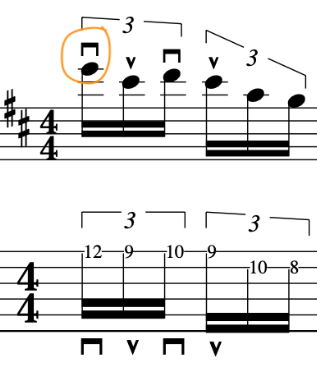
MOTIF: Starting on a down stroke:
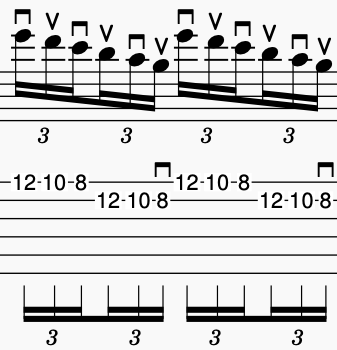
We can also start on a downstroke. This works best and is most natural when picked/phrased in triplets/sextuplets like this:
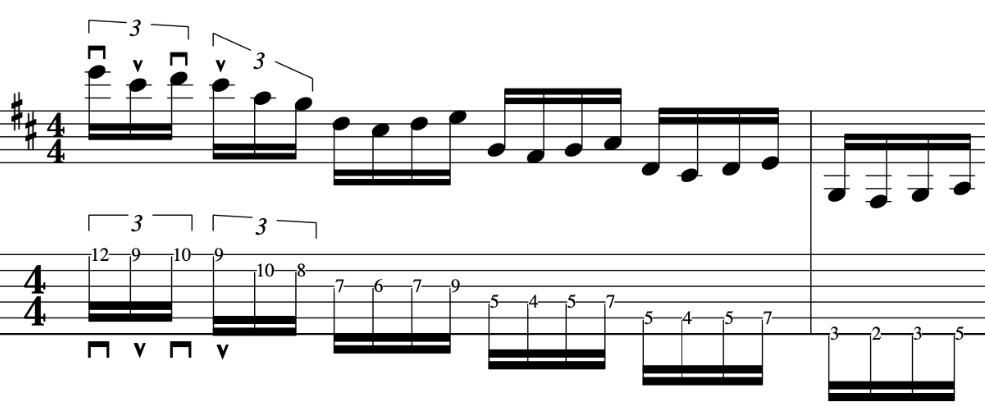
Full Phrase starting on a downstroke:
IN CONCLUSION:
This little motif/concept is only a small detail, but, it is a good representation of how a lot of material can be created/repeated or imitated from such a small cell. It is like a little hinge that can swing a big door.
This way of building solid lines is really useful for the alternate picking guitar technique as it means that we can unfold material quite easily and if we ever do get lost we can slot back in with simple motif material and rebuild our phrases and keep our lines going.
Today, a look at the alternate picking guitar style of the great John McLaughlin.
PART 1:
Before starting it is essential to look at the rhythmic aspect.
To do this, let’s take basic 8th notes.
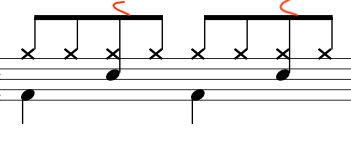
Here, we will accent the 3rd note in each 4 note grouping.
Now, let’s add another 4 note grouping and do the same thing.
Musical notation illustrating the technique of alternate picking with accents on specific notes.
What you will notice is that this is like a basic 4/4 drum rhythm with the accent landing on the snare:
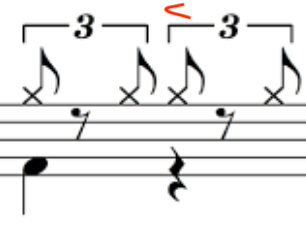
With this in mind, let’s now take this and add a shuffle or swing feel to it.
Tip-This accent and swing feel keeps the picking hand secure and focused on plucking the rhythm and not jumping ahead.
PART 2: Double Timing.
Now that we are comfortable with 8th notes, let’s double the time with 16th notes.
It dosen’t matter how you want to count 16th notes. Regardless of 1 e and a or Ta Ka Di Mi or some inner murmur, the point is that your counting needs to be internalised so that the picking hand knows what to pluck.
So, let’s pluck this around 110 to 140 bpm
Musical notation demonstrating alternate picking techniques in guitar practice.
Okay, let’s now apply everything we have studied so far:
1] Accent 3rd note in each 4 note phrase
2] Apply a swing/shuffle feel
3] Count time – follow internalised rhythm
and play the whole phrase:
PART 3: RIGHT HAND TECHNIQUE:
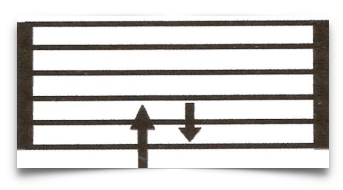
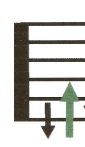
For the picking hand [Right hand technique] one needs to be aware of plucking inside of the string and outside of the string:
From the outside of the strings it will be:
Up skip over and pluck down:
Diagram illustrating alternate picking technique for guitar, showing the directions of plucking from outside the strings.
From the inside of the strings it will be:
Down skip over pluck up:
Diagram illustrating alternate picking techniques with directional arrows for upstrokes and downstrokes from inside of the strings.
For most players it is easier to pluck [alternate pick] from the outside of the strings.
Here is a 2 string exercise plucking from the inside of the strings starting on a downstroke:
Illustration of a 2-string exercise demonstrating alternate picking techniques on guitar.
Here, is a 2 string exercise plucking from the outside of the strings, but, starting on an upstroke:
An illustration of a musical exercise showcasing alternate picking techniques on the guitar.
Now, let’s start on a downstroke on the outside of the strings:
Musical notation demonstrating 2 string alternate picking exercises for guitar.
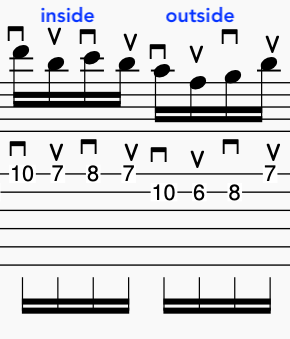
Finally, let’s mix it up a bit starting on a downstroke:
Illustration of alternate picking technique showing ‘inside’ and ‘outside’ stroke patterns on guitar.
From these short repetitive exercises, we can gauge where we are with the picking hand. We can acknowledge wether we are picking inside or outside of the strings.
For fluid right hand technique this is essential, as you will know where you are and what you prefer or what’s easiest and most natural for you.
This in turn means that you can start creating phrases either inside or outside the strings that fit your style.
PART 3: CONNECTIONS
In order to play fluid phrases it’s essential to “Connect” parts, groupings, lines and licks, etc, together.
This means, having the fretting hand ready to “Shift” positions.
This also means, employing simple logical fingering by having the fingers prepared for fretting.
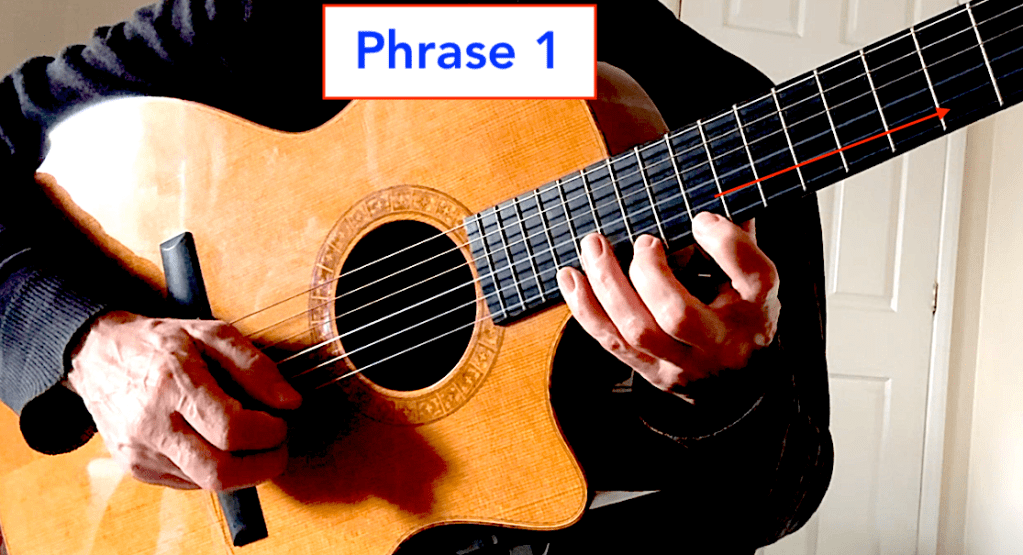
Here, is the natural movement from our example line-[built in 3 deliberate parts]
Demonstration of a guitar phrase highlighting finger positioning for fluid playing.
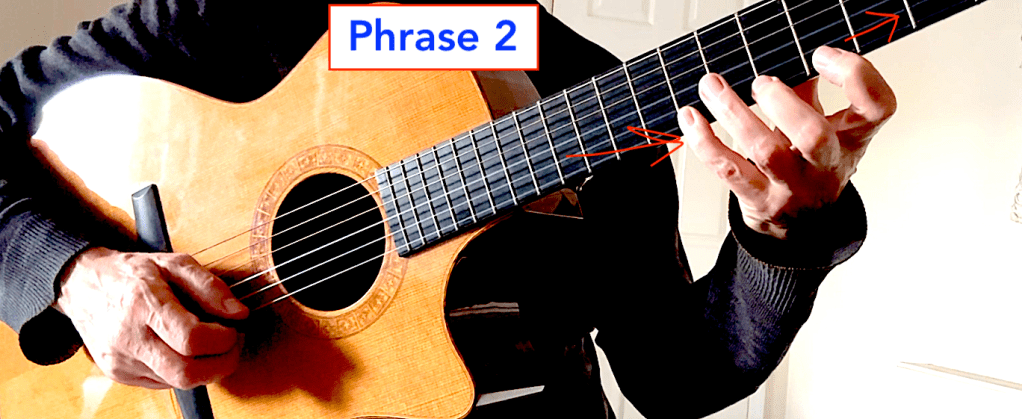
The fretting hand prepares shape to shift down to the next positions with the hand and fingers “Aligned” for the next phrase.
Demonstration of Phrase 2 in alternate picking technique on guitar.
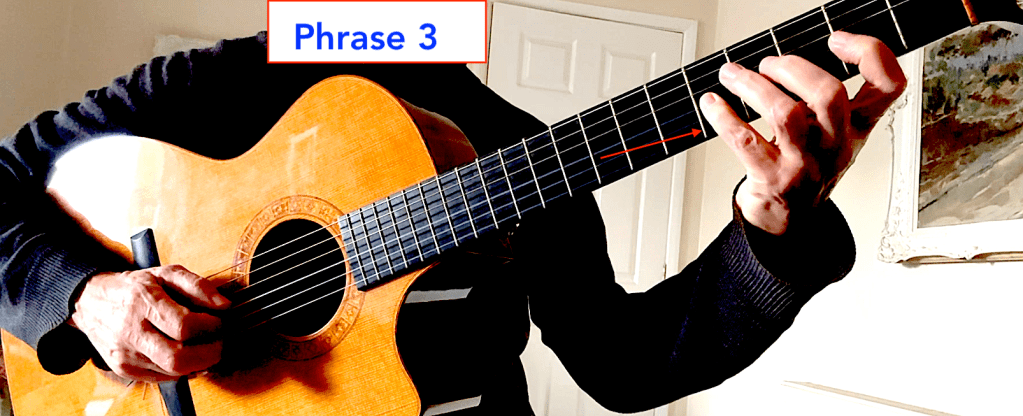
Fretting hand plays the phrase and prepares the shape and fingersto shift down to next position:
Illustration of Phrase 3 technique in John McLaughlin’s alternate picking style.
Fretting hand plays the last phrase comfortably. Hand, shape and fingering are aligned to the correct position.
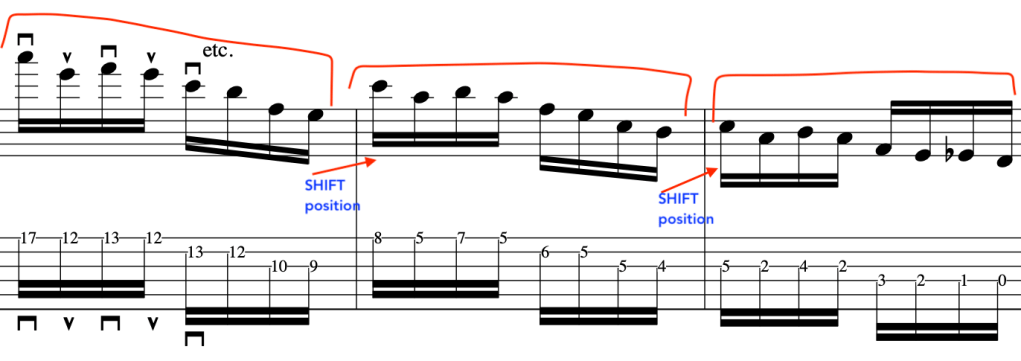
Full Line -Shifting Positions:
A musical score demonstrating alternate picking techniques for guitar, highlighting shifts in position.
In conclusion this was just a quick look at the basics of Johns alternate picking guitar technique style.
From here, one can start to form and develop the improvisational elements needed to complete the style. [“This is the way I do it” video-a great example]
As John has taken so many paths in his musical journey it is impossible to get everything down in one webpage/blog. But, from a basic perspective, hopefully this lesson helps somewhat in understanding John’s alternate picking guitar technique.
If this blog lesson was of use to you then please SUBSCRIBE to us on YOUTUBE below, Thanks!
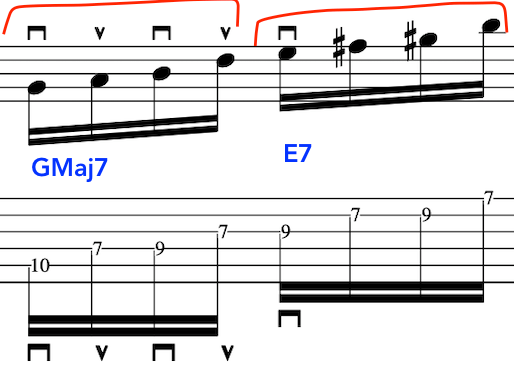
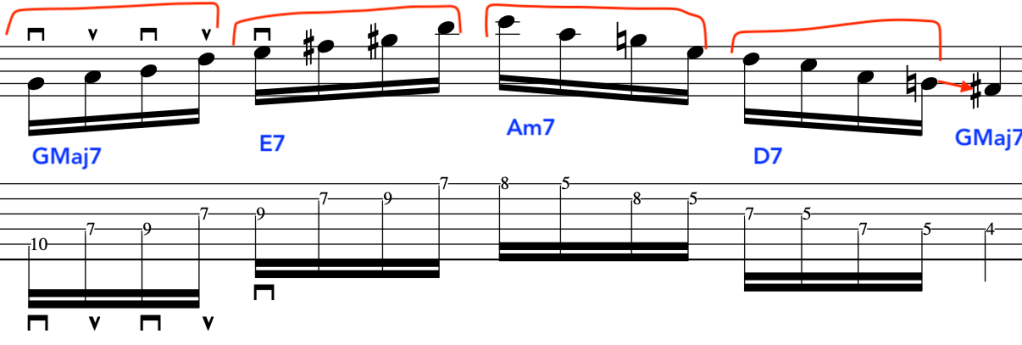
Today, a look at playing through a Vi ii V7 I Turn around/Cadence at a quick pace/tempo.
This is in the style of Don Mock, Pat Martino and John McLaughlin. So, this employs the alternate picking guitar technique.
PART 1:
In order to achieve our goal, we will exploit pentatonic fragments and connect them together in four note groupings.
This also means that we can make use of simple guitar fingering and hence pick quick rapid phrases.
Here, is the chord sequence:
Now, we will solo through the first two chords of I VI [Chord VI as a Domoninat 7th]
Starting, on a down stroke with alternate picking, we can see how easy it is to connect these simple pentatonic’s together through the twochord changes.
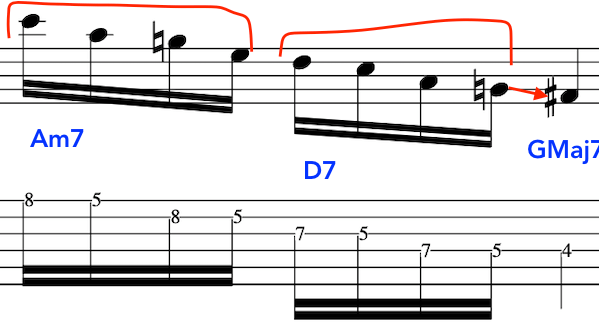
Now, let’s connect the pentatonic’s over the next two chords in the same manner. [Notice the G to F# resolution for Gmaj7]
PART 2:
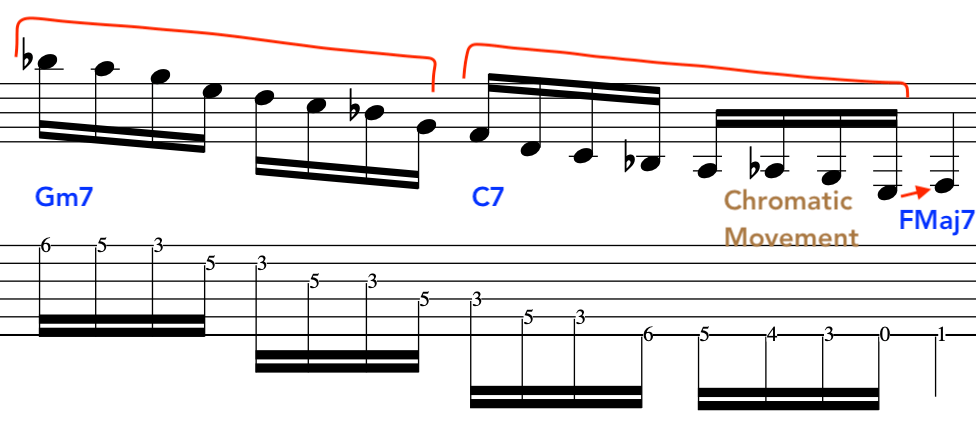
Having completed our Turnaround, let’s cadence this to a new key: This will be F Major.
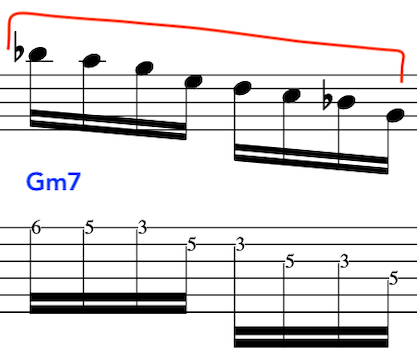
To do this, we will make the GMajor7th chord, minor, to G minor 7th.
From here, we will carry this pentatonic scale/line along and play it over the next chord.
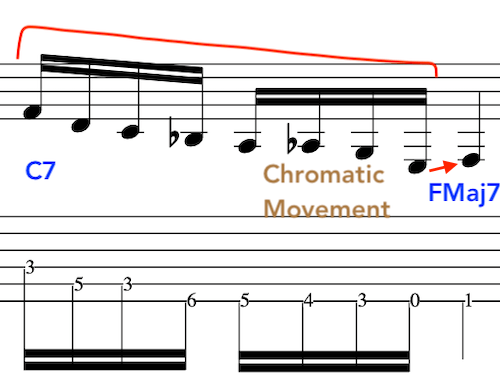
This will be the Dominant chord of C7[or chord V leading to/of the new key F Major].
Notice: the use of a few chromatic notes to fill out the pentatonic scale/line.
PART 3:
Full Turnaround/Cadence:
This, was just a quick look at how easy it is to connect long lines together through very quick chord changes, especially, at the guitar with alternate picking technique.
It’s amazing the amount of chords we can play through fluently and quickly with this simple pentatonic four note [tetrachord] approach when improvising.
This short blog/lesson was just touching the surface. But, it does still give quite a comprehensive view of what can be achieved with this approach.
It’s a good idea to apply this method to any quick chord changes that you can find [e,g “Giant Steps”] and try this.