How to Anticipate/syncopate and use anacrusis at the guitar in Music
OFF-BEAT PLAYING
In order to play “Off” the beat you must first establish the “On” beat. This way you can anticipate or push the music/melody/riff or motif along and then return to the established “On” beat.
How to play on the beat and off the beat in music with chords.
When beat one is established we can then push any beat from there on. The key is then to return to the “On” beat to start the next phrase or vamp or piece of music.
If you play “Off” the beat continuously the syncopation/anticipation will be lost.
In order to fully comprehend off-beat playing it is an extremely good idea to learn and practice the two most common essential rhythms in every way possible, both in the bar and across the bar line. But, always coming back to the “On” beat for the start of the new phrase.
Rhythm 1
How to play on the beat and off the beat in music with chords.
Rhythm 2
How to play on the beat and off the beat in music with chords.
You can change the harmonic rhythm or join the rhythms together and create vamps or phrases.
Example:
How to play on the beat and off the beat in music with chords.
Example:
How to play on the beat and off the beat in music with chords.
Mixing Both Rhythms Together:
How to play on the beat and off the beat in music with chords.
Now we will add a bass push/anticipation: [Notice the BASS note is “Tied” across the bar line].
How to play on the beat and off the beat in music with chords. [Anticipation]
In this example we will add a short “Melody” to a chord:
How to play on the beat and off the beat in music with chords/Melody
Here are a set of variations on a chord change:
Variation 1:
How to play on the beat and off the beat in music with chords.
Variation 2:
On the beat
Variation 3:
How to play on the beat and off the beat in music with chords.
IF THIS LESSON WAS OF VALUE TO YOU THEN PLEASE SUBSCRIBE TO US ON YOUTUBE BELOW, THANKS!
In addition to fusing American and Indian music, Shakti also represented a fusion of the Hindustani and Carnatic music traditions, since Hussain is from the north region of India while the other Indian members are from the South.
The group came together in 1974, after the dissolution of the first incarnation of the Mahavishnu Orchestra, and toured fairly extensively during the period 1975-1977; it made only sporadic appearances (with personnel changes) thereafter.
Two concerts at the Montreux Jazz Festival (July 6, 1976 and July 8, 1977) are included among the 17 CDs of the box set Montreux Concerts by John McLaughlin.
IF THIS LESSON WAS OF VALUE TO YOU THEN PLEASE SUBSCRIBE TO US ON YOUTUBE BELOW, THANKS!
Messiaen, Fripp, Mclaughlin, Schoenberg, 21st century harmonic concepts
In this blog we will look at improvising over one chord. This will be D minor [D Dorian].
Messiaen, Fripp, Mclaughlin, Schoenberg, 21st century harmonic concepts
The key is to use chromaticism, tertian harmony, superimposition and outside harmonic content in order to create interesting improvised lines and move away from the cliches of scales and modes to create originality.
For example:
Messiaen, Fripp, Mclaughlin, Schoenberg, 21st century harmonic concepts
The key for smoothness is to be aware of where the 1/2 steps [Semitones]are in the “Connections”.
If we look below we can see where the 1/2 steps connect and how to play off of the tonic note with this. In this case we play off of the tonic D note resolving straight into the Eb note for Eb melodic minor. We can then resolve down a half step to C#m and back down into D Dorian
Messiaen, Fripp, Mclaughlin, Schoenberg, 21st century harmonic conceptsFripp ,Brecker, Mclaughlin chromatic Improvising method for jazz fusion improvisationChromatic jazz improvisation Brecker, Mclaughlin and creative Fripp improvising concepts
So as you can see it is easy to weave in and out of the harmony and get back to D Dorian via the 1/2 step.
Fripp ,Brecker, Mclaughlin chromatic Improvising method for jazz fusion improvisation
Below is a line that beautifully weaves in and out of D minor
Messiaen, Fripp, Mclaughlin, Schoenberg, 21st century harmonic concepts
In this next example we will use tertian harmony and exploit superimposition. We will employ D melodic minor and and keep extending via C melodic minor.
Fripp ,Brecker, Mclaughlin chromatic Improvising method for jazz fusion improvisation
Now we will extend the whole line:
Fripp ,Brecker, Mclaughlin chromatic Improvising method for jazz fusion improvisation
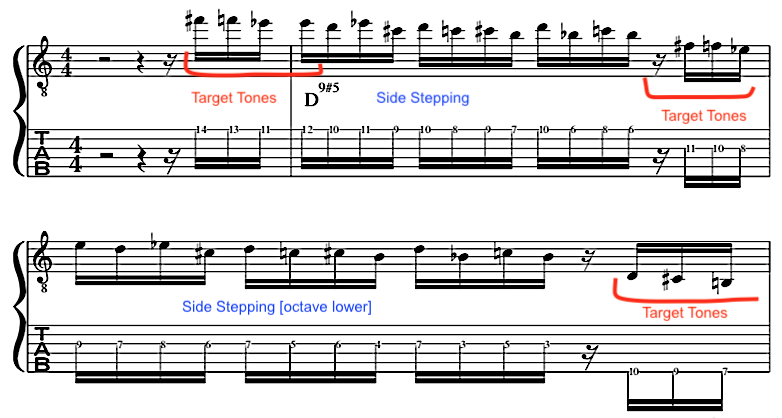
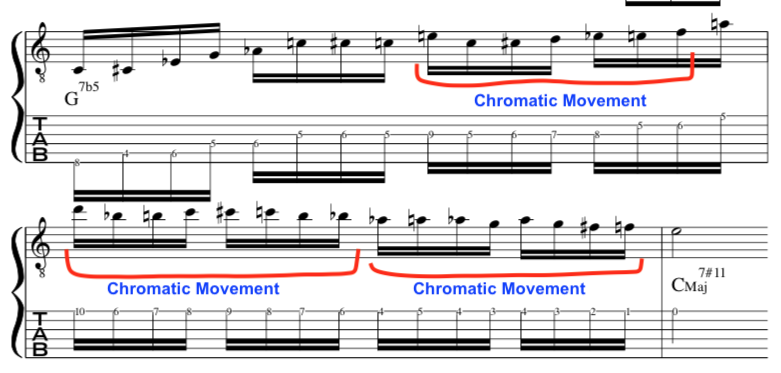
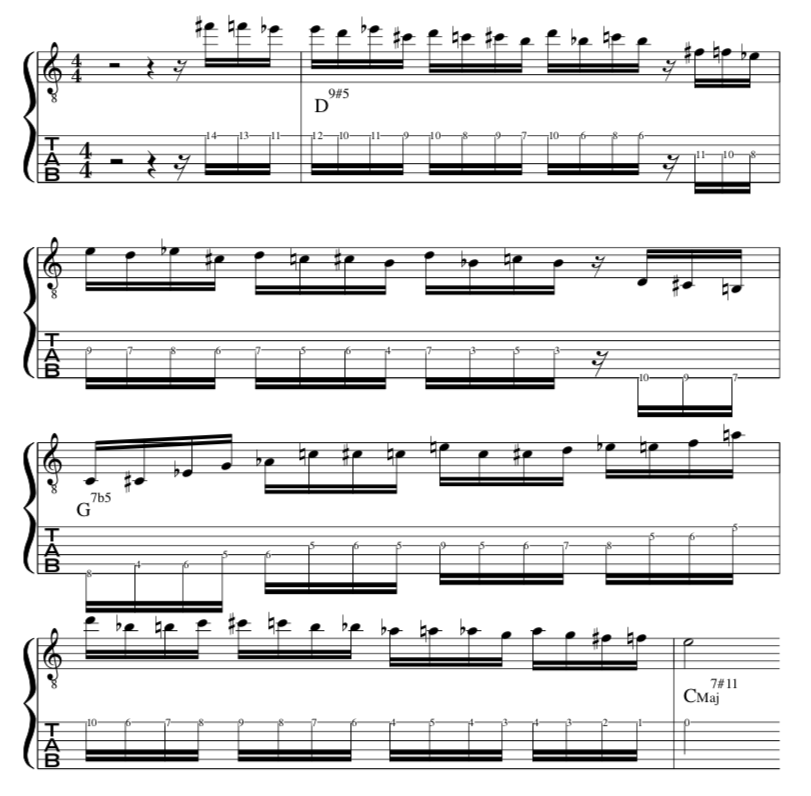
As another idea, there are still useful concepts like “Target Tones”. These can be manipulated without resorting to cliches.
Fripp ,Brecker, Mclaughlin chromatic Improvising method for jazz fusion improvisation
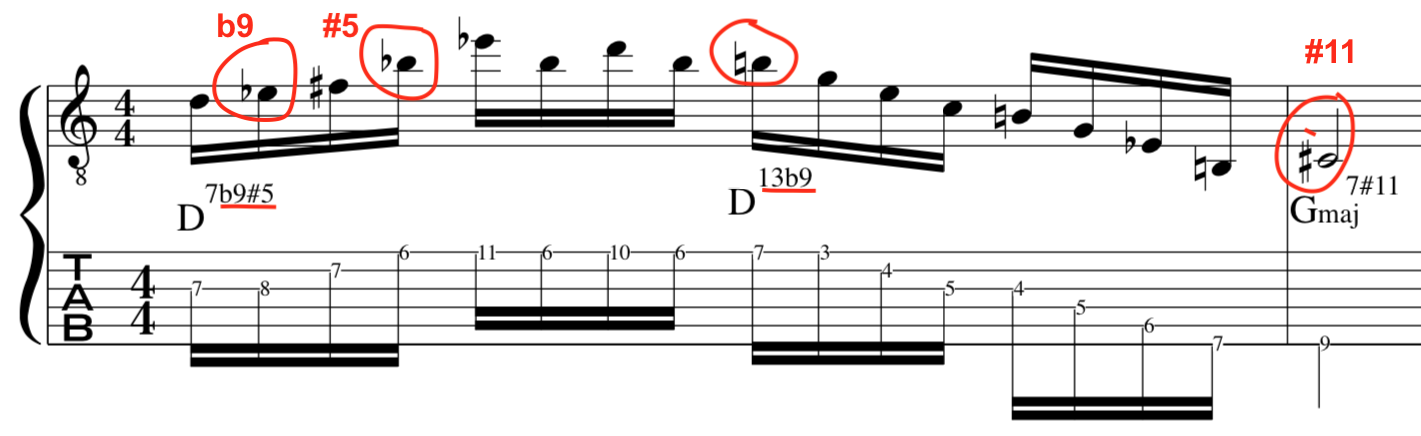
Lastly we will exploit the use flat 5 concepts. In this case there is an Abmaj7/D and a Cmaj7/F# with which we can be creative.
Fripp ,Brecker, Mclaughlin chromatic Improvising method for jazz fusion improvisation
Thanks for viewing this blog. Please SUBSCRIBE to us on Youtube below!