Hexatonic Scale building from the Harmonic Minor Scale Part 1

John McLaughlin Hexatonic Harmonic minor Guitar Scales Lesson and Explanation

Hi Guys,

Today, a quick look at creating a 6 note Hexatonic scale from the harmonic minor scale.

This works really well on the guitar as the harmonic minor scale is generally a clumpy and awkward affair in regards to the fingering.

So, if we take a look at the Harmonic minor scale in its classic, stock form, we have:
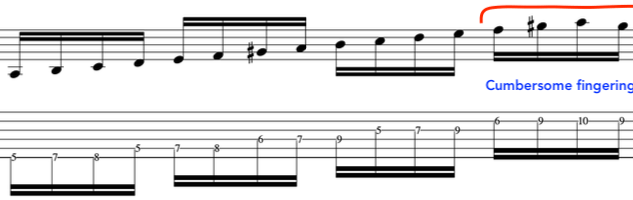
But, for effective guitar fingering, especially on a clean guitar or acoustic guitar this is not the most fluid way for the fretting hand.

Well, the key is to break it up in the most Shakti way possible:

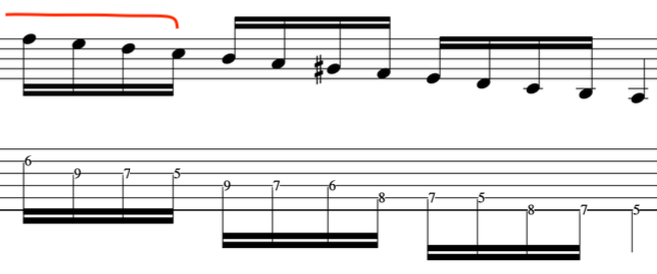
Here’s what we will do: We will employ 6 notes only of the scale. These will be: G# A B D E F
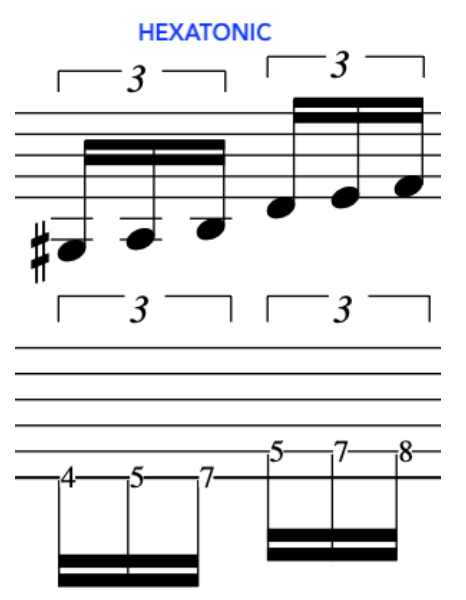
Musical notation illustrating a hexatonic scale built from the harmonic minor scale for music theory.
Hexatonic scale diagram with notation showing finger placements for guitar.

This simple 6 note Hexatonic scale gives us an easy 3 notes per string repetitive figure/pattern to alternate pick.

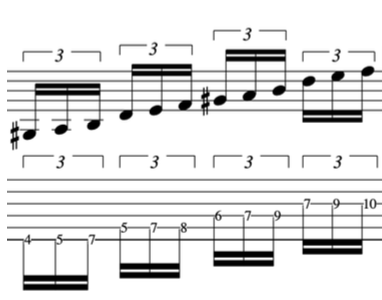
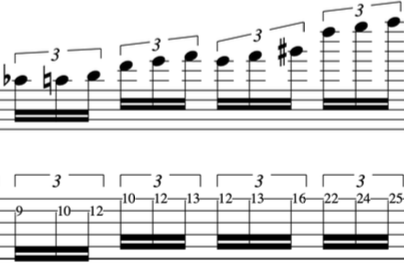
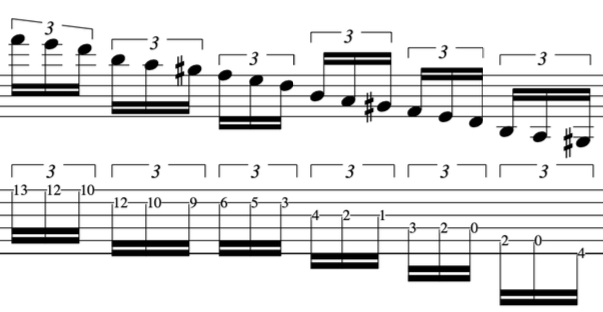
We can now play this across all 6 strings and create a nice line/phrase/scale that is easy to execute, pick and fret.

Sheet music displaying musical notes and tablature for a hexatonic guitar scale built from the harmonic minor scale.
Notated example of ascending and descending patterns for the Hexatonic scale on guitar.
Sheet music featuring a sequence of musical notes form the hexatonic harmonic minor scale.
Hexatonic scale notation for guitar, showcasing ascending and descending patterns.

Way 1:

Sheet music featuring guitar tablature and standard notation, for the hexatonic guitar scale built from the harmonic minor scale.
Musical notation illustrating the descending pattern for the Hexatonic scale in harmonic minor.

WAY 2:

Sheet music displaying John McLaughlin's hexatonic guitar scale built form the harmonic minor scale
Notation for the Hexatonic scale, illustrating finger placement and notes on guitar.

In Part 2 we will look at composition and improvisational techniques with the Hexatonic.

McLaughlin-esque ii V7 I Alt Guitar Line [140 Bpm]

CLICK SUBSCRIBE!

John McLaughlin-esque ii V7 I Alt Guitar Line [140 Bpm]

Please watch video above for detailed info:

Hi Guys,

Today, a quick ii V7 I McLaughlin-esque lick

This is at 140 Bpm with an altered approach to harmony with strict alternate picking guitar technique.

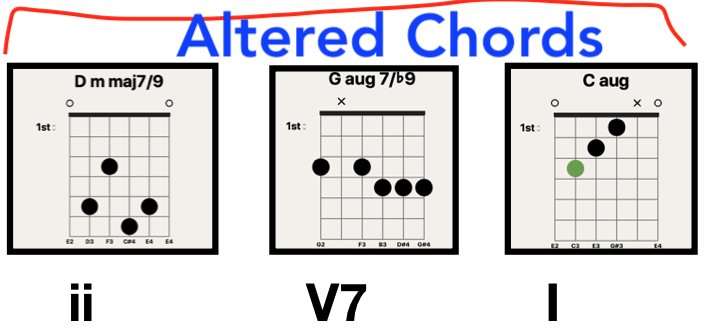
The chords are as follows.

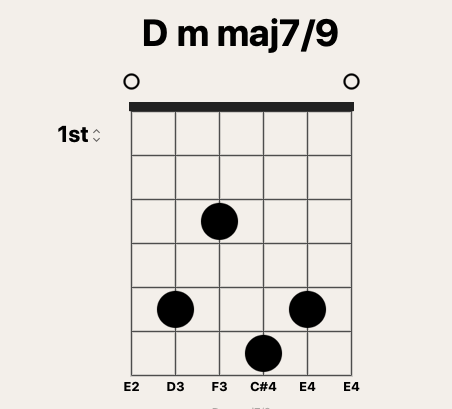
For the ii minor chord I employ a minor chord with a Major 7th and an added 9th.

mclaughlin-altered-harmony-guitar-theory

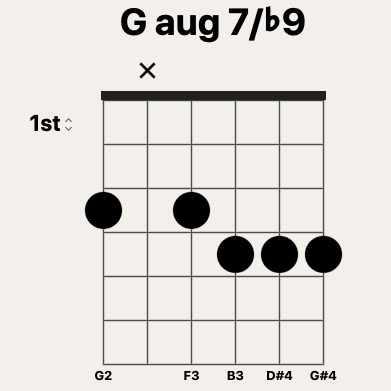
For the V7 chord I raise the 5th [#5] and add a flattened 9th note.

mclaughlin-altered-harmony-guitar-theory

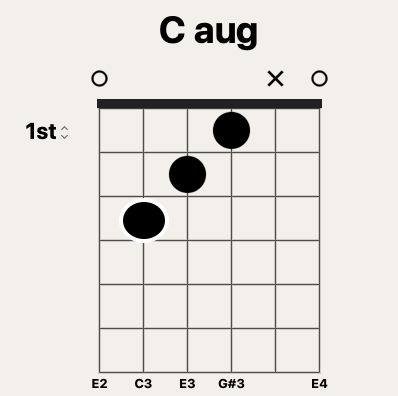
And for the I chord I make this augmented by raising the 5th.

So, the ii V7 I becomes harmonically altered and creates an interesting sound

john-mclaughlin-altered-harmony-guitar-theory

Guitar Line

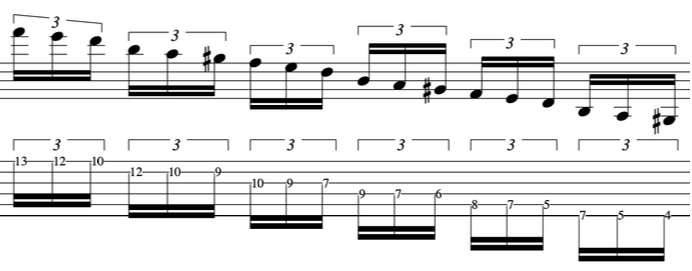
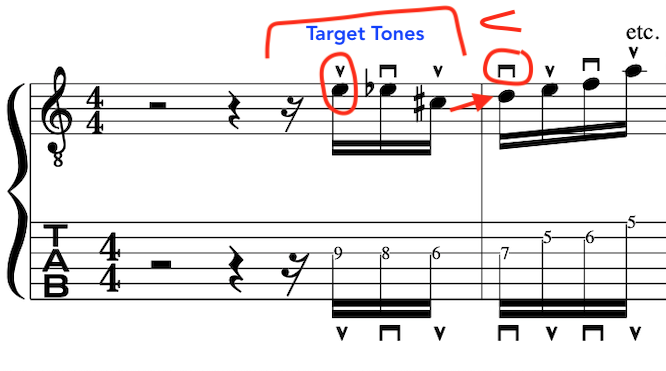
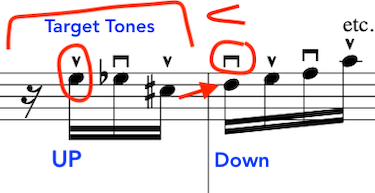
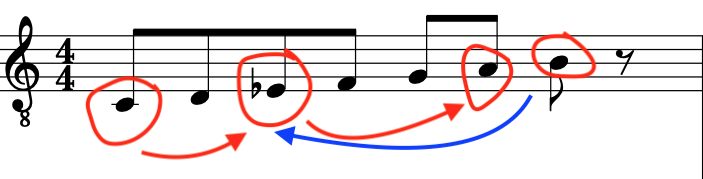
The line starts on an upbeat with 3 target tones that deliberately set up the 1st note of bar one. This adds forward momentum and adds a colourful chromatic set-up.

mclaughlin-altered-harmony-guitar-chromatics-lesson

The target tones start on an “Up stroke” so that on the first beat of bar one you will land and start a “Down stroke”

mclaughlin-alternate-picking-guitar-how-to

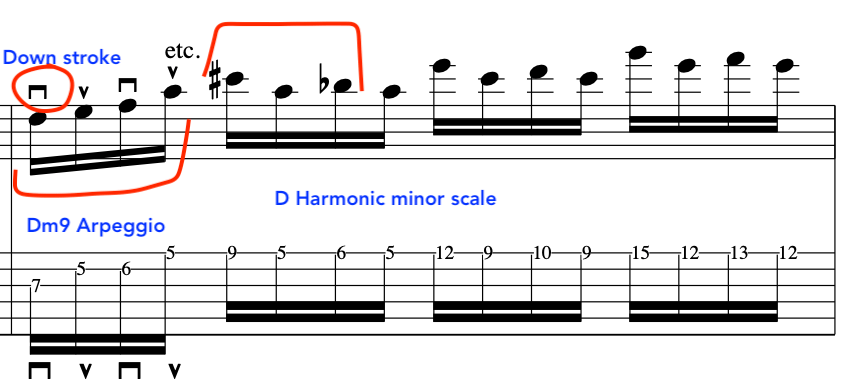
Over the DmMaj7/9 chord I start with a Dm9 arpeggio and then exploit the D Harmonic minor scale by ascending in fragments.

mclaughlin-altered-harmony-guitar-improvisation-theory

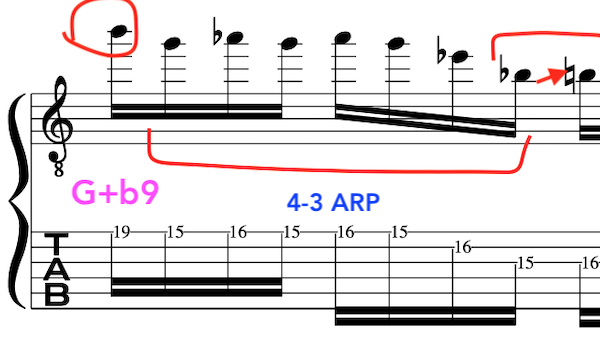
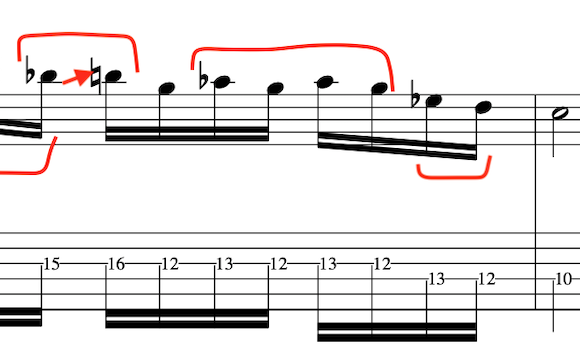
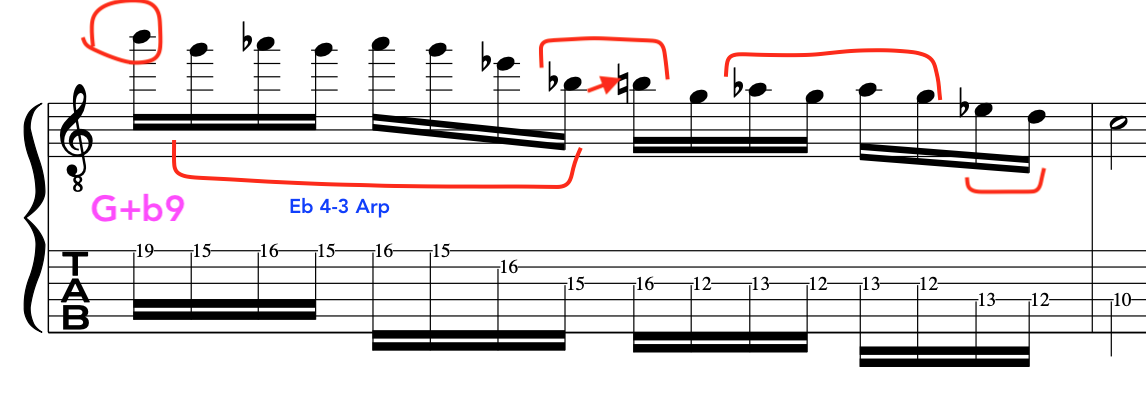
Over the G+b9 chord I start on the third note B and then play an Eb 4-3 arpeggio.

mclaughlin-guitar-music-theory-improvisation

The Bb from this arpeggio then moves up to the B natural and then I play the b9 to tonic and #5 to5 which then finally moves down to the note C for the tonic of the next chord C+.

mclaughlin-guitar-music-theory-improvisation

Whole Bar:

John-mclaughlin-altered-dominant-guitar-improvisation-theory

PDF DOWNLOAD:

IF THIS LESSON WAS OF USE TO YOU THEN PLEASE SUBSCRIBE TO US BELOW ON YOUTUBE, THANKS!

Creating “Scales” from Scales Tetrachords [C melodic minor]

yt_logo_rgb_light

CLICK SUBSCRIBE!

Creating “Scales” from Scales Tetrachords [C melodic minor]

PLEASE WATCH VIDEO ABOVE FOR DETAILED ANALYSIS:

Hi Guys,

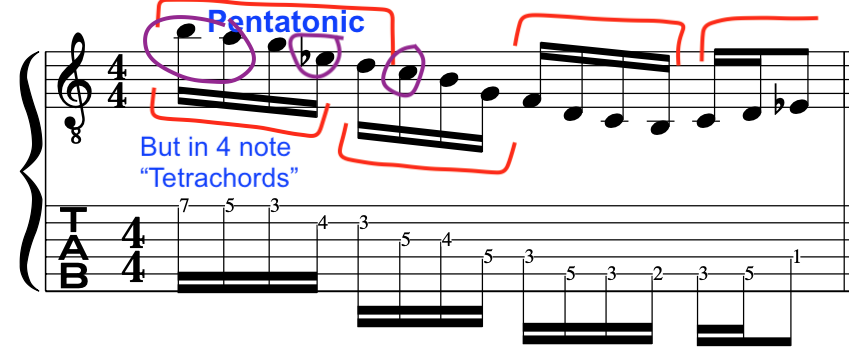
The key to making scales from scales wether they be Triadic, Tetrachord, Pentatonic or Hexatonic is to highlight the key notes that give that scale its unique flavour/sound:

Below we can see this in the C melodic minor scale.

how-to-create-scales-jazz-music

The crucial Eb note and B natural note against the C root note tells us that this is not major and that it has a specific vibe/atmosphere to it.

In this first example we will employ 3 notes and 2 notes for highlighting: This employs alternate picking starting on an upstroke:

how-to-create-scales-jazz-music

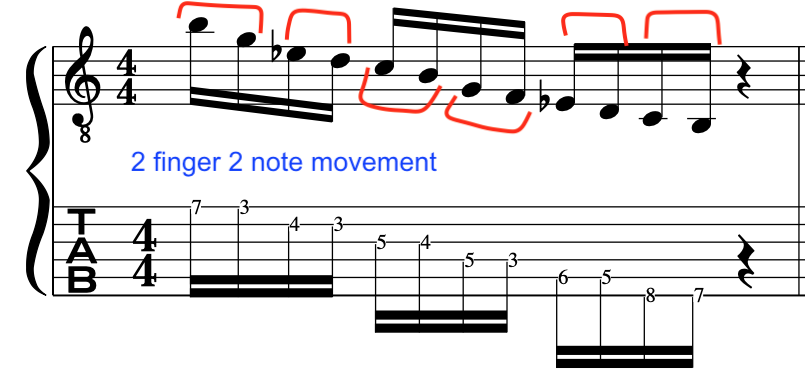
This next example starts on a “Downstroke” and is even simpler. This is a simple 2 note fingering into a 2 note scale.

how-to-create-scales-jazz-music

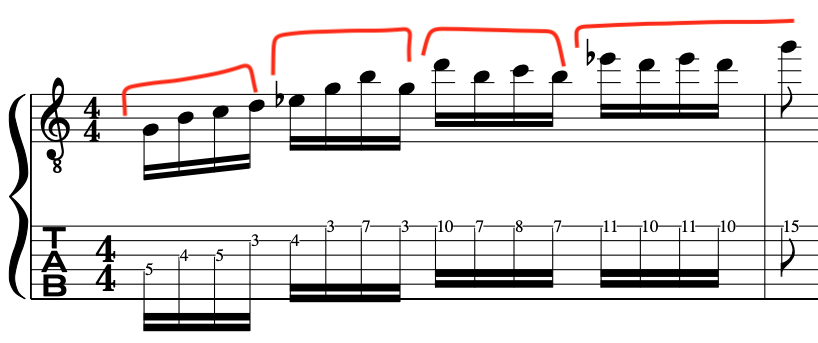
Now let’s create an ascending line:

how-to-create-scales-from-scales

HARMONIC MINOR

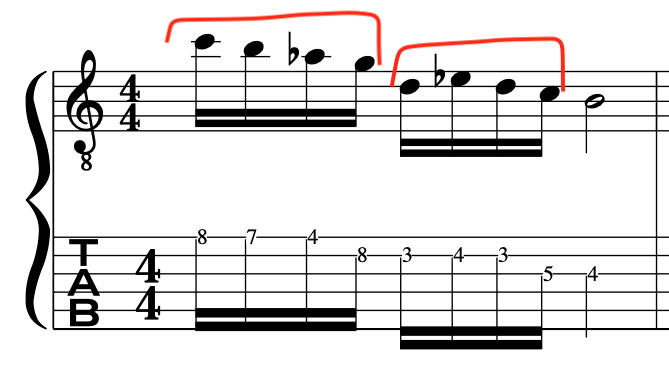
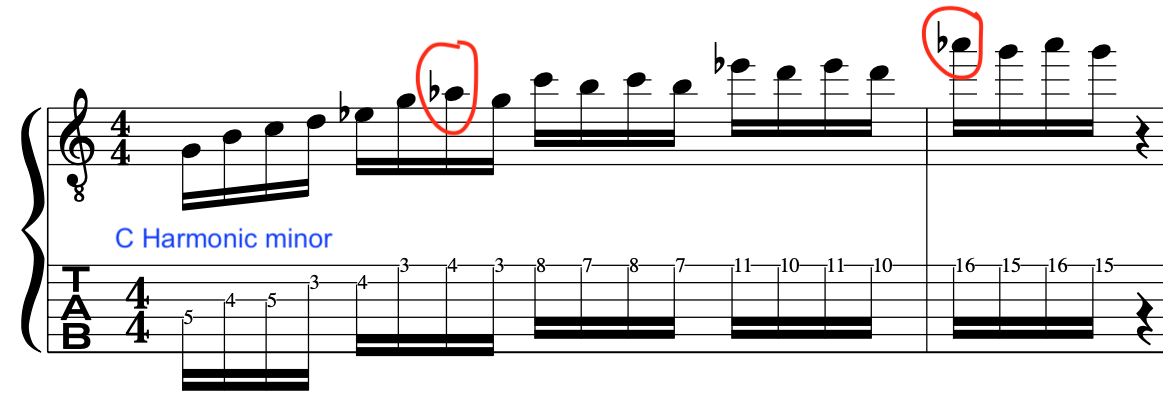
Next we will add an Ab and make 2 Tetrachord scales from C Harmonic minor and create a little run:

how-to-create-scales-tetrachords-example

This time we will ascend with the C Harmonic minor scale:

how-to-create-scales-jazz-guitar

LASTLY

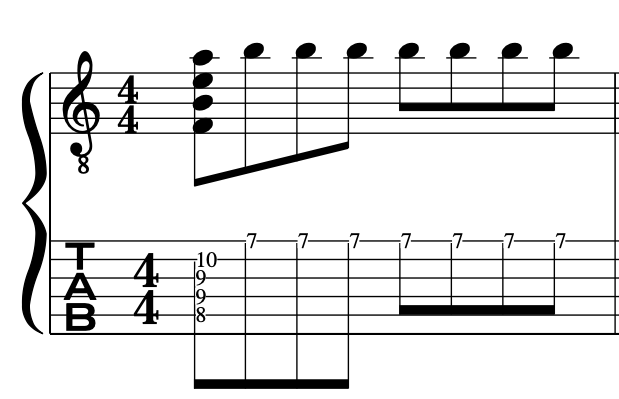
It’s also a good idea to play the key chord of a scale and then pluck the key note or notes that give that scale it’s unique flavour.

For example below is an F Maj7#11 chord that when you pluck the B natural it really stands out as Lydian:

how-to-create-scales-jazz-guitar

IF THIS LESSON WAS OF USE TO YOU THEN PLEASE SUBSCRIBE TO US BELOW ON YOUTUBE, THANKS!