
Please watch video above for detailed info:
Hi Guys,
Today, a look at playing through a Vi ii V7 I Turn around/Cadence at a quick pace/tempo.
This is in the style of Don Mock, Pat Martino and John McLaughlin. So, this employs the alternate picking guitar technique.
PART 1:
In order to achieve our goal, we will exploit pentatonic fragments and connect them together in four note groupings.
This also means that we can make use of simple guitar fingering and hence pick quick rapid phrases.
Here, is the chord sequence:

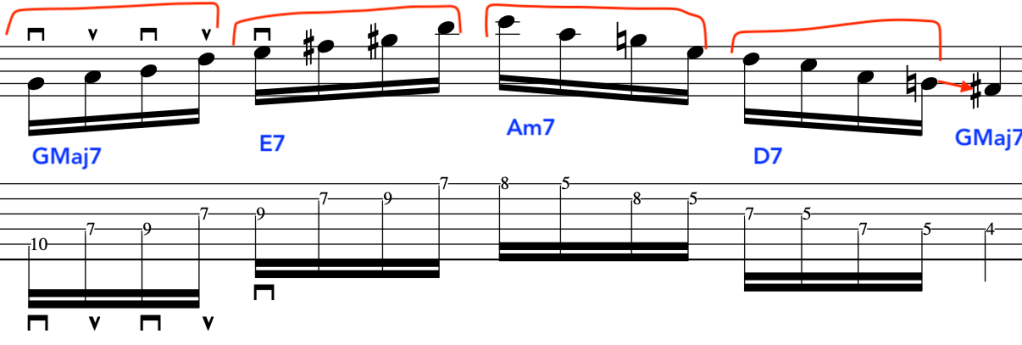
Now, we will solo through the first two chords of I VI [Chord VI as a Domoninat 7th]
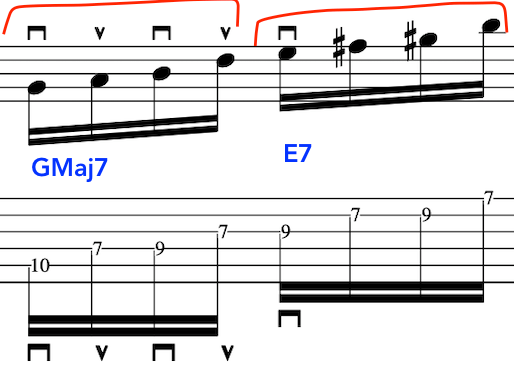
Starting, on a down stroke with alternate picking, we can see how easy it is to connect these simple pentatonic’s together through the two chord changes.
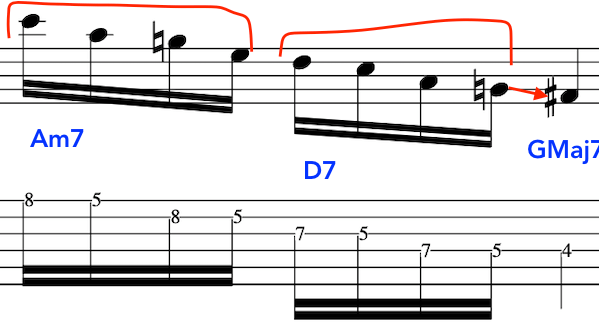
Now, let’s connect the pentatonic’s over the next two chords in the same manner. [Notice the G to F# resolution for Gmaj7]
PART 2:
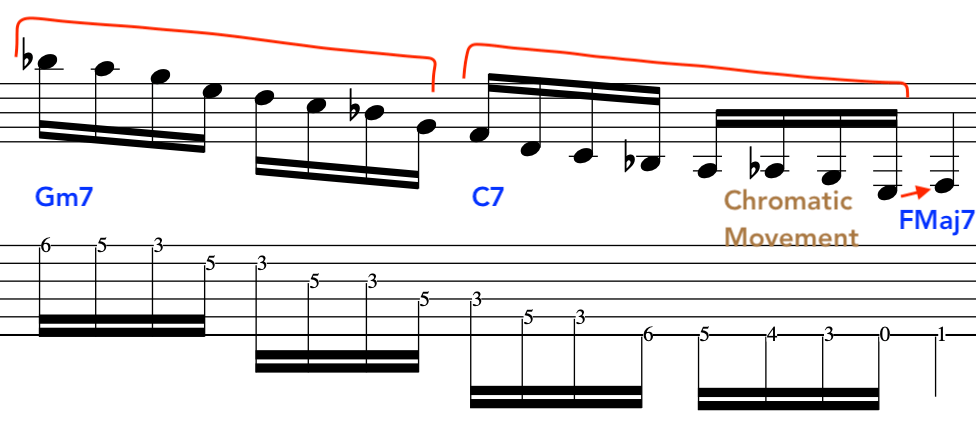
Having completed our Turnaround, let’s cadence this to a new key: This will be F Major.
To do this, we will make the G Major 7th chord, minor, to G minor 7th.
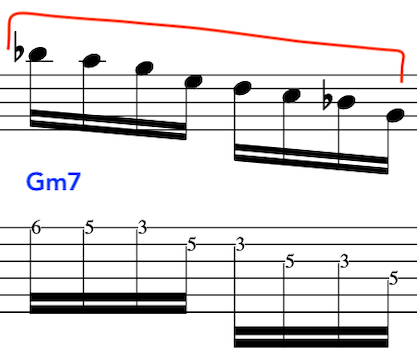
From here, we will carry this pentatonic scale/line along and play it over the next chord.
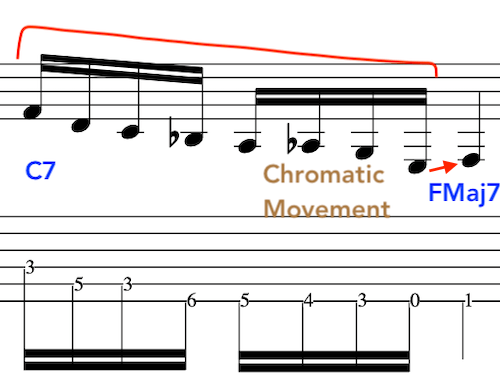
This will be the Dominant chord of C7 [or chord V leading to/of the new key F Major].
Notice: the use of a few chromatic notes to fill out the pentatonic scale/line.
PART 3:
Full Turnaround/Cadence:
This, was just a quick look at how easy it is to connect long lines together through very quick chord changes, especially, at the guitar with alternate picking technique.
It’s amazing the amount of chords we can play through fluently and quickly with this simple pentatonic four note [tetrachord] approach when improvising.
This short blog/lesson was just touching the surface. But, it does still give quite a comprehensive view of what can be achieved with this approach.
It’s a good idea to apply this method to any quick chord changes that you can find [e,g “Giant Steps”] and try this.
PDF DOWNLOAD:
If this Lesson was of use to you, then please SUBSCRIBE to us on YOUTUBE below, Thanks!