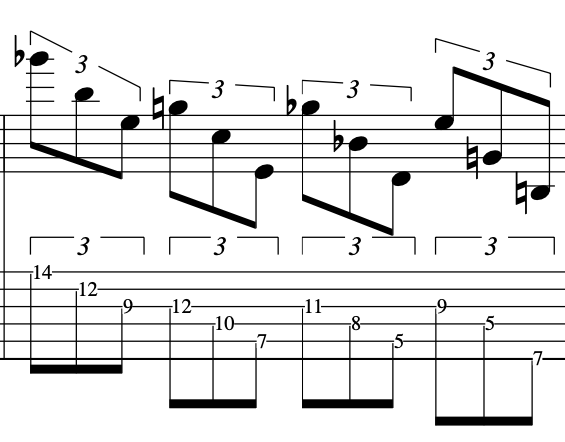
Exploring the Minor Flat 6th Chord in Modern Music:Jobim/Piazolla

Hi Guys,

Today, a look at the amazing minor flat 6th chord as used in the compositional styles of Carlos Jobim, John McLaughlin, Astor Piazolla and Al Di Meola.

Most people seem to have a preference for the minor 6th chord, [which in this case has the F# or the Major 6th].
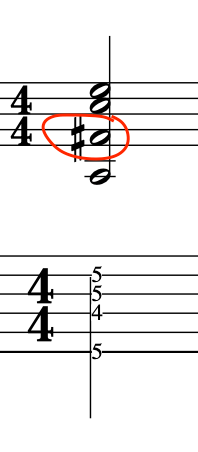
Musical notation showing a chord structure of A minor 6th, highlighting the major 6th note in red.

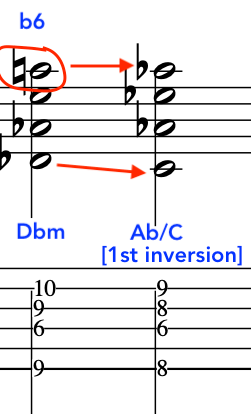
But, the minor flattened 6th chord [F natural in this case] has an amazing character of its own, [especially when it resolves to the first inversion, as we will see].
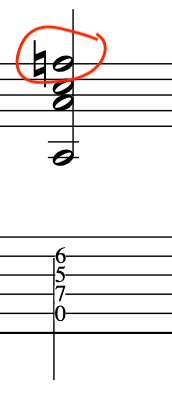
Musical notation showing a minor chord with a highlighted flattened 6th note.
Musical notation showing a Db minor flat 6th chord resolving to an Ab Major chord in first inversion, highlighting the flattened 6th note.
Illustration of the Db minor flat 6th chord to 1st inversion Ab Major chord, highlighting the flattened 6th note.
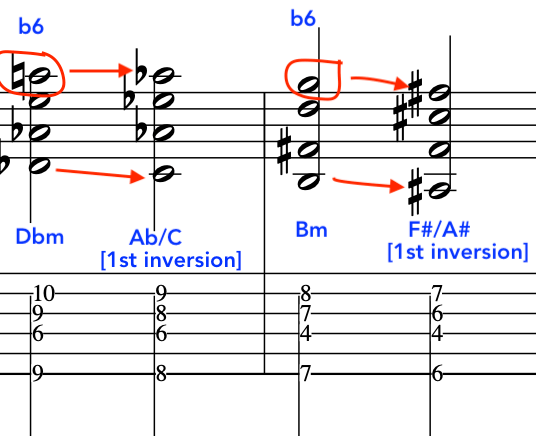
Sheet music showing a D flat minor flat 6th chord resolving to a first inversion A flat major chord, and B minor chord, with annotations indicating flattened sixth notes and first inversions.
Diagram illustrating the transition from Db minor to Ab major first inversion, highlighting the flattened 6th note.

Let’s now add some more first inversion chords:

Here, we employ F#m/A with the bass resolving a half step down to the G # note.

Once again, we have a wonderful melodic transition, this time going to the E first inversion chord.
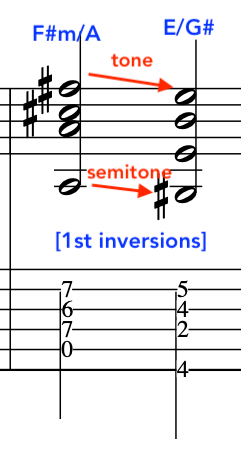
Musical notation showing first inversion chords F#m/A and E/G# with indicators for 'tone' and 'semitone' resolutions
Illustration of F#m/A and E/G# first inversion chords highlighting tone and semitone relationships.

In order to move away from cliche-dom we will now alter the harmony a bit.

Here, we will add a chord of D9/F# [1st inversion] and let the bass move down a semitone to a chord of F7 [but with a Maj7th also and a #11th].
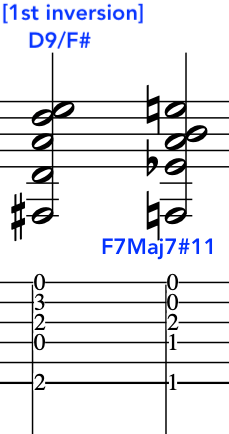
Musical notation showing D9/F# chord in first inversion and F7Maj7#11 chord for altered  harmonic cadence
Chord diagram illustrating the first inversion D9/F# and F7Maj7#11 chords

To complete this example, we will exploit chains of 7 Sus4 chords: Here, are the first three chords moving up in semitones.
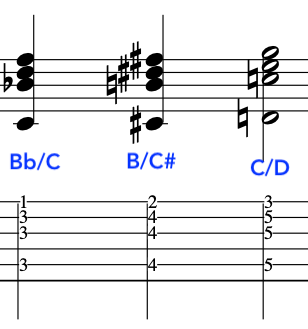
Music notation showing how to use 7sus4 chords  Bb/C, B/C#, and C/D chords.
Illustration of 7sus4 chord transitions in semitones, featuring Bb/C, B/C#, and C/D for musical composition.

Here are the next three chords moving up in semitones :
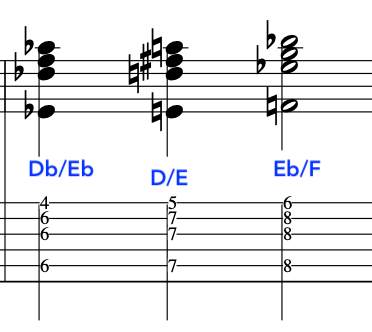
Musical notation showing 7sus4 chords Db/Eb, D/E, and Eb/F with corresponding finger positions.
Chord progression analysis showcasing 7sus4 chords Db/Eb D/E Eb/F

Finally, we come to a conclusion and rest on an E/F# Chord, up a semitone once again.
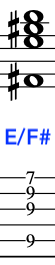
Musical notation displaying the 7sus4 chord E/F# with labeled fret positions on a guitar neck.

Schoenberg’s chord of the 15th-Music Examples and Analysis

Hi Guys,

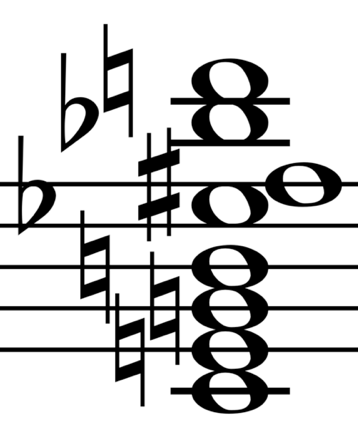
Today, a look at the final chord of Arnold Schoenberg’s “Sechs Kleine Klavierstucke” 2nd movement.  In thirds this reads as: C–E–G–B–D♯–F♯–A♯–Cx.

schoenberg_chord_music_analysis_extended_15th_in_music

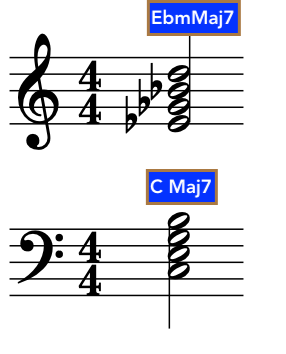
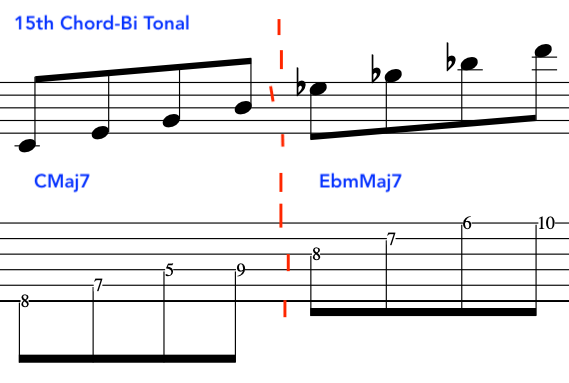
This extended chord of a 15th, can also be viewed and heard as a bi-tonal construction of C Major 7th with Eb minorMajor 7th superimposed on top

schoenberg_chord_music_analysis_extended_15th_in_music

This can also, be thought of [especially in terms of the guitar] as an arpeggio of CMaj7 and an Arpeggio of EbmMaj7.

schoenberg_chord_music_analysis_explained_15th_in_music

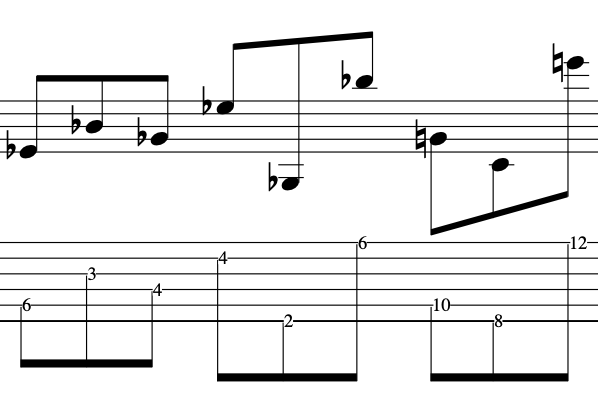
Due, to the nature of its sound and collection of notes, it can produce some interesting counterpoint. Especially, as the Eb to E natural resolution creates colour and drama. [view video at top of page].

schoenberg_chord_music_analysis_extended_15th_in_music_guitar

Being, a Bi-Tonal chord it is useful as it gives us triad pairs.

schoenberg_chord_music_analysis_extended_15th_in_music_guitar

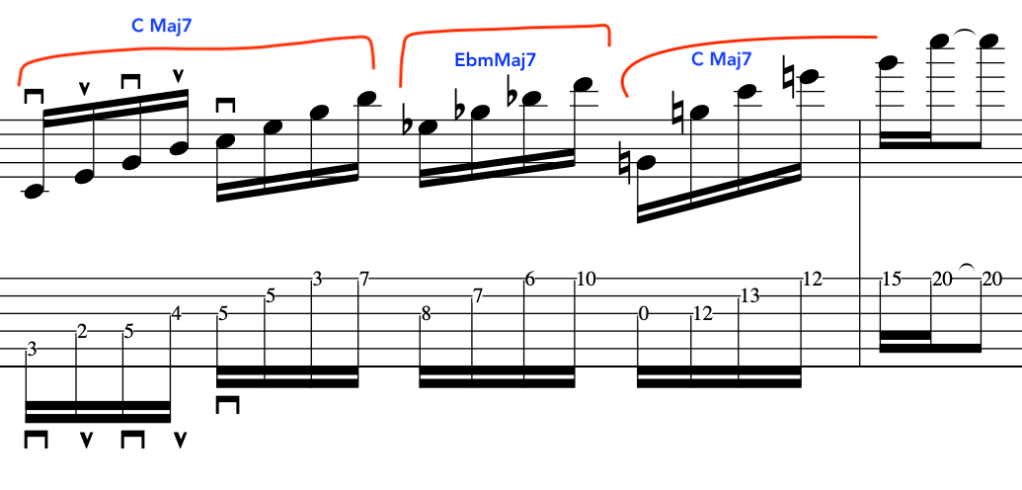
Ascending Line:

schoenberg_chord_music_analysis_chord_pairs_guitar

Now, we will take this a stage further by adding more chords/triads available.

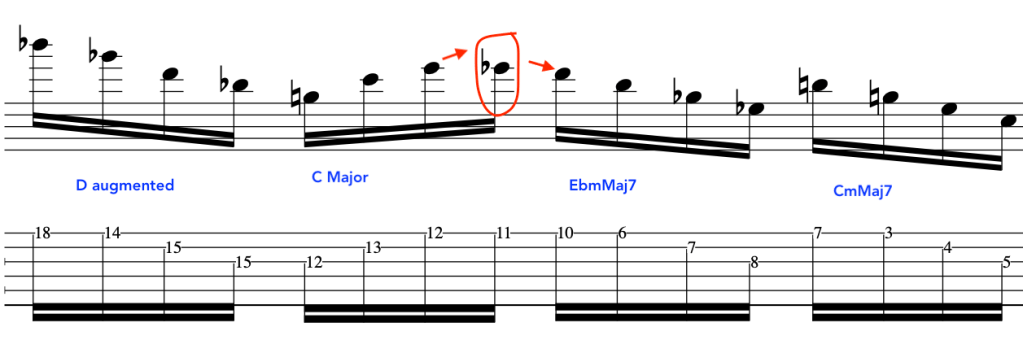
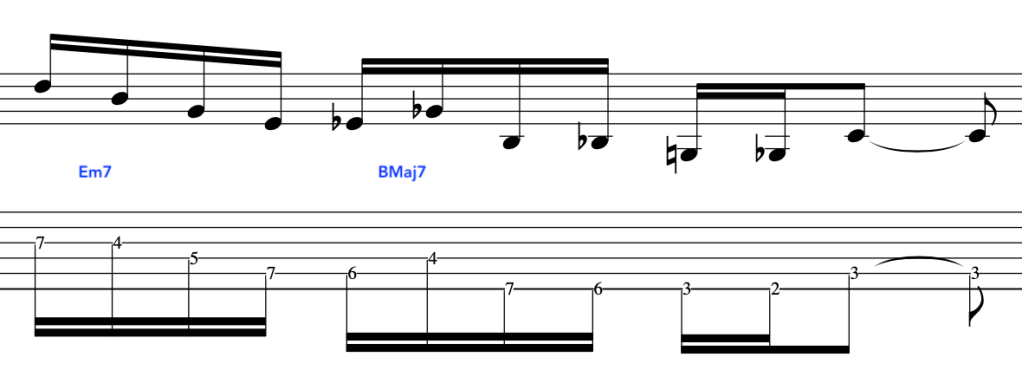
D+ to C to EbmMaj7 to CmMaj7 to Em7 to Bmaj7

schoenberg_chord_music_analysis_chord_pairs

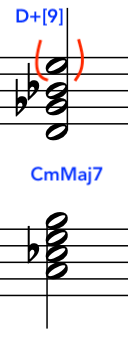
Let’s now, re voice the chord. Here we will make the chord of C a minMaj7 and add D Augmented [9th] on top.

schoenberg_chord_music_analysis_extended_15th_in_music

In the video/audio [a quick demo I created] below, we can hear the dramatic sound of this voicing in the orchestra.

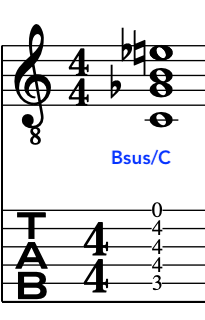
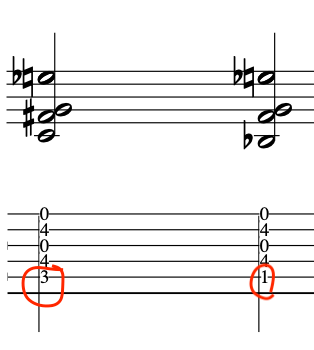
Next, we have two guitar voicing’s. Firstly we have a Bsus/C [or plain B/C] as a typical McLaughlin guitar voicing.

schoenberg_chord_music_analysis_extended_15th_in_music_mclaughlin_guitar

Secondly, we have the same voicing but with a changing bass.

schoenberg_chord_music_analysis_extended_15th_in_music_guitar

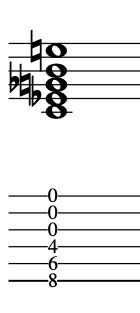
Lastly, another guitar voicing that is useful for chordal picking:

schoenberg_chord_music_analysis_extended_15th_in_music_guitar

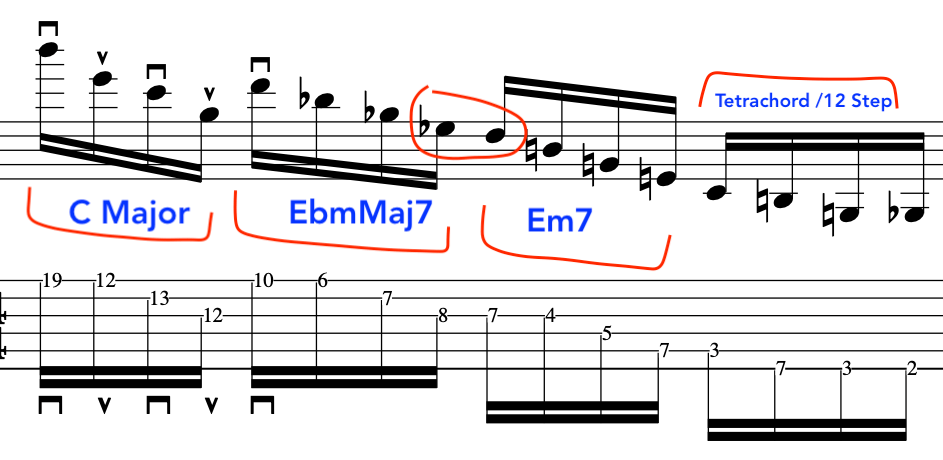
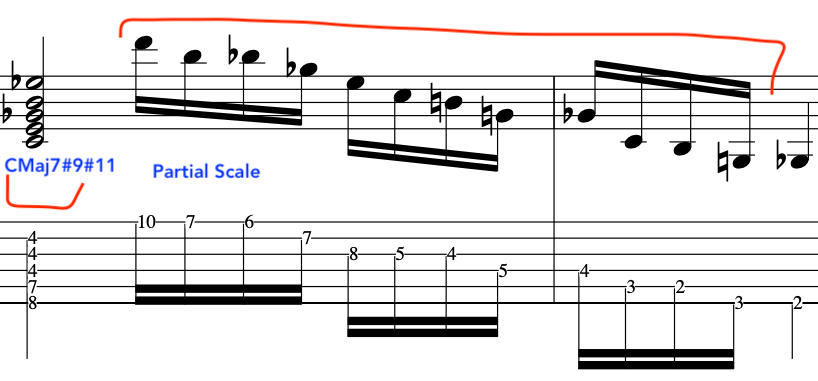
From here, we will add a partial scale descending that is formed from the chord: This chord voicing has a flattened 5th and a sharpened 9th.

schoenberg_chord_music_analysis_extended_15th_in_music_guitar

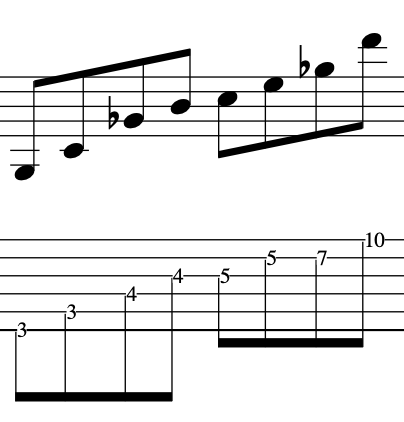
Lastly, we can create some interesting and colourful passages by exploiting the intervals inherent within this 15th chord.

schoenberg_chord_music_analysis_extended_15th_in_music_intervals

Arnold_Schoenberg's_chord-of-the 15th_analysis_music_theory