
Please watch video above for detailed info:
Hi Guys,
Today, a quick look at the fretting hand and fretting notes “Safely”and easily on the guitar.
This is essential to ensure a relaxed hand, relaxed elbow and relaxed shoulders that are aligned and in sync with the right alternate picking hand at uptempo BPM’s.
PART 1:
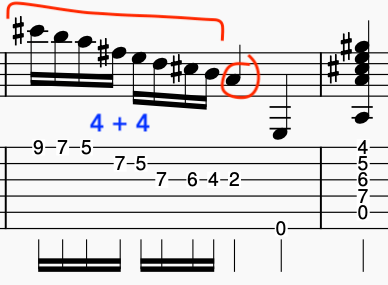
To begin with, let’s take a simple 5 note prime number pattern and alternate pick it.
This will be done starting on an upstroke.
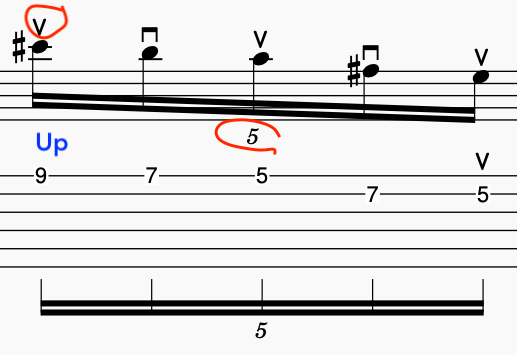
From this simple 5 note pattern, we can move the fretting hand quickly avoiding pressure on the tendons.
Now that we have this let’s add another 3 note prime number pattern.
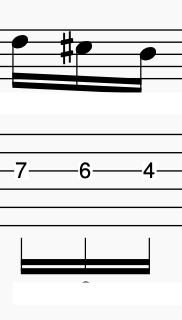
When these are connected together we have a “Smooth” little phrase of picking and fretting in sync.
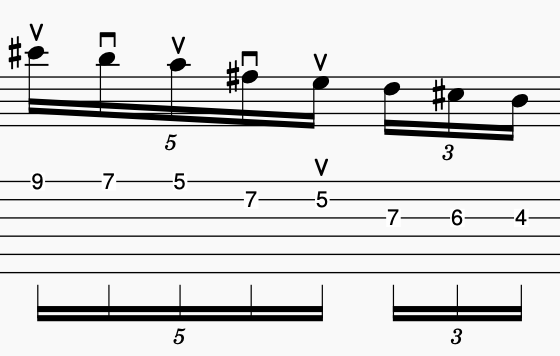
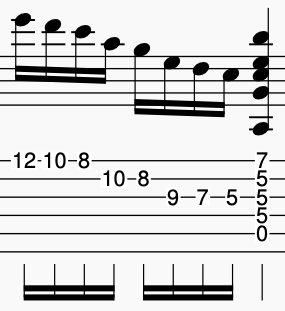
Now, let’s turn the 2 prime number patterns into “Standard” music notation – as 16ths.
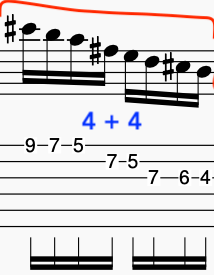
From here, let’s add a chord, so that what we have starts to become/sound like music:
PART 2: Ascending/Descending:
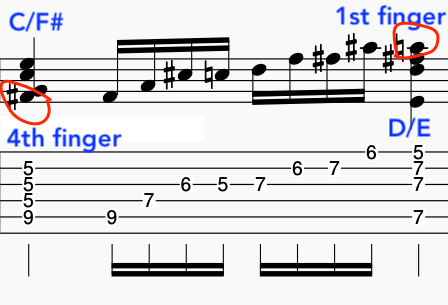
In this example, we will start with a chord and then comfortably play off of that chord ascending and descending into the next chord.
As you can see we have what looks like a bit of a stretch.
But, it is only a barred 2nd inversion C Major triad, with an F# note in the bass on the 4th finger.
The point here is that from that F# note we will start the alternate picking line from that 4th finger as it is already in position.
This makes it easy to do and connect to the next chord as the 1st finger will be in position to play the next chord.
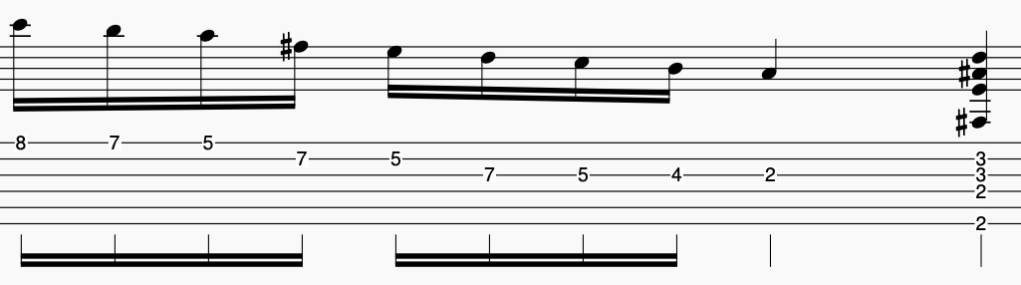
The second part then descends nicely into the last chord of F#+7
PART 3: Ascending 5
Here, is another group of 5 + 3. Again, this is easy to fret and pick, and as before we will start on an upstroke.
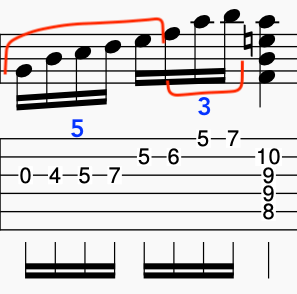
The beauty of this is that when we finish the chord on the downstroke it is natural to then go into the opposite direction and descend into another chord connection.
PART 3: Sextuplets.
Finally, let’s finish with a much favoured guitar picking pattern that encapsulates 6 notes [Sextuplets]
We will employ our 5 note prime number pattern and add 1 note.
This will give us a nice and quick 6 note sextuplet pattern to execute.
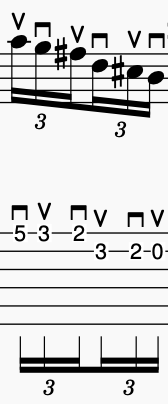
Now, we will shift this up the fretboard as we repeat it.
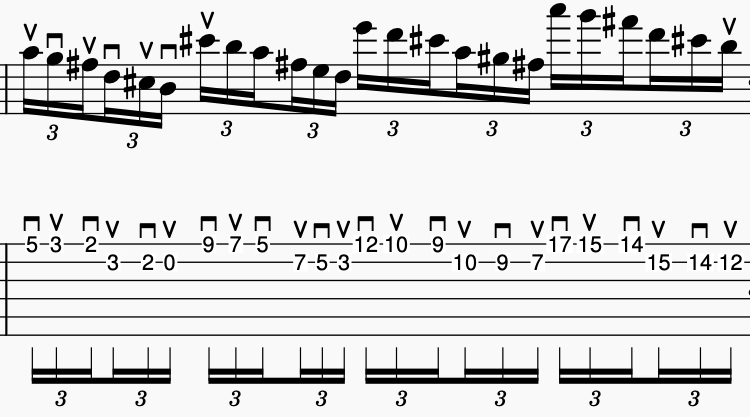
I
FREE PDF DOWNLOAD:
If this lesson was of use to you, then please SUBSCRIBE to us on YOUTUBE below, Thanks!