Lessons from Jazz/World to 20 Century Classical Music Harmony Rhythm and Theory
Category: Jazz fusion guitar music theory lessons, guitar technique and improvisation.
How to improvise over altered dominant chords. How to employ chromatic jazz and fusion harmony. Apply twentieth century classical composition techniques to modern jazz music and improv. How to exploit modes of the major. minor and diminished scales. Lesson in alternate picking guitar techniques as used by John Mclaughlin and Al di Meola. How to do metal rock and all styles of alternate picking on the guitar. Plectrum pick technique for electric and acoustic guitarists. alternate guitar style of picking lessons.
John McLaughlin Hexatonic Harmonic minor Guitar Scales Lesson and Explanation
Hi Guys,
Today, a quick look at creating a 6 note Hexatonic scale from the harmonic minor scale.
This works really well on the guitar as the harmonic minor scale is generally a clumpy and awkward affair in regards to the fingering.
So, if we take a look at the Harmonic minor scale in its classic, stock form, we have:
But, for effective guitar fingering, especially on a clean guitar or acoustic guitar this is not the most fluid way for the fretting hand.
So, what to do?
Well, the key is to break it up in the most Shakti way possible:
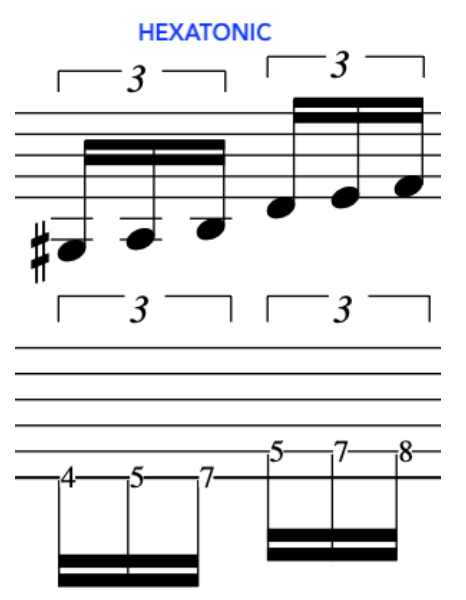
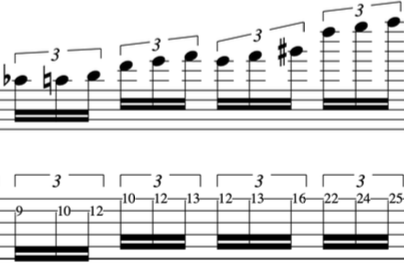
Here’s what we will do: We will employ 6 notes only of the scale. These will be: G# A B D E F
Hexatonic scale diagram with notation showing finger placements for guitar.
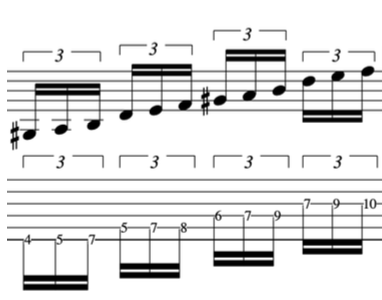
This simple 6 note Hexatonic scale gives us an easy 3 notes per string repetitive figure/pattern to alternate pick.
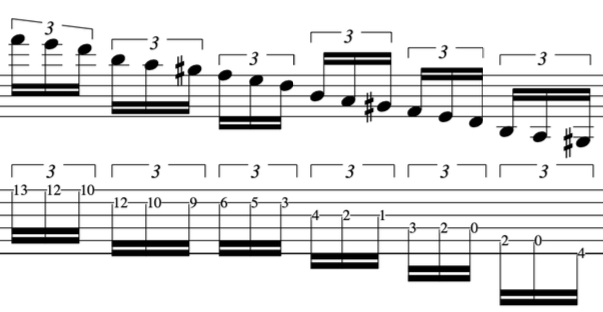
We can now play this across all 6 strings and create a nice line/phrase/scale that is easy to execute, pick and fret.
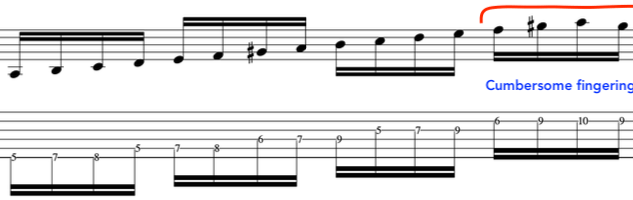
ASCENDING:
Notated example of ascending and descending patterns for the Hexatonic scale on guitar.Hexatonic scale notation for guitar, showcasing ascending and descending patterns.
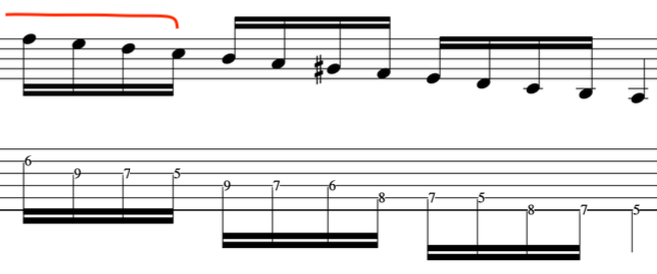
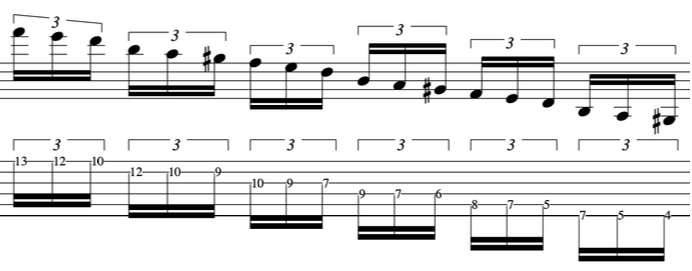
DESCENDING:
Way 1:
Musical notation illustrating the descending pattern for the Hexatonic scale in harmonic minor.
WAY 2:
Notation for the Hexatonic scale, illustrating finger placement and notes on guitar.
In Part 2 we will look at composition and improvisational techniques with the Hexatonic.
Today, a look at John McLaughlin’s emotional and melodic chords for composition and reharmonisation.
PART 1:
The key to both parts of this blog is the employment of the 1st Inversion Major chord and its resonant guitar voicing:
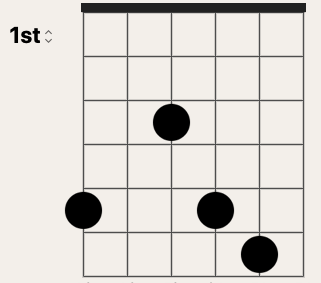
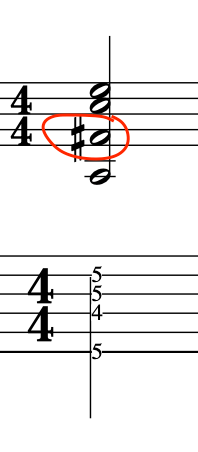
Below, is the key voicing shape: Here, we have F Major as a 1st Inversion [or F/A] voicing:
Diagram showing the F Major 1st Inversion (F/A) chord voicing.
From this, let’s take the sequence from John’s classic “Electric dreams/Electric Sighs” composition.
John’s melodic harmony:
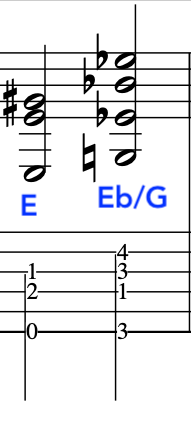
We will start with a basic E Major chord that will then go to an Eb first inversion chord:
Chord progression from E Major to Eb first inversion in a musical notation.
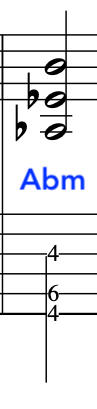
From here, we will resolve this by moving to Ab minor:
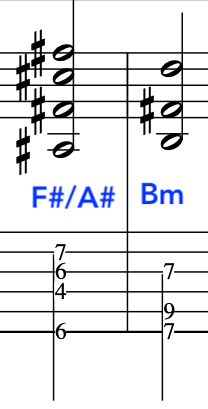
We will now repeat the pattern, and, create an ascending sequence with F#/A# resolving to B minor:
Chord progression featuring F#/A# resolving to B minor, illustrating melodic harmony.
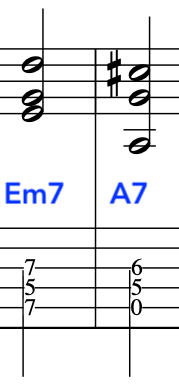
There is now an implied cadence with Em7 to A7. But, this doesn’t Modulate to the key of D,
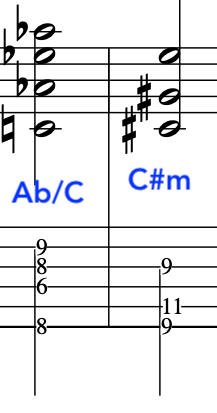
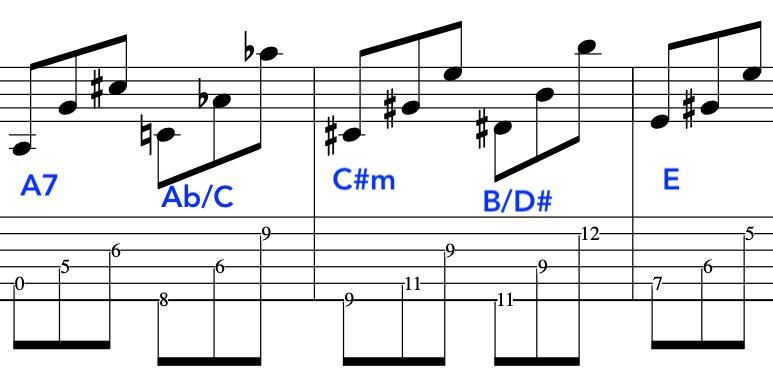
Instead, we carry on with the sequence. This time we employ Ab/C to Db minor[enharmonically C#m]
Musical notation illustrating the Ab/C to C# minor chord transition, highlighting melodic harmony.
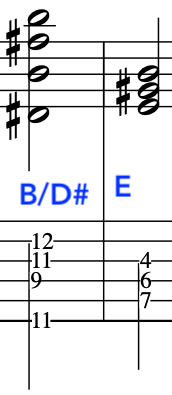
And finally, we do resolve, but, this is back to our tonic chord/Key of E Major.
Musical notation showing a B/D# chord transitioning to an E chord.
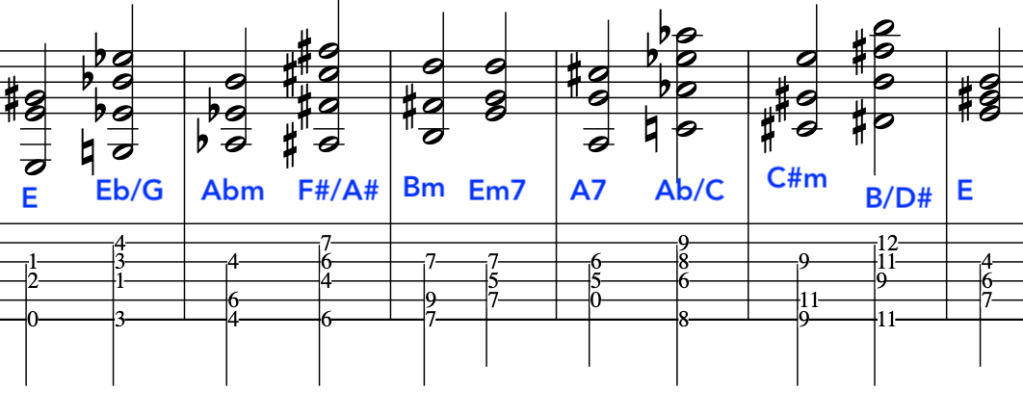
FULL SCORE:
Musical score featuring various chord progressions and their notations for melodic harmony.
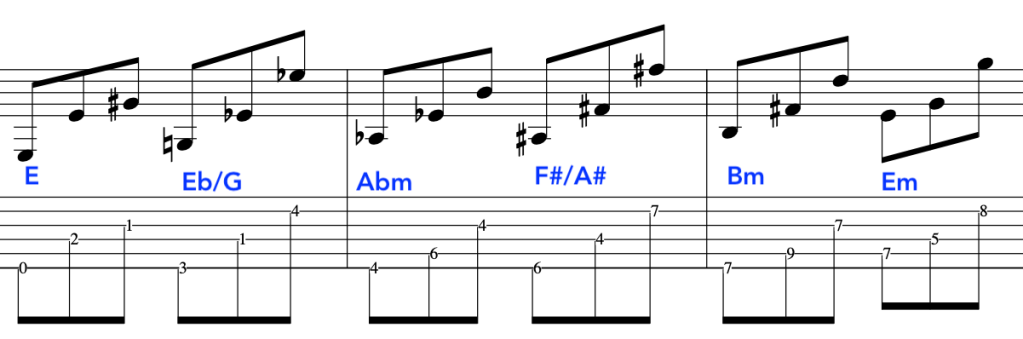
With this type of beautiful, creative, melodic harmony, it’s a good idea to apply arpeggios to underline it and give it movement.
Musical notation showcasing arpeggio chord transitions including E, Eb/G, Abm, F#/A#, Bm, and Em.Musical notation illustrating chord transitions with A7, Ab/C, C#m, B/D#, and E.
PART 2
The minor b6 and First Inversion Chord Relationship:
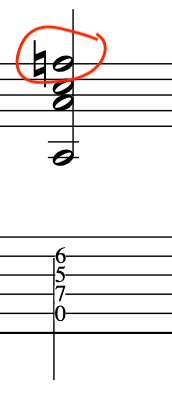
Most people seem to have a preference for the minor 6th chord, [which in this case has the F# or the Major 6th].
But, the minor flattened 6th chord [F natural in this case] has an amazing character of its own, [especially when it resolves to the first inversion, as we will see].
What makes the minor chord with a flattened 6th work really well is to move down to a first inversion chord.
EXAMPLE:
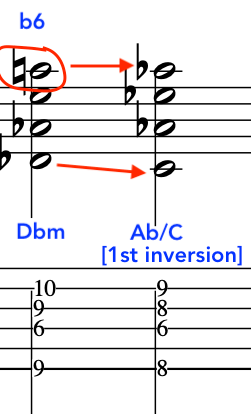
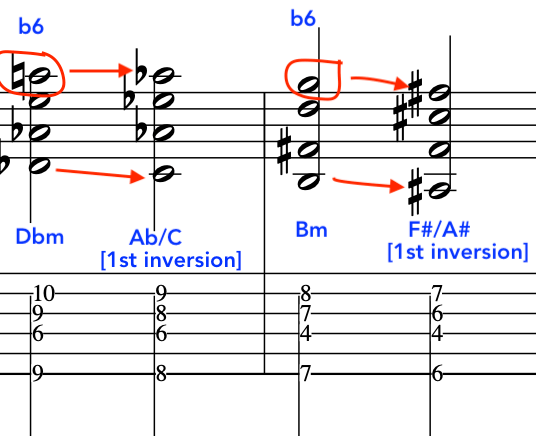
Here, we have a Db minor chord moving down to a 1st inversion Ab Major chord:
Notice the flattened 6th note of A at the top moving down a semitone to the Ab note:
Illustration of the Db minor flat 6th chord to 1st inversion Ab Major chord, highlighting the flattened 6th note.
This smooth chordal transition works beautifully when creating melodic sequences.
Diagram illustrating the transition from Db minor to Ab major first inversion, highlighting the flattened 6th note.
Let’s now add some more first inversion chords:
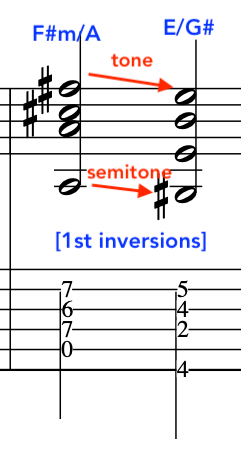
Here, we employ F#m/A with the bass resolving a half step down to the G # note.
Once again, we have a wonderful melodic transition, this time going to the E first inversion chord.
Illustration of F#m/A and E/G# first inversion chords highlighting tone and semitone relationships.
In order to move away from cliche-dom we will now alter the harmony a bit.
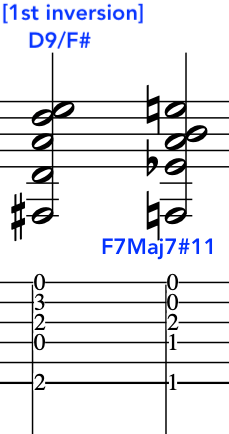
Here, we will add a chord of D9/F#[1st inversion] and let the bass move down a semitone to a chord of F7 [but with a Maj7th also and a #11th].
Chord diagram illustrating the first inversion D9/F# and F7Maj7#11 chords
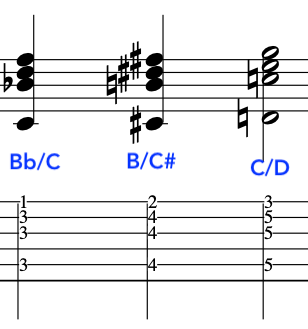
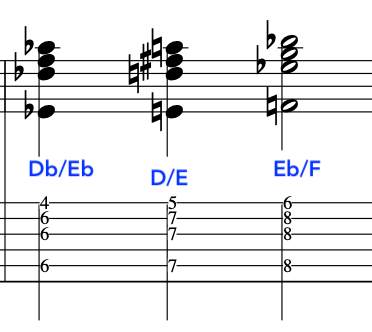
To complete this example, we will exploit chains of 7 Sus4 chords: Here, are the first three chords moving up in semitones.
Illustration of 7sus4 chord transitions in semitones, featuring Bb/C, B/C#, and C/D for musical composition.
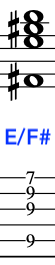
Here are the next three chords moving up in semitones :