How to play Shakti Indian Guitar Scales

Hi Guys,

Today, a quick look at the first of a few Shakti Indian guitar scales for tabla and guitar improvisation.

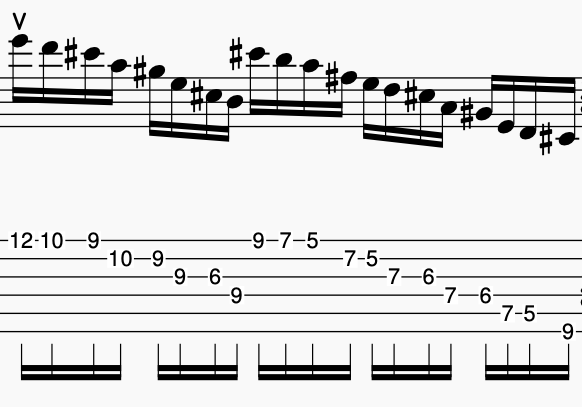
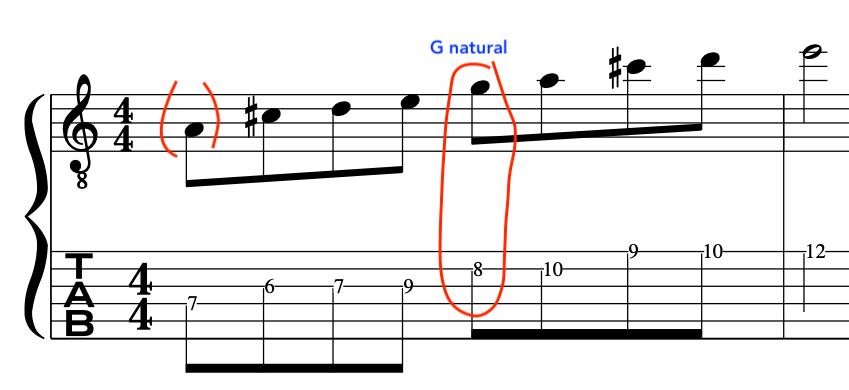
The first one that we will look at today is the A Mixolydian Mode exploited in a pentatonic form.

Here, is the basic scale ascending. The G natural gives the unique flavour and colour as it possesses the dominant sound, but, in a non resolving from.
how_to_play_shakti_indian_guitar_scales_lesson

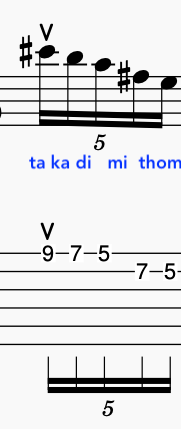
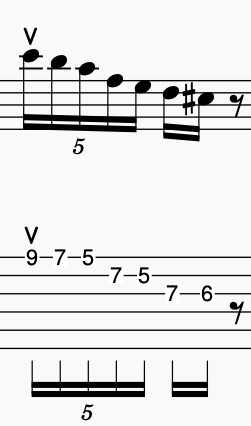
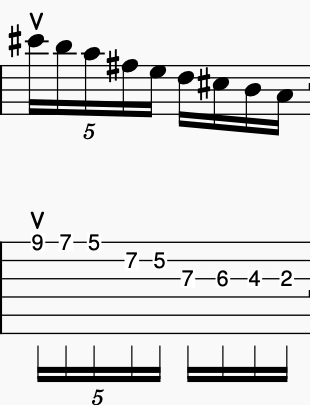
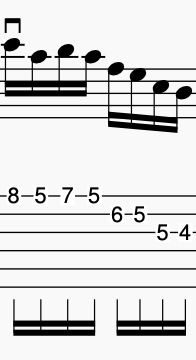
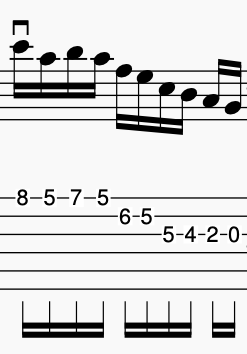
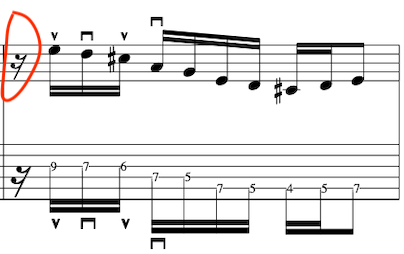
In this first exercise we will descend with the A mixolydian mode and employ imitation with the pentatonic form.

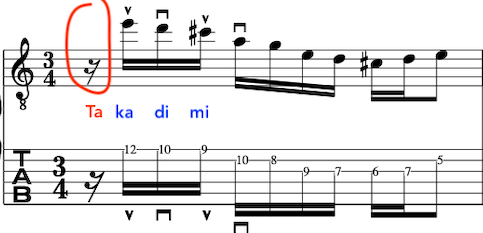
This example exploits strict alternate picking guitar technique. And, it works really well for two reasons:

A] It start on an “Up stroke”

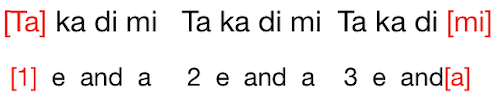
B] It starts in the bar and on the “Off” beat

This creates a nice, smooth phrasing and is easy to copy and repeat down the octave.

how_to_play_shakti_indian_guitar_scales_lesson

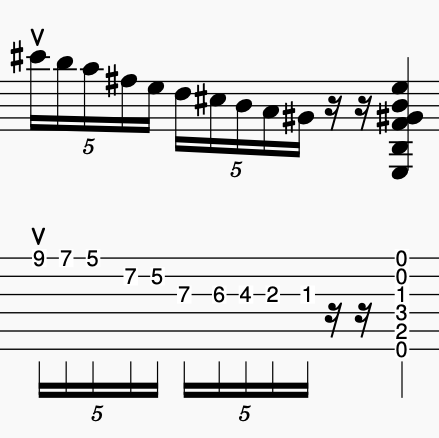
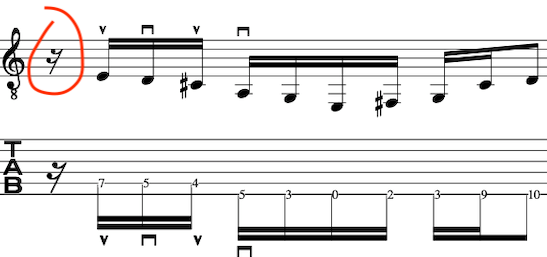
As you can see below, it is repeated, and copied down an octave starting on the upstroke and on the off beat:
how_to_play_shakti_indian_guitar_scales_lesson

Finally, a variation/implication of this is played, due to the guitar running out of notes to fully copy it.
how_to_play_shakti_indian_guitar_scales_lesson

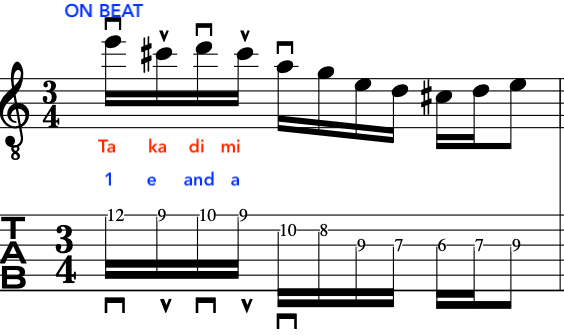
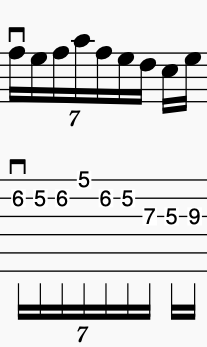
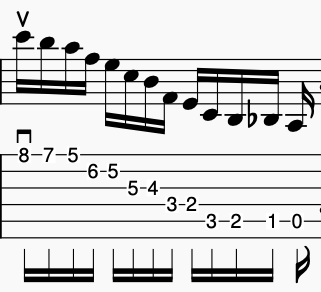
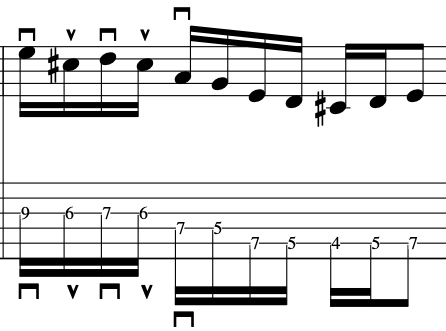
In this next example we will vary what we have just played in the example above.

But,

with two differences,

A] We will start on a “Down” stroke

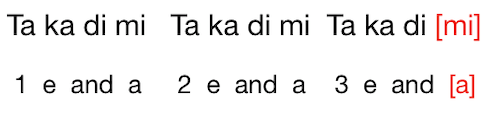
B] We will play “On” the beat.

how_to_play_shakti_indian_guitar_scales_lesson

As with the previous example, we will now imitate what we have just played and copy it exactly down an octave:
how_to_play_shakti_indian_guitar_scales_lesson

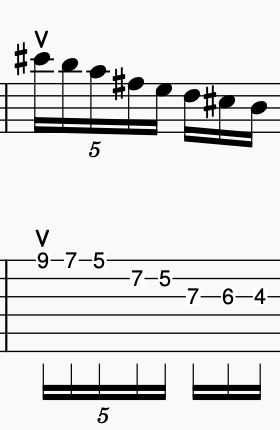
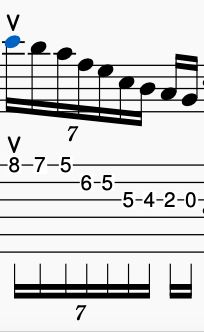
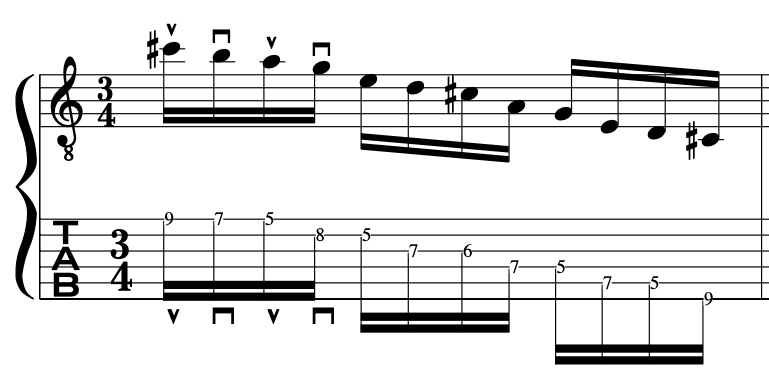
Here, is another form/fingering of the scale in descent: Notice that this is starting on an “Up” stroke.
how_to_play_shakti_indian_guitar_scales_lesson

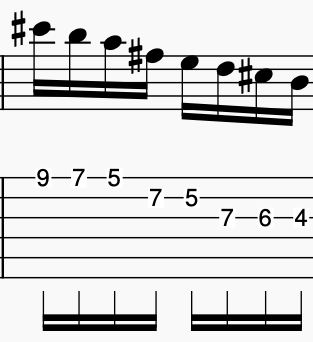
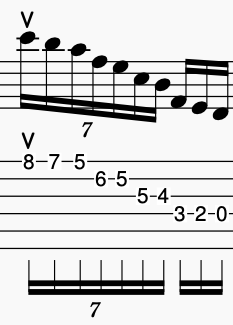
And finally, an ascending form/sequence starting on a “Down” stroke.
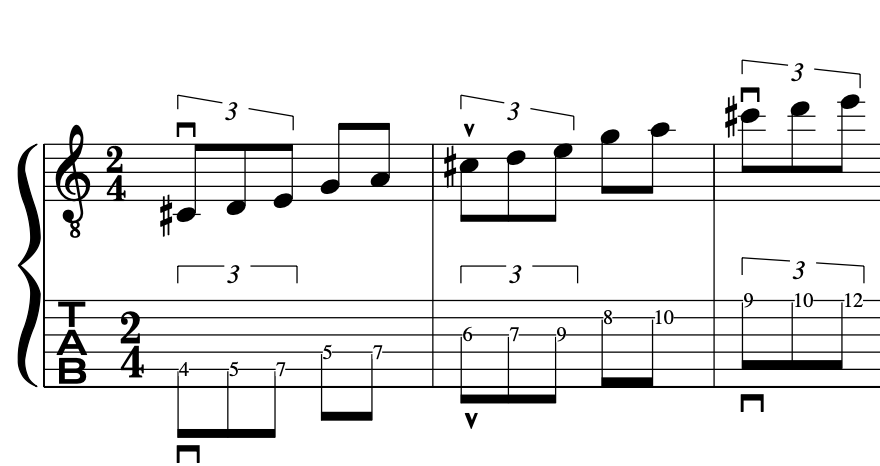
how_to_play_shakti_indian_guitar_scales_lesson

Mastering John McLaughlin’s Guitar Techniques

Hi Guys,

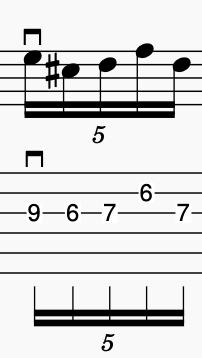
Today, Part 2 of the alternate picking patterns/numbers for John McLaughlin style guitar playing/picking.

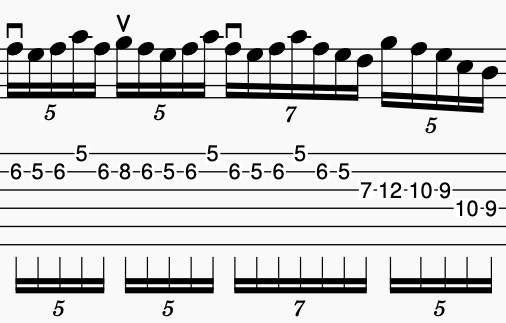
These are all building off of the number 5 and starting on the “Up” stroke for strict alternate picking guitar technique in standard tuning:


john_mclaughlin_guitar_technique_example

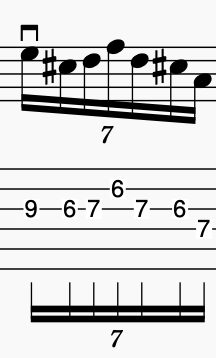
These example like those above expand on the number 5 but start on a “Down”stroke this time.

john_mclaughlin_guitar_technique_example

Example 1:

john_mclaughlin_guitar_technique_example

Example 2:

john_mclaughlin_guitar_technique_example

FREE PDF DOWNLOAD:

John McLaughlin-Prime Numbers-Alternate Pick Guitar Examples/Thoughts

Hi Guys,

Here are the Number groupings from the Youtube video I posted today as promised.

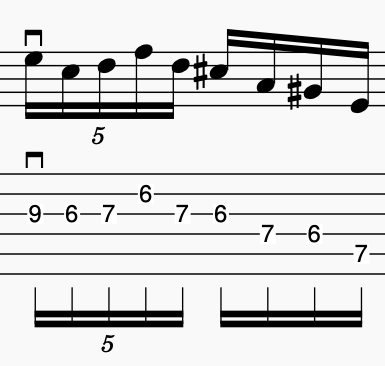
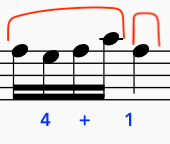
First of all we have the 4+1 or 1 e and a 2. [Hence nailing the next beat].

Sheet music showing rhythmic grouping of John McLaughlin's 4 + 1 with notes and time signatures for guitar technique.

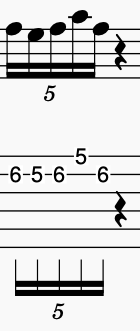
This could also be transformed into a quintuplet. Or, Ta ka di mi thom from Johns use of Konokol.

john-mclaughlin-guitar-lesson

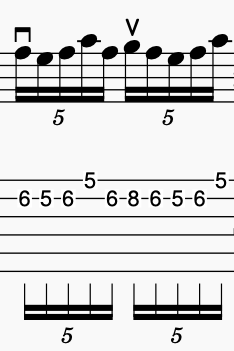
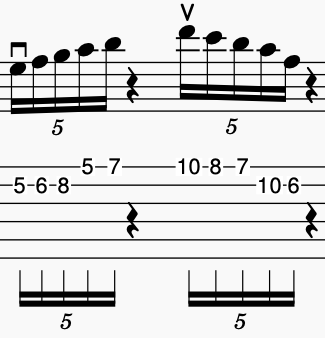
Here, we double this amazing “Prime number”.

NOTICE: We start on a downstroke for the first grouping and then start on an upstroke for the next grouping.

Musical notation with notes and tablature for guitar, showcasing various rhythms and groupings of John McLaughlin guitar techniques.
Musical notation and tab demonstrating alternate picking techniques and rhythmic groupings .

In terms of “Alternate Picking” guitar technique this creates some magic dust in our favour as not only are we two beats ahead of typical 4 note picking groupings, we are also connecting with both the up and downstrokes resulting in very quick and fluid picking.

From this, we can then start to break it up into musical motifs or phrases or riff/unison material.

john-mclaughlin-guitar-lesson

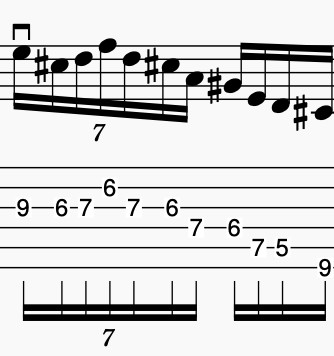
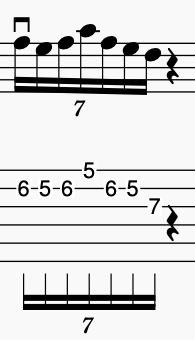
The next great number for interesting phrasing and alternate picking groupings is the prime number 7

Music notation showing a sequence of notes with a 7 for John McLaughlin alternate picking and time signature.

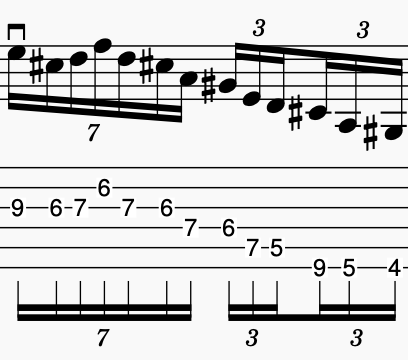
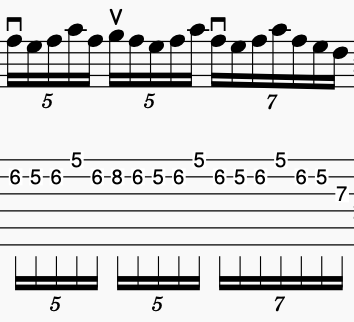
Now, let’s connect these two prime number patterns together!

Sheet music notation showing guitar tabs and rhythmic markings for musical phrasing, prime numbers and John McLaughlin's alternate picking techniques.
Musical notation illustrating the connection of two prime number patterns in guitar technique.

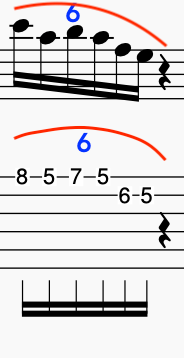
This next example is also useful, although, it’s not a prime number but a group of 6 notes “Sextuplets”

Musical notation illustrating a sequence of six notes. McLaughlin's  a rhythmic pattern.

From this, let’s add two more notes to form a common grouping of 8 notes:

john-mclaughlin-guitar-lesson

We will now add one more note for a group of 9

john-mclaughlin-guitar-lesson

9- Example 2

john-mclaughlin-guitar-lesson

Now, let’s go up one more again for ten notes.

john-mclaughlin-guitar-lesson

10-Example 2

A musical notation sheet showing rhythmic patterns and guitar tabs for John McLaughlin prime number guitar technique.

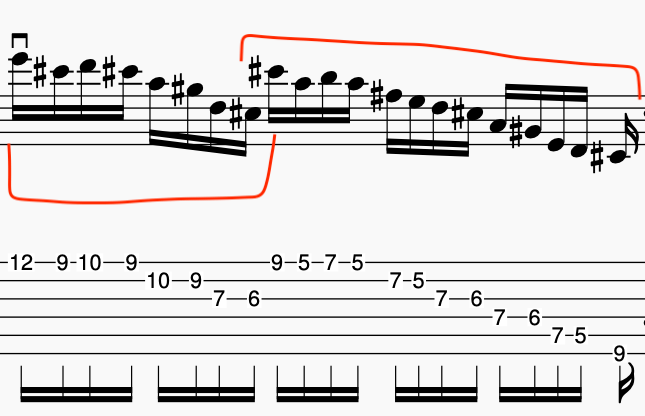
This time we will go back to prime numbers with a group of 13 notes

Musical notation showing a series of notes and tablature for guitar, with specific symbols indicating John McLaughlin's  rhythm and phrasing.
Musical notation illustrating a grouping of 13 notes [Prime number] for alternate picking techniques.

Finally, let’s exploit a whole bar of 4/4 time

Sheet music displaying a John McLaughlin guitar exercise with notes, including various groupings and techniques for alternate picking.
Guitar tablature and notation illustrating alternate picking techniques and rhythmic groupings of John McLaughlin.

In conclusion, this was just a concept related to alternate picking guitar technique specifically.

This is because sometimes the rhythmic motifs are not logical and need to be re-framed in order to make sense of the demands of the picking hand.

Also, sometimes starting on an upstroke works better than the down stroke or visa versa. These prime numbers generally put us a beat ahead which for alternate picking is extremely important because otherwise there is the age old tendency to just tremolo and hammer on willy nilly trying to catch up and this music is the antithesis of that.

So, in summation: These groupings help make sense of illogical phrasing for the picking hand whilst making sure that we are ahead in the music.