Pat Martino’s Guitar Improvisation Techniques | Free PDF Download

Pat Martino’s Guitar Improvisation Techniques | Free PDF Download

Hi Guy’s,

Today, a look at how jazz guitar legend Pat Martino approaches jazz improvisation.

This unique insight is strictly for guitar players, [although, players of other instruments may well find some of this extremely interesting and probably useful].

Pat’s approach to guitar improvisation is also a brilliant method for any guitarists that find playing through complex chord changes difficult or confusing

Okay, let’s say we are given this set of chord changes to improvise over.

pat-martino-jazz-guitar-improvisation-technique

Well, this is a lot of chords in different keys and with harmonic shifts to get through. This is 3 Chords per bar!!!

At a fast tempo this is a lot of different scales and arpeggios to connect together quickly!!!

Here’s where Pat’s unique approach comes into play.

Pat would approach this by employing the minor.

So, if we take a closer look at our sequence we will notice three sets of ii V7 I’s.

pat-martino-jazz-guitar-improvisation-technique

for F#m7 we will use C#m

and for Dm7 we will use Am.

In the example below we can visually see it all set up.

pat-martino-jazz-guitar-improvisation-technique

EXAMPLE: “minor” shapes to build from:

pat-martino-minor-conversion-jazz-guitar-improvisation-technique

This allows us to play freely and easily without worrying about messing up harmonically or rhythmically when connecting/playing through the changes.

Let’s now exploit this with 7sus4 chordal movement and slash chords.

pat-martino-minor-conversion-jazz-guitar-improvisation-technique

As before w will make the dominants minor:

F#7sus7 = C#minor

Ab7sus4 = Ebminor

B7sus4 = F#minor

[DbMaj7 = Fminor or Bbm7]

VISUAL CHART: with dominant minor application below.

pat-martino-minor-conversion-jazz-guitar

BASIC minor shape examples to build from:

pat-martino-minor-conversion-jazz-guitar-improvisation-technique

Finally, let’s add a chain of minor ii V7’s

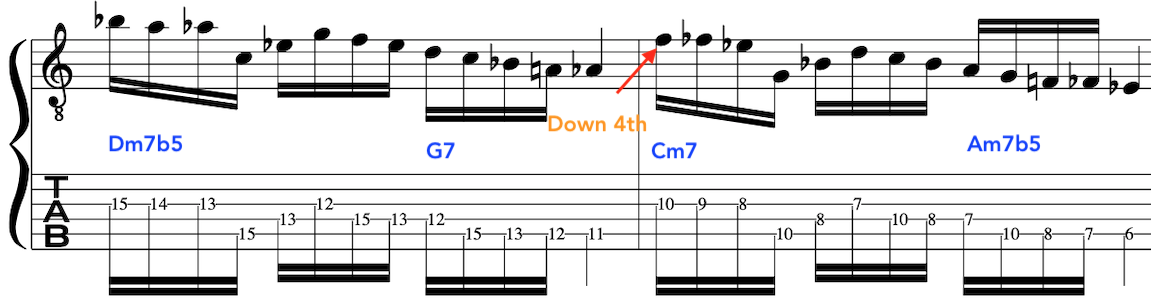
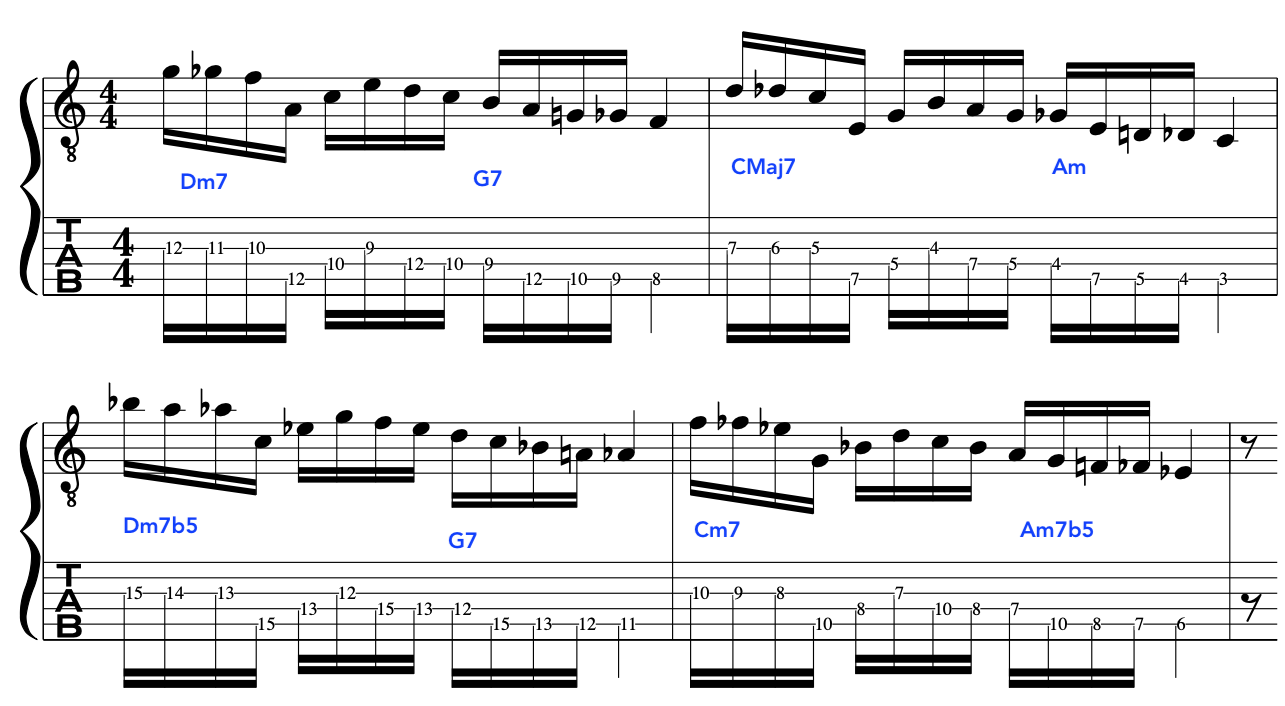
Here we will employ biii as our minor-isation for easy improvisation:

pat-martino-minor-conversion-jazz-guitar-improvisation-technique

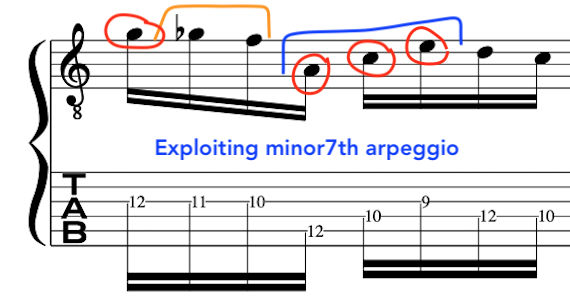
To make this really authentic we will add the 6th to the minor arpeggio:

So,

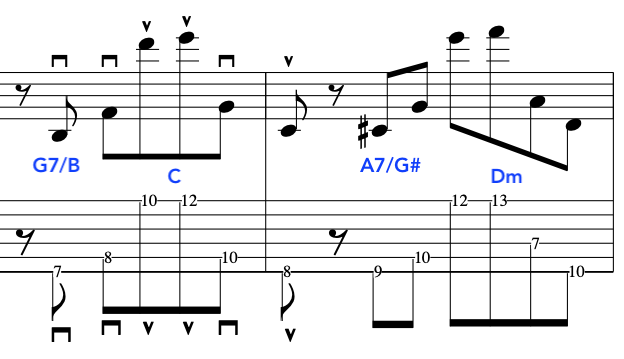
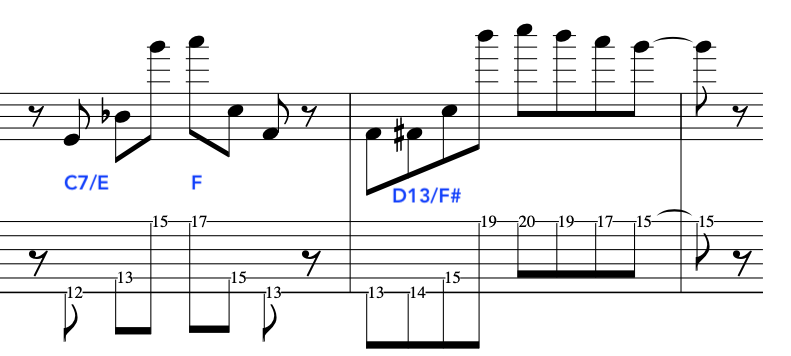
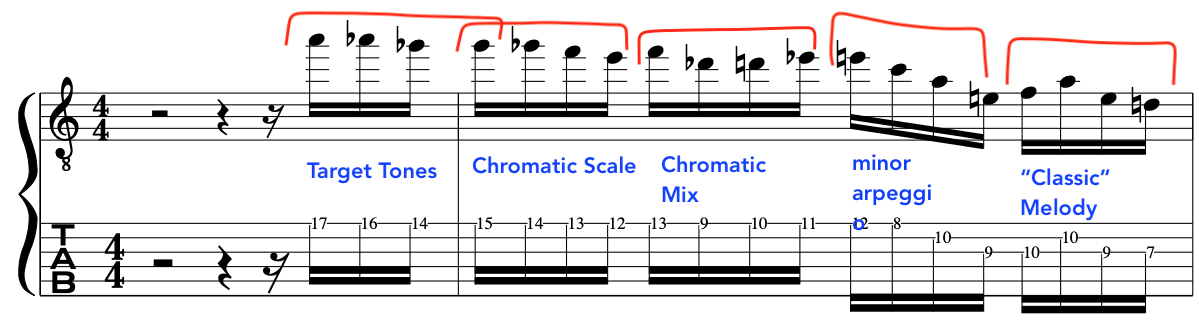
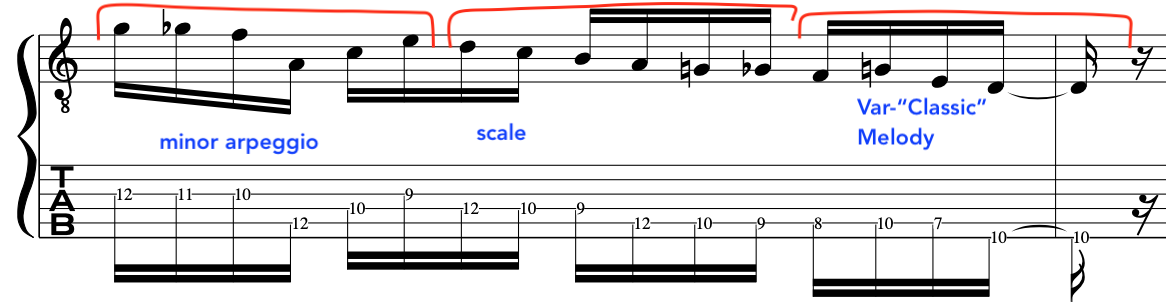
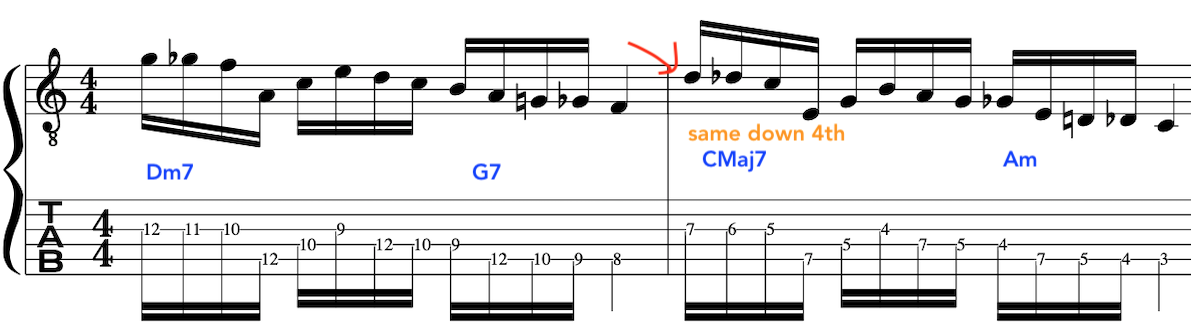
Example: Classic Jazz Seq Lick:

pat-martino-minor-conversion-jazz-guitar-ii-V7-1

With this in mind we can either sequence our way through the chain of chords or play freely by exploiting minor biii

pat-martino-jazz-guitar-improvisation-technique

IN CONCLUSION

In conclusion this was a brief look at Pat Martino’s brilliant approach to jazz improvisation through any chord changes on the guitar.

The guitar unlike the piano cannot play the same shape through countless octaves, so, when improvising on the guitar we need to be selective [in what actually works] so that ironically we have the freedom to let go and just play.

The minor topic [minorisation] technique allows us to achieve the guitar improvisers aim in a short period of time. For any student frustrated or seeing no end in sight, Pat’s methodology is a shining light. This method can save you 20 years of practice and frustration.

FREE PDF DOWNLOAD;

Scriabin’s ‘Prometheus’ Mystic Chord Analysis and examples for Guitar, Orchestra and Piano

The “Prometheus” Chord-Scriabin’s “Mystic” Chord Analysis

Hi Guy’s,

Today, we will take a look at Alexander Scriabin’s “Prometheus” or mystic chord.

The “Prometheus chord,” introduced by Alexander Scriabin, is a fascinating and innovative harmonic structure that reflects the composer’s mystical and philosophical inclinations. Officially known as the “mystic chord, this six-note chord (C, F#, Bb, E, A, D) forms the foundation of Scriabin’s “Prometheus: The Poem of Fire,” Op. 60.

Okay, let’s take the scale notes in order [Hexatonic 6 notes]

Now, let’s arrange the pitches by intervals,

root
major second
major sixth
major third
minor seventh
augmented fourth
root

This results in the “Promethus/Mystic” Chord:

Analysis-of-Scriabin's-Prometheus-chord

Here is the outline of the chord in single notes:

Analysis-of-Scriabin's-Prometheus-chord

Now, let’s apply it as a guitar fingering:

Analysis-of-Scriabin's-Prometheus-chord

Here is a Barre Guitar chord shape/voicing:

Guitar-voicing-bar-chord-Scriabin-Prometheus-chord

From here, we can now play around with this unique sound and create some interesting musical ideas from it.

Here are two “Chordal picking” guitar arpeggio vamps:

In the first example the key is to make sure not to dampen the open D string in the first bar even though this same string is fretted in the second bar.

Example 1:

composing-with-Scriabin's-Prometheus-chord

In the next example [below] the key to execution is the same by remembering not to dampen any open strings with the fretting hand.

EXAMPLE 2:

composing-with-Scriabin's-Prometheus-chord

Here is an example of a longer line built from this chord/scale concept:

improvising-with-Scriabin's-Prometheus-chord

This little phrase exploits the chord/scale outline with some string skipping/intervallic picking to create interest and to make it more compositional in its approach.

This chord/scale is employed a lot in modern and old Film and T.V music:

Example 1: Old 70’s detective shows like “Columbo”

composing-with-Scriabin's-Prometheus-chord

Example 2: Mystery/Drama from the late 30’s early 40’s Film.

composing-with-Scriabin's-Prometheus-chord

Example 3: Tremolo Build up for suspenseful crescendo.

composing-with-Scriabin's-Prometheus-chord

In conclusion this was just a quick look at the amazing “Prometheus” chord and it’s use and function in music.

It’s a very useful tool becasue it can be employed for lovely guitar vamps, solo lines and improvisation. It’s also excellent for orchestration where drama and suspense is required.

This chord departs from traditional harmonic conventions, creating a sonorous, otherworldly soundscape that evokes transcendence and spiritual awakening. The chord’s ambiguous tonal center and unconventional intervallic relationships challenge listeners’ expectations and epitomize Scriabin’s quest to explore new harmonic realms. This daring musical innovation was part of Scriabin’s broader artistic vision, intertwining music with his synesthetic experiences and esoteric beliefs, aiming to elevate human consciousness through art.


Exploring Messiaen’s Mode 1: Musical Concepts and Colorful Creations

Unlocking Messiaen’s Mode 1: Guitar Explorations

Hi Guys,

Today a look at Messiaen’s first mode of limited transposition:

This is the Whole tone scale and has two transpositions and one mode. It is a “Hexatonic” scale that has a dreamy, enigmatic air to it due to lack of resolution as all of the tones are the same distance apart.

The goal of this blog post is to create something interesting out of this scale.

Here is the first bar: This employs a Fripp-esque repetitive picking “Riff”

exploring-messiaen-mode-one-Fripp-guitar-style

From here, let’s make a smooth transition with an ascending whole tone scale:

exploring-messiaen-mode-one

Now, let’s employ some 20c Classical Messiaen style “Intervallic” movement to complete the phrase:

exploring-messiaen-mode-one-intervallic-guitar

From here, we will descend with the whole tone scale and connect it to the augmented arpeggio:

exploring-messiaen-mode-one

Let’s now return to and exploit our intervallic movement as we ascend the guitar fingerboard:

exploring-messiaen-mode-one-intervallic-guitar

Finally, let’s finish with some string skipping whole tone scale and a couple of plucks up high:

exploring-messiaen-mode-one-string-skipping-guitar

This was just an example of playing around with musical concepts and creating something colourful and interesting from Messiaen’s Mode 1.

Although, this is only a six note scale it has plenty to offer due to it’s non resolving/non diatonic nature. It works really well for riffs, motifs and hooks and really draws the listeners ear in. Even when used sparingly it can really add colour and texture to a composition [or part of] .

FREE PDF DOWNLOAD:

Exploring Messiaen’s 5th Mode of limited transposition
Messiaen’s modes of limited transposition: