John McLaughlin’s Alternate Picking Guitar Technique

Hi Guys,

Today, a look at the alternate picking guitar style of the great John McLaughlin.

Before starting it is essential to look at the rhythmic aspect.

To do this, let’s take basic 8th notes.

Here, we will accent the 3rd note in each 4 note grouping.
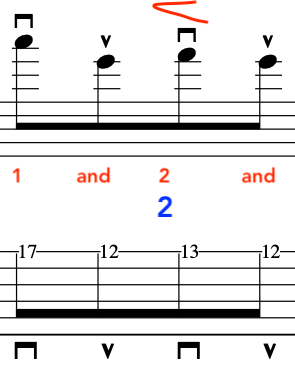
A notated sheet music example illustrating a rhythmic guitar exercise focusing on alternate picking, with notes and accents marked.

Now, let’s add another 4 note grouping and do the same thing.
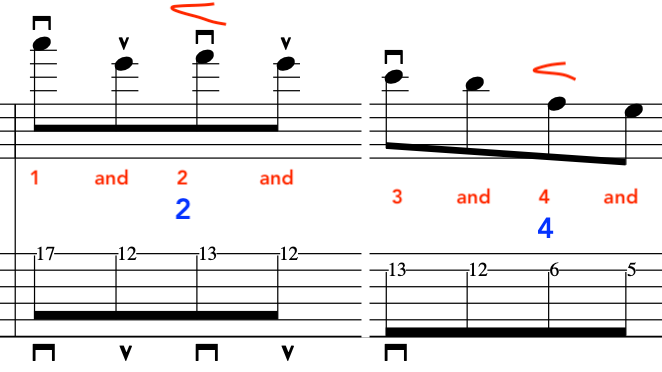
Annotated sheet music demonstrating rhythmic patterns for alternate picking on guitar with accents.
Musical notation illustrating the technique of alternate picking with accents on specific notes.

What you will notice is that this is like a basic 4/4 drum rhythm with the accent landing on the snare:
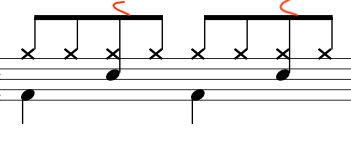
With this in mind, let’s now take this and add a shuffle or swing feel to it.
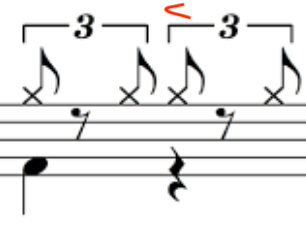
Tip-This accent and swing feel keeps the picking hand secure and focused on plucking the rhythm and not jumping ahead.

Now that we are comfortable with 8th notes, let’s double the time with 16th notes.

It dosen’t matter how you want to count 16th notes. Regardless of 1 e and a or Ta Ka Di Mi or some inner murmur, the point is that your counting needs to be internalised so that the picking hand knows what to pluck.

So, let’s pluck this around 110 to 140 bpm
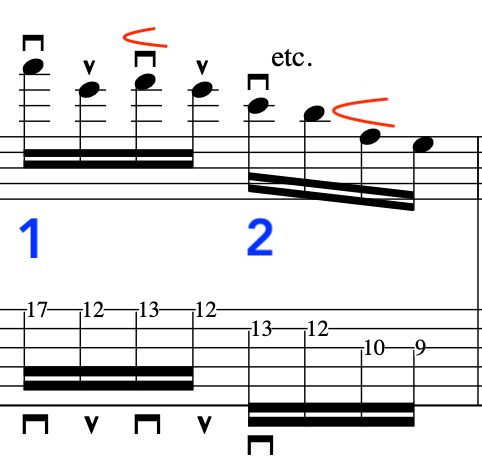
A music sheet displaying rhythmic notations for alternate picking technique, featuring notes and accents.
Musical notation demonstrating alternate picking techniques in guitar practice.

Okay, let’s now apply everything we have studied so far:

1] Accent 3rd note in each 4 note phrase

2] Apply a swing/shuffle feel

3] Count time – follow internalised rhythm

and play the whole phrase:
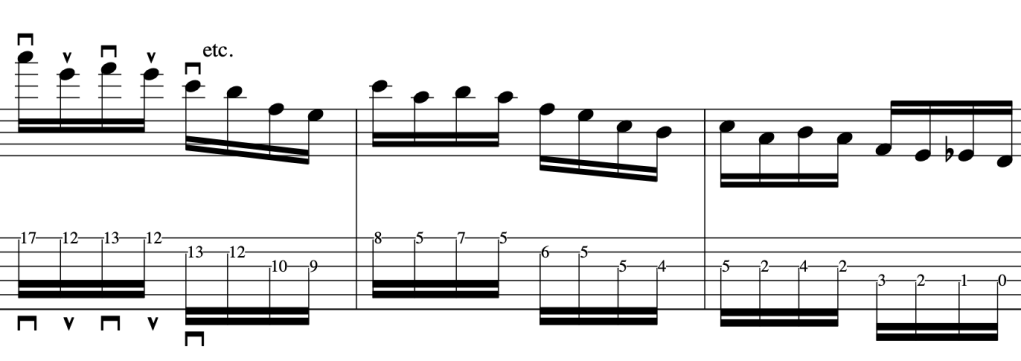
Sheet music illustrating alternate picking guitar technique with note placements and rhythmic accents.

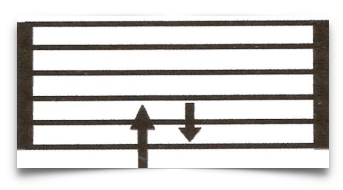
For the picking hand [Right hand technique] one needs to be aware of plucking inside of the string and outside of the string:

From the outside of the strings it will be:

Graphic showing guitar alternate picking direction with arrows indicating up and down strokes.
Diagram illustrating alternate picking technique for guitar, showing the directions of plucking from outside the strings.

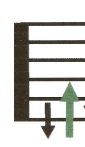
From the inside of the strings it will be:

Diagram illustrating alternate picking technique with arrows indicating up and down strokes inside of the strings for guitar playing.
Diagram illustrating alternate picking techniques with directional arrows for upstrokes and downstrokes from inside of the strings.

For most players it is easier to pluck [alternate pick] from the outside of the strings.

Here is a 2 string exercise plucking from the inside of the strings starting on a downstroke:
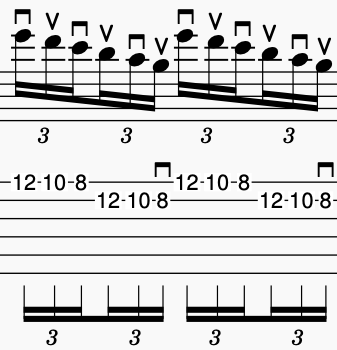
Musical notation illustrating alternate picking 2 string exercise technique with accentuated notes and rhythmic groupings.
Illustration of a 2-string exercise demonstrating alternate picking techniques on guitar.

Here, is a 2 string exercise plucking from the outside of the strings, but, starting on an upstroke:
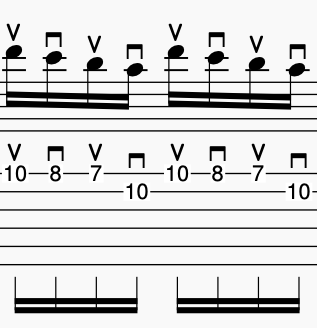
Musical notation sheet showing a series of sixteenth notes organized in a four-note pattern with specific accents indicated.
An illustration of a musical exercise showcasing alternate picking techniques on the guitar.

Now, let’s start on a downstroke on the outside of the strings:
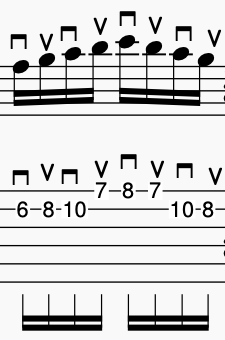
Sheet music displaying guitar notes with alternate picking notation, including accents and rhythmic groupings. 2 string repetitive exercise.
Musical notation demonstrating 2 string alternate picking exercises for guitar.

Finally, let’s mix it up a bit starting on a downstroke:
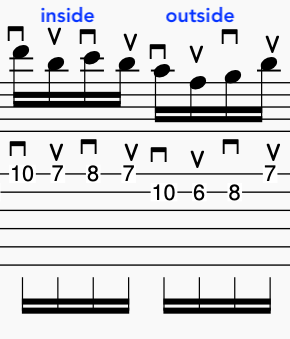
A guitar tab illustrating alternate picking techniques, with annotations for 'inside' and 'outside' picking strokes.
Illustration of alternate picking technique showing ‘inside’ and ‘outside’ stroke patterns on guitar.

From these short repetitive exercises, we can gauge where we are with the picking hand. We can acknowledge wether we are picking inside or outside of the strings.

For fluid right hand technique this is essential, as you will know where you are and what you prefer or what’s easiest and most natural for you.

This in turn means that you can start creating phrases either inside or outside the strings that fit your style.

In order to play fluid phrases it’s essential to “Connect” parts, groupings, lines and licks, etc, together.

This means, having the fretting hand ready to “Shift” positions.

This also means, employing simple logical fingering by having the fingers prepared for fretting.

Here, is the natural movement from our example line-[built in 3 deliberate parts]
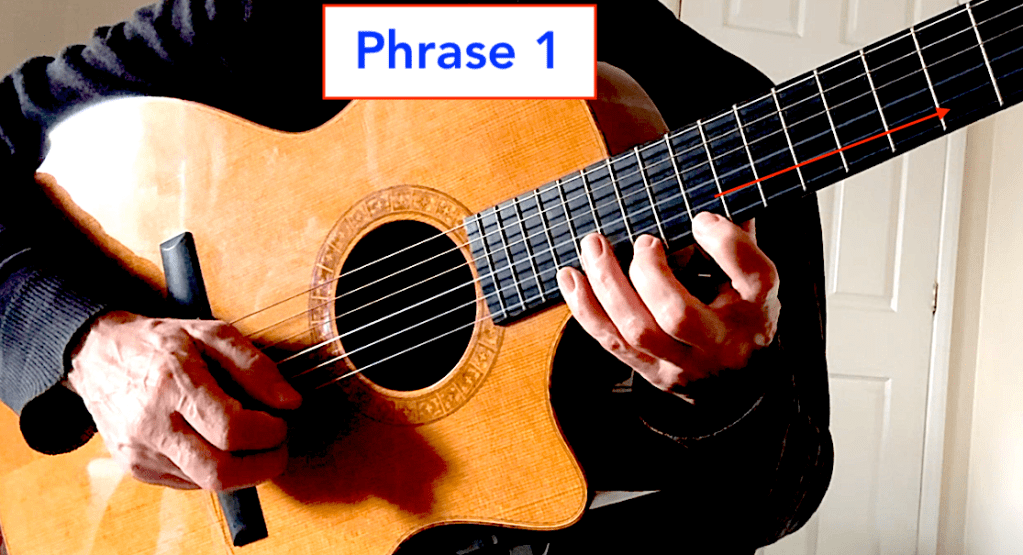
Close-up of a person playing a guitar, with fingers positioned on the fretboard demonstrating a musical phrase labeled 'Phrase 1' for alternate picking guitar technique.
Demonstration of a guitar phrase highlighting finger positioning for fluid playing.

The fretting hand prepares shape to shift down to the next positions with the hand and fingers “Aligned” for the next phrase.
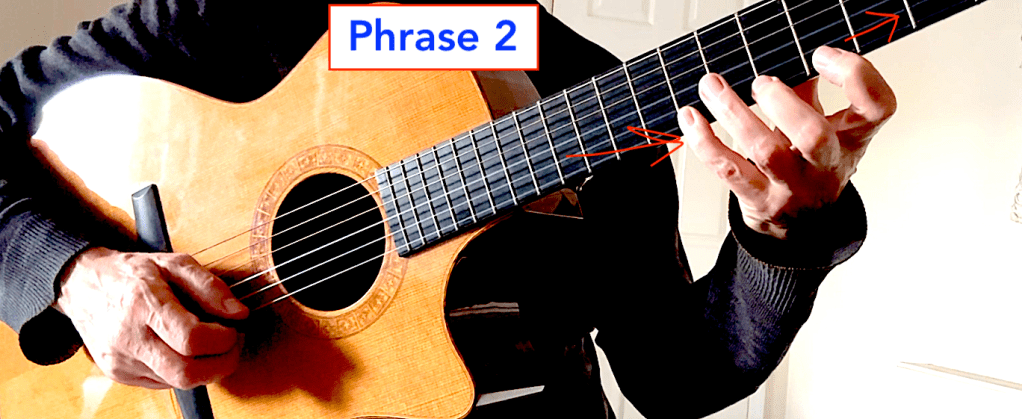
Close-up of a guitarist's hand demonstrating finger positioning on the fretboard with an arrow indicating the movement for phrase 2 for alternate picking guitar technique.
Demonstration of Phrase 2 in alternate picking technique on guitar.

Fretting hand plays the phrase and prepares the shape and fingers to shift down to next position:
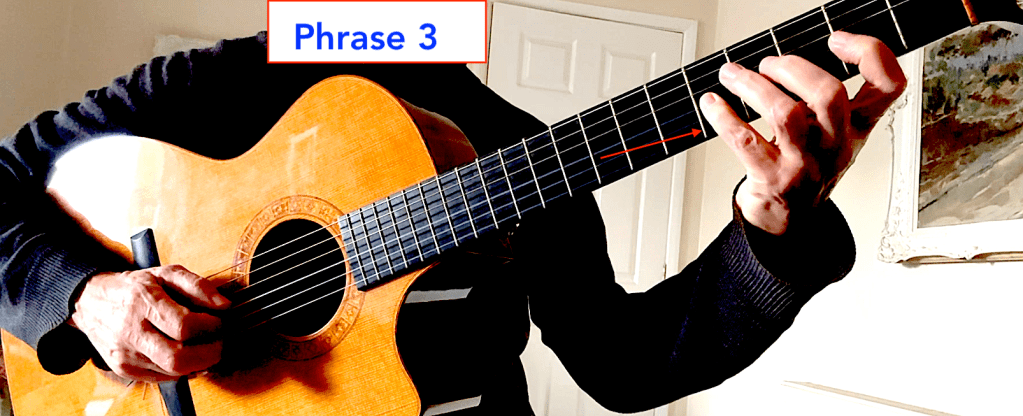
A guitarist demonstrating finger placement on the neck of an acoustic guitar, labeled 'Phrase 3' of alternate picking guitar technique.
Illustration of Phrase 3 technique in John McLaughlin’s alternate picking style.

Fretting hand plays the last phrase comfortably. Hand, shape and fingering are aligned to the correct position.

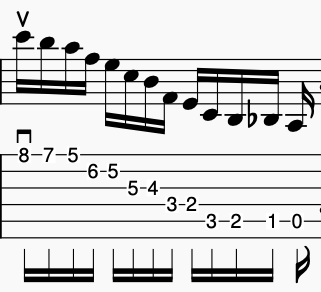
Full Line -Shifting Positions:
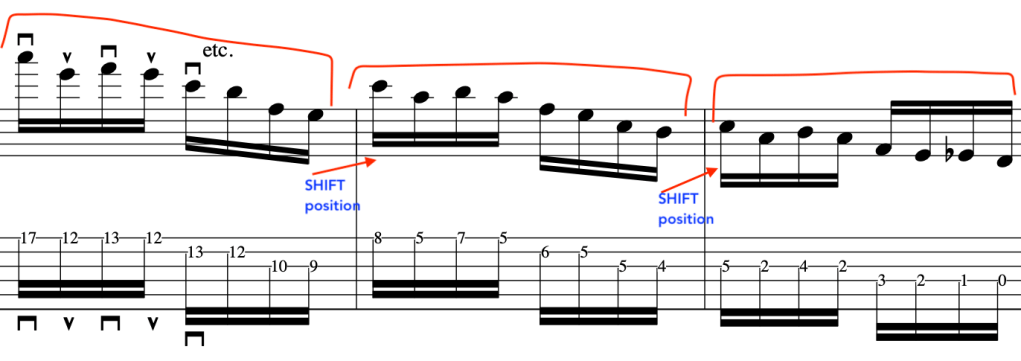
Music notation illustrating shifting positions for guitar playing, showing notes and rhythms for practicing alternate picking techniques.
A musical score demonstrating alternate picking techniques for guitar, highlighting shifts in position.

In conclusion this was just a quick look at the basics of Johns alternate picking guitar technique style.

From here, one can start to form and develop the improvisational elements needed to complete the style. [“This is the way I do it” video-a great example]

As John has taken so many paths in his musical journey it is impossible to get everything down in one webpage/blog. But, from a basic perspective, hopefully this lesson helps somewhat in understanding John’s alternate picking guitar technique.

Quick Tips for Jazz Guitar Turnarounds: Martino,Mock,McLaughlin

Hi Guys,

Today, a look at playing through a Vi ii V7 I Turn around/Cadence at a quick pace/tempo.

This is in the style of Don Mock, Pat Martino and John McLaughlin. So, this employs the alternate picking guitar technique.

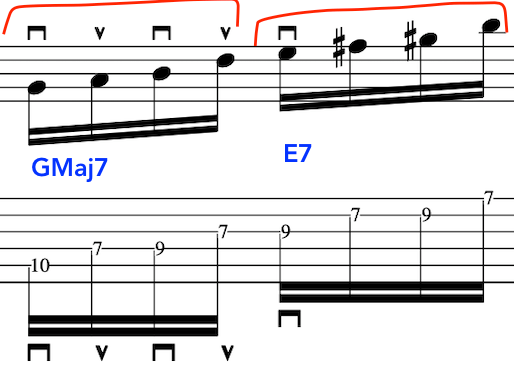
A jazz chord turnaround and cadence featuring Gmaj7, E7, Am7, D7, Gmaj, Gm7, C7, and Fmaj7 in 4/4 time.
Musical notation and tab showing GMaj7 and E7 jazz turnaround chords with corresponding notes and finger placements for guitar.

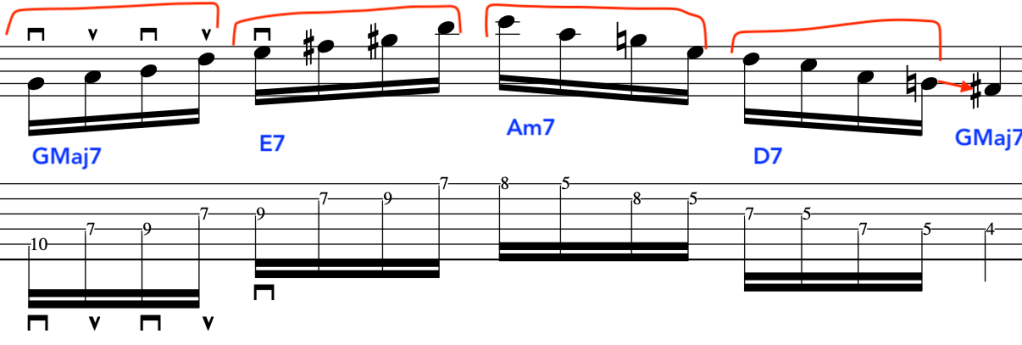
Starting, on a down stroke with alternate picking, we can see how easy it is to connect these simple pentatonic’s together through the two chord changes.

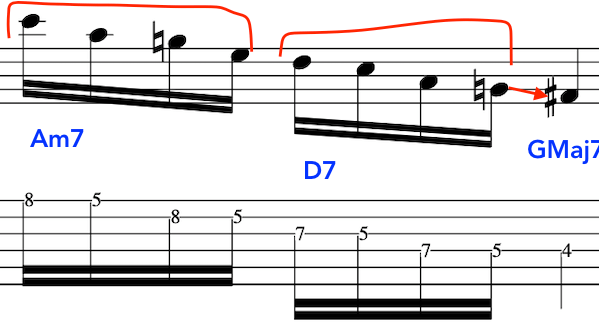
Now, let’s connect the pentatonic’s over the next two chords in the same manner. [Notice the G to F# resolution for Gmaj7]

Musical notation and tablature showing jazz ii V7 I chords Am7, D7, and Gmaj7 with highlighted notes and guitar finger placements.

Having completed our Turnaround, let’s cadence this to a new key: This will be F Major.

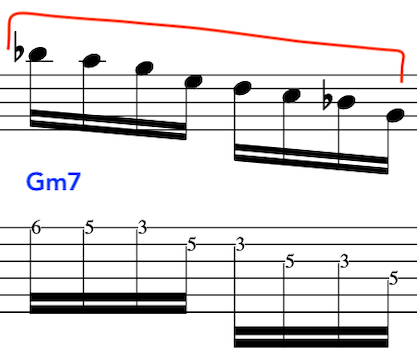
To do this, we will make the G Major 7th chord, minor, to G minor 7th.

Musical notation and tab for the Gm7 chord featuring pentatonic scale connections for jazz improvisation

From here, we will carry this pentatonic scale/line along and play it over the next chord.

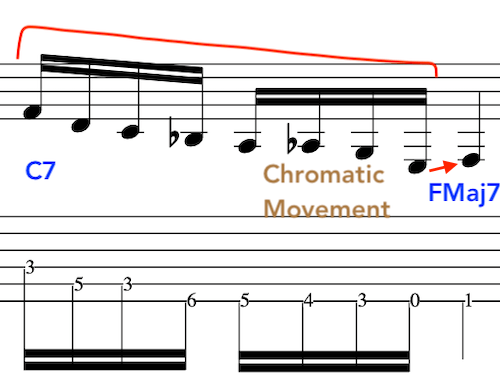
This will be the Dominant chord of C7 [or chord V leading to/of the new key F Major].

Notice: the use of a few chromatic notes to fill out the pentatonic scale/line.

Sheet music showing a chord progression with annotations for C7 and Fmaj7, highlighting chromatic jazz improvisational movement.

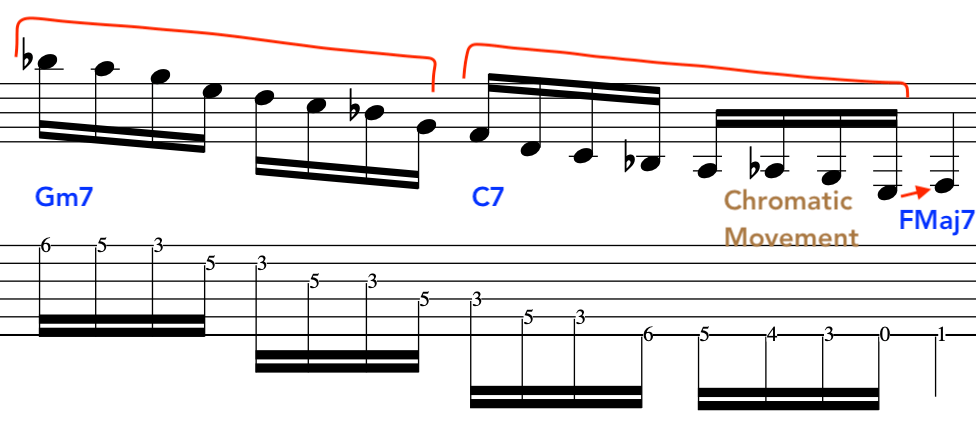
Full Turnaround/Cadence:

Sheet music and tablature  displaying chord progression for jazz Vi ii V7 I Gmaj7, E7, Am7, D7, and Gmaj7, with annotations and notes for guitar performance.
Sheet music showing a chord progression for jazz with ii V7 I with Gm7, C7, and FMaj7, highlighting chromatic scale movement and alternate picking guitar techniques.

This, was just a quick look at how easy it is to connect long lines together through very quick chord changes, especially, at the guitar with alternate picking technique.

It’s amazing the amount of chords we can play through fluently and quickly with this simple pentatonic four note [tetrachord] approach when improvising.

This short blog/lesson was just touching the surface. But, it does still give quite a comprehensive view of what can be achieved with this approach.

It’s a good idea to apply this method to any quick chord changes that you can find [e,g “Giant Steps”] and try this.

John McLaughlin-Prime Numbers-Alternate Pick Guitar Examples/Thoughts

Hi Guys,

Here are the Number groupings from the Youtube video I posted today as promised.

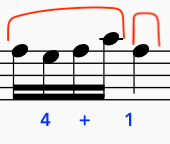
First of all we have the 4+1 or 1 e and a 2. [Hence nailing the next beat].

Sheet music showing rhythmic grouping of John McLaughlin's 4 + 1 with notes and time signatures for guitar technique.

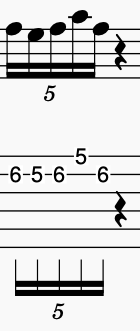
This could also be transformed into a quintuplet. Or, Ta ka di mi thom from Johns use of Konokol.

john-mclaughlin-guitar-lesson

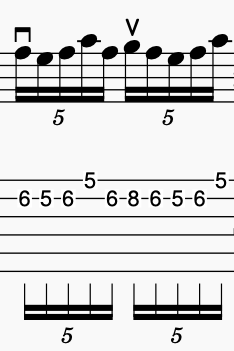
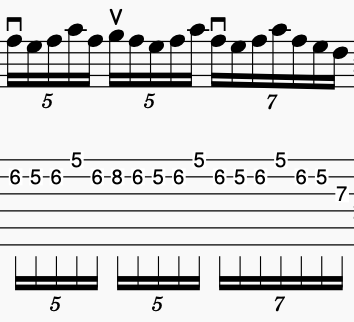
Here, we double this amazing “Prime number”.

NOTICE: We start on a downstroke for the first grouping and then start on an upstroke for the next grouping.

Musical notation with notes and tablature for guitar, showcasing various rhythms and groupings of John McLaughlin guitar techniques.
Musical notation and tab demonstrating alternate picking techniques and rhythmic groupings .

In terms of “Alternate Picking” guitar technique this creates some magic dust in our favour as not only are we two beats ahead of typical 4 note picking groupings, we are also connecting with both the up and downstrokes resulting in very quick and fluid picking.

From this, we can then start to break it up into musical motifs or phrases or riff/unison material.

john-mclaughlin-guitar-lesson

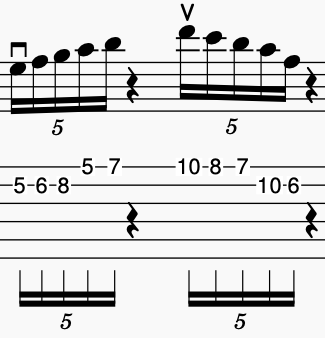
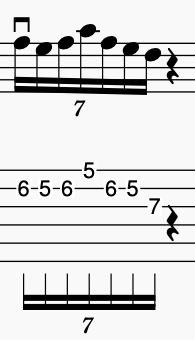
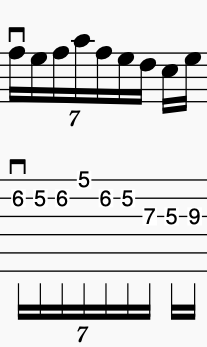
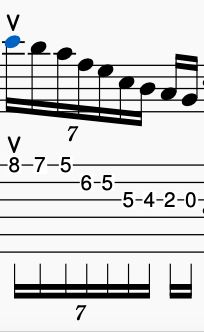
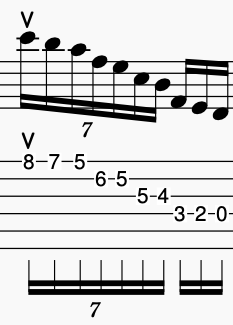
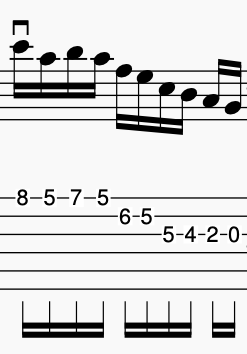
The next great number for interesting phrasing and alternate picking groupings is the prime number 7

Music notation showing a sequence of notes with a 7 for John McLaughlin alternate picking and time signature.

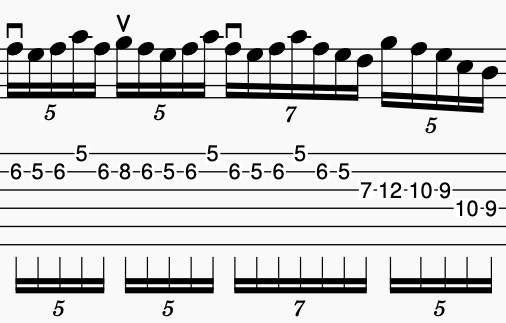
Now, let’s connect these two prime number patterns together!

Sheet music notation showing guitar tabs and rhythmic markings for musical phrasing, prime numbers and John McLaughlin's alternate picking techniques.
Musical notation illustrating the connection of two prime number patterns in guitar technique.

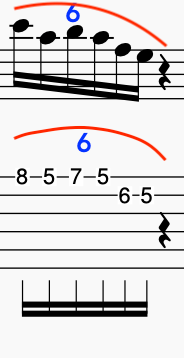
This next example is also useful, although, it’s not a prime number but a group of 6 notes “Sextuplets”

Musical notation illustrating a sequence of six notes. McLaughlin's  a rhythmic pattern.

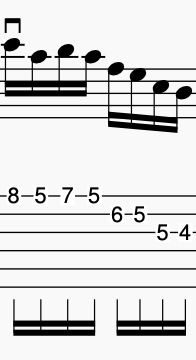
From this, let’s add two more notes to form a common grouping of 8 notes:

john-mclaughlin-guitar-lesson

We will now add one more note for a group of 9

john-mclaughlin-guitar-lesson

9- Example 2

john-mclaughlin-guitar-lesson

Now, let’s go up one more again for ten notes.

john-mclaughlin-guitar-lesson

10-Example 2

A musical notation sheet showing rhythmic patterns and guitar tabs for John McLaughlin prime number guitar technique.

This time we will go back to prime numbers with a group of 13 notes

Musical notation showing a series of notes and tablature for guitar, with specific symbols indicating John McLaughlin's  rhythm and phrasing.
Musical notation illustrating a grouping of 13 notes [Prime number] for alternate picking techniques.

Finally, let’s exploit a whole bar of 4/4 time

Sheet music displaying a John McLaughlin guitar exercise with notes, including various groupings and techniques for alternate picking.
Guitar tablature and notation illustrating alternate picking techniques and rhythmic groupings of John McLaughlin.

In conclusion, this was just a concept related to alternate picking guitar technique specifically.

This is because sometimes the rhythmic motifs are not logical and need to be re-framed in order to make sense of the demands of the picking hand.

Also, sometimes starting on an upstroke works better than the down stroke or visa versa. These prime numbers generally put us a beat ahead which for alternate picking is extremely important because otherwise there is the age old tendency to just tremolo and hammer on willy nilly trying to catch up and this music is the antithesis of that.

So, in summation: These groupings help make sense of illogical phrasing for the picking hand whilst making sure that we are ahead in the music.