Exploring Modal Chord Progressions in C Major

CLICK SUBSCRIBE!

Hi Guys,

Today, a quick look at modal chords.

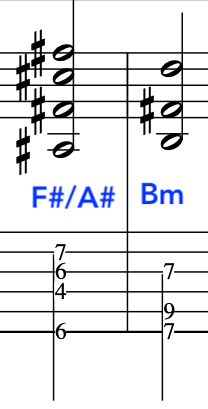
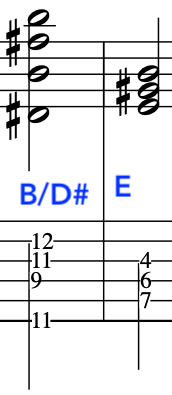
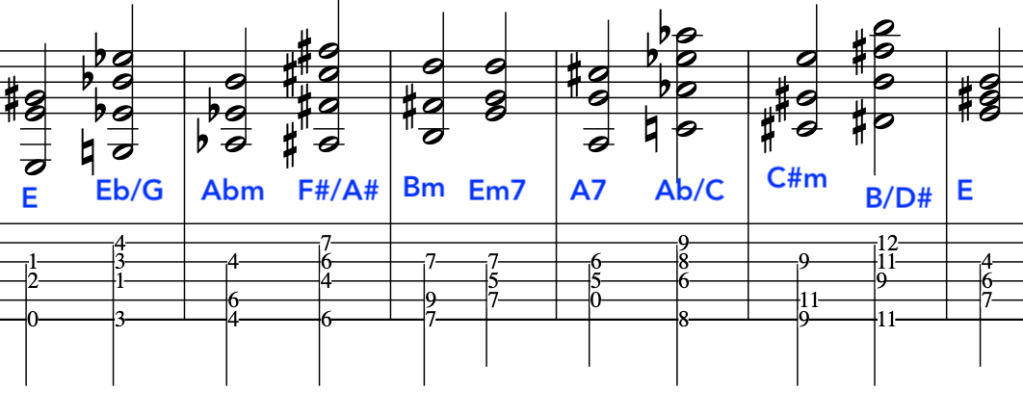
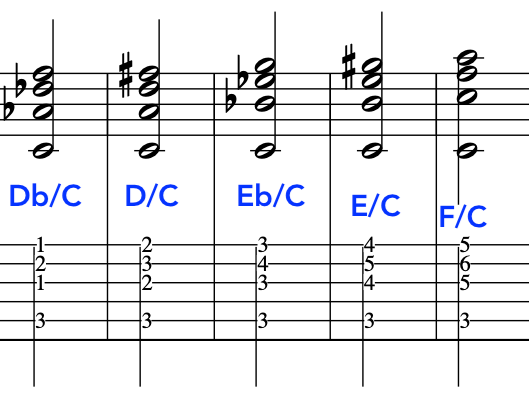
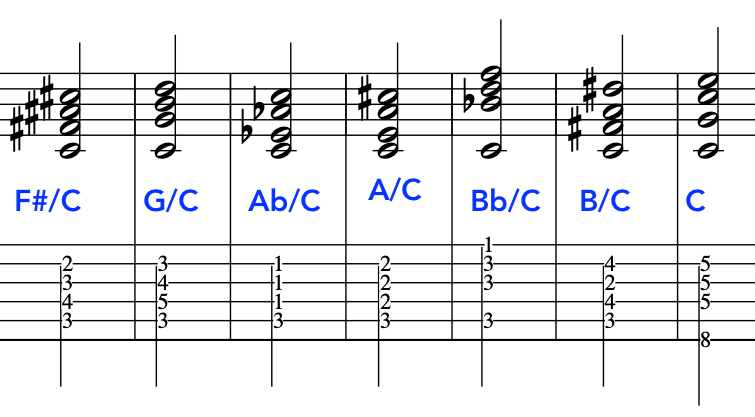
The chords are from the backing track [below in this page] and they are “Transposed” with C as the root note.

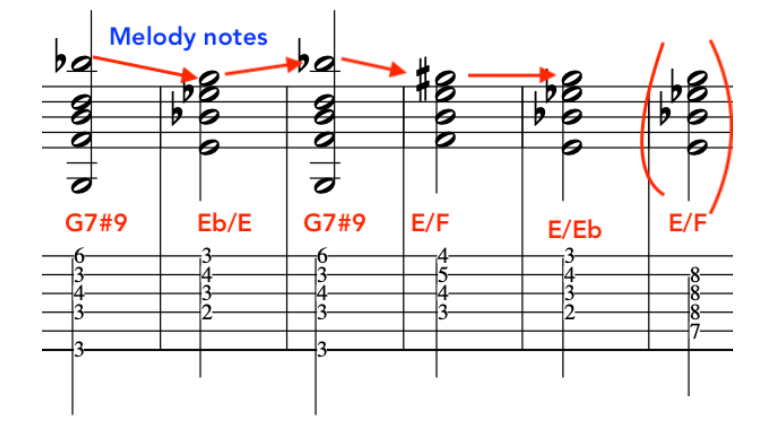
These are exploited in the 12 bar form of a fusion blues.

modal_chords_guitar_lesson_explained_easily

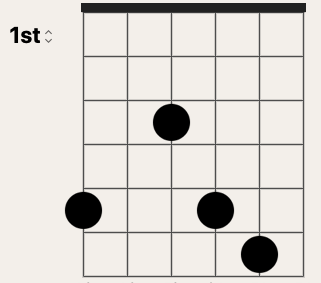
To begin with, we will take the first chord for the basic Ionian/Major sound. Here we have a chord/triad of G Major over the bass note C as a substitution for Cmaj7:

modal_chords_guitar_lesson_explained_easily

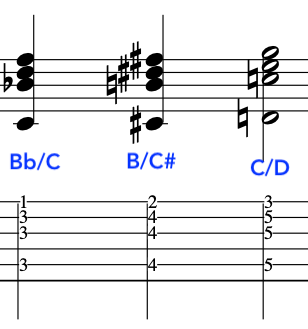
Next, we have a C Dorian tonality. For this I am employing a 7sus4 chord with a triad of Bb over a C bass once again

modal_chords_guitar_lesson_explained_easily

From here, we will create a C Lydian sound. We will do this by employing a triad of D Major over a C Bass.

modal_chords_guitar_lesson_explained_easily

Now, we will move back to Ionian with another 7sus4 chord. This time it’s a triad of C Major over a D Bass.

modal_chords_guitar_lesson_explained_easily

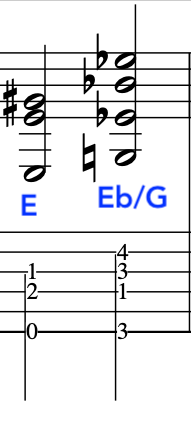
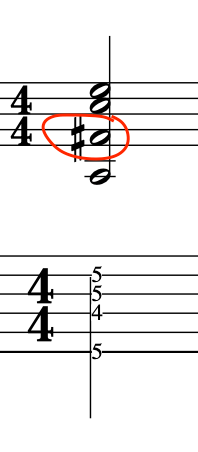
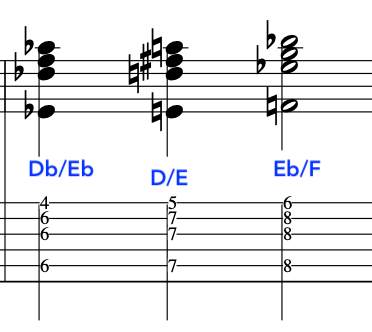
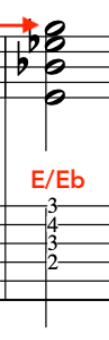
To create interest, we will now make this tonality minor by adding a triad of Eb Major over a C Bass [a la C minor 7th]. [Aeolian/Dorian]

modal_chords_guitar_lesson_explained_easily

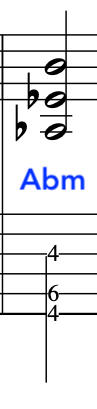
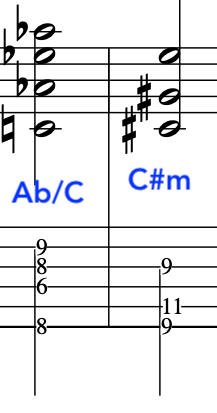
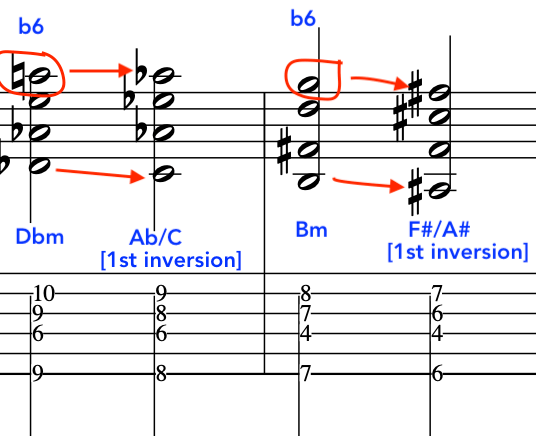
For, the Phrygian/Aeolian sound, we will employ a 1st inversion triad of Ab Major over a C bass.

modal_chords_guitar_lesson_explained_easily

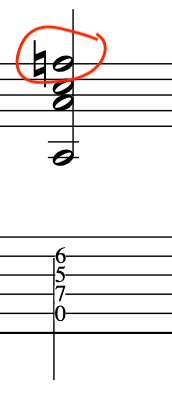
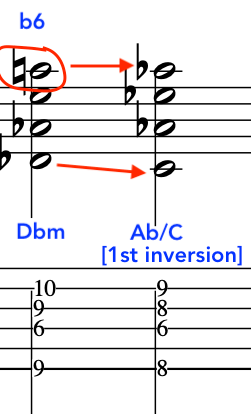
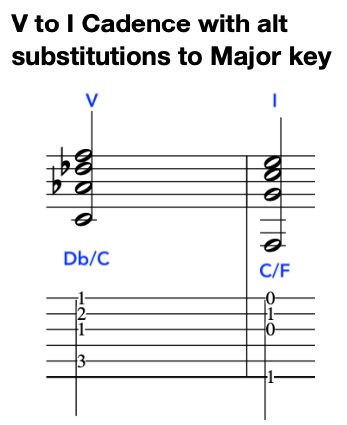
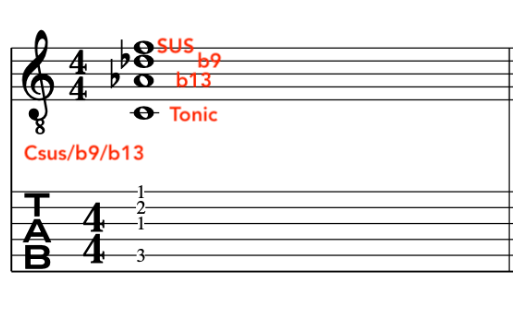
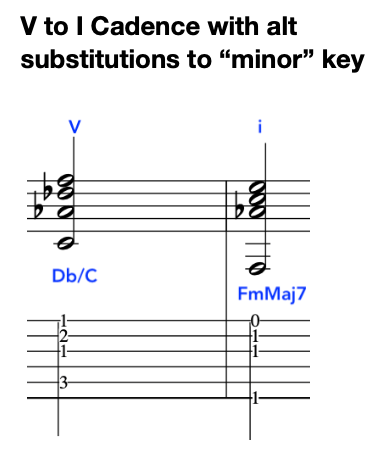
To create some dissonance, and a more ethereal sound it’s a good idea to add a Locrian chord. In this instance, I am employing a triad of Db Major over the C Bass.

modal_chords_guitar_lesson_explained_easily

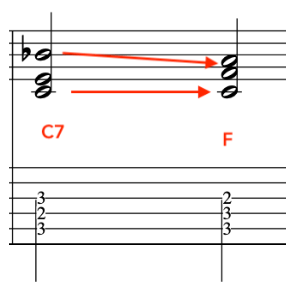
For the mixolydian sound I am employing a simple C7 chord. [You could also add a 4-3 suspension]

Now, let’s add a couple of Dorian chords.

These will be another 7sus4 chord of an Eb triad over an F bass.

modal_chords_guitar_lesson_explained_easily

And, a Major 9 [or sus2] no 3rd chord. For this we will add a triad of F major over a Bb bass.

modal_chords_guitar_lesson_explained_easily

For the penultimate Mixolydian chord, we will create a 3rd inversion [Dominant]. This will be a C Major triad over a [the 7th] Bb bass.

modal_chords_guitar_lesson_explained_easily

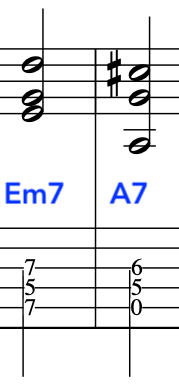
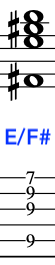
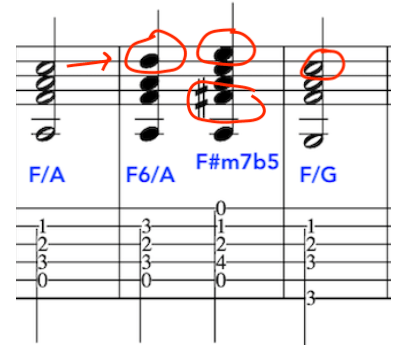
And finally, an Aeolian sound with an Fm6 chord over a G bass.

modal_chords_guitar_lesson_explained_easily

Modes Backing Track Transposed in C Major with Chart and Scale Suggestions.
modal_chords_guitar_lesson_explained_easily

modal_chords_guitar_lesson_explained_easily

IF THIS LESSON WAS OF USE TO YOU THEN PLEASE SUBSCRIBE TO US BELOW ON YOUTUBE, THANKS!

Alternate Picking from Ascending 5’s

Hi Guys,

Today, a quick look at building from the “Ascending group of 5” with alternate picking guitar technique.

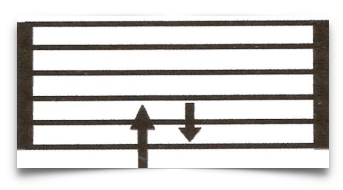
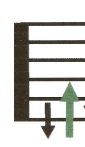
This group of 5 exploits the “Up” stroke. It works well as a tool for building longer and longer lines/phrases.

This is NOT shred and is really only for jazz, fusion and world-esque music like John McLaughlin’s super creative outlet Shakti. It is an improvisers tool.

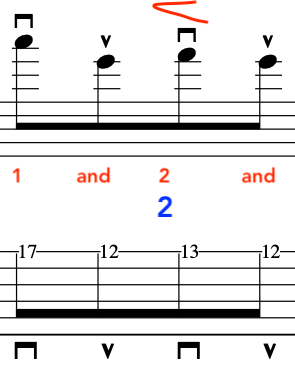
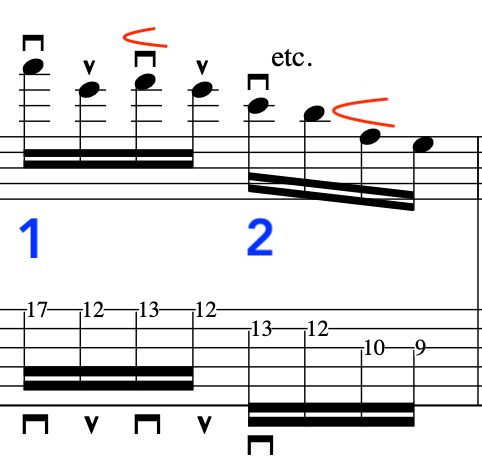
Here is an example of the 5 figure. It consists of an open string and starts on an upstroke.

This 4 note + 1 sets up the upstroke for the string cross.

alternate_picking_guitar_technique_example

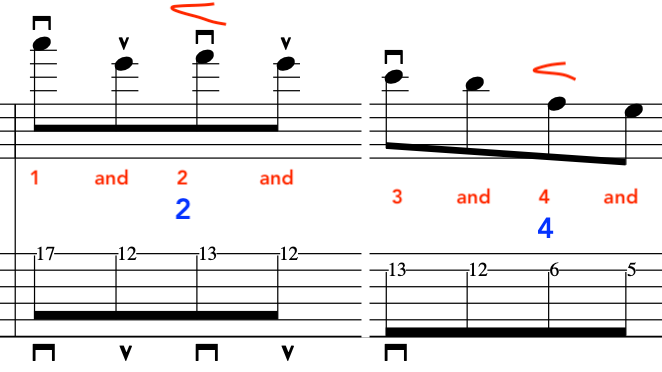
Here’s how it would be as a tetrachord to the next beat. [As opposed to a quintuplet or Ta ka di mi Thom.

alternate_picking_guitar_technique_example

Let’s now build off of the ascending 5 figure.

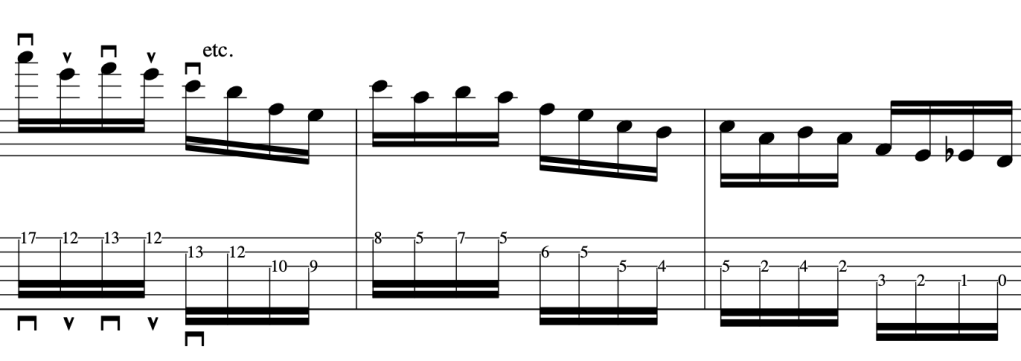
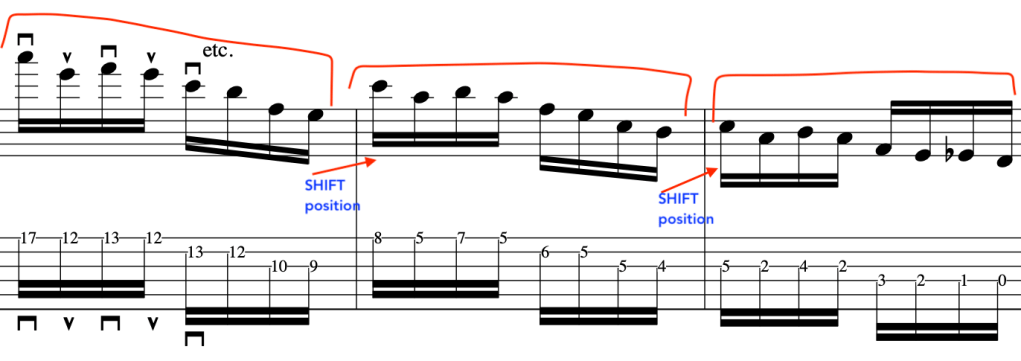
In the example below, we can clearly see the extension from the 5’s to 7’s to two groups of 4 note tetrachords.

alternate_picking_guitar_technique_example

From here, we will add a Dom7th chord to the scale/phrase.

alternate_picking_guitar_technique_example

This sets us up nicely to descend smoothly starting on the upstroke.

alternate_picking_guitar_technique_example

Here, we will do exactly the same thing, except that this time we are moving from G7 to C Major. [Notice the open string and 5 figure extended].

alternate_picking_guitar_technique_example

Once again, the descent is on the upstroke.

alternate_picking_guitar_technique_example

FULL EXAMPLE:

alternate_picking_guitar_technique_example

Here, we see the process in action again. The line building from the 5 figure.

alternate_picking_guitar_technique_example

The descent starts on the upstroke as before, but, this time leads to a perfect V I cadence:

alternate_picking_guitar_technique_example

Here is a variation, but, this time in the key of A Major.

alternate_picking_guitar_technique_example

The same form of descent is employed that once again ends in a V I cadence.

alternate_picking_guitar_technique_example

Counting Rhythms for Alternate Picking Guitar “Right Hand” Technique:

Hi Guys,

Here are a few of the Rhythms that I like to count and/or practice when alternate picking:

These are based around Indian Konokol: But: I am using them to INTERNALISE patterns. This could be Ta ka di mi but felt/internalised as du du du du

These, I find help me enormously with the right hand picking, as I can connect phrases together from the internalised beats/syllables.

These are NOT cast in stone and are only a few ideas that I use personally, and are not aiming at strict Indian classical music technique, but, are employed as reference points/patterns/beats in the way that they are enunciated.

1] Ta ka di mi [1 2 3 4]

2] Ta ki ta Ta [more as 123 1]

1] Ta ka di mi thom [1 2 3 4 5]

2] Ta ka di mi Ta [1 2 3 4+1]

3] Ta ki ta Ta ka [1 2 3 1 2]

1] Ta ka di mi Ta ki ta [4+3]

2] Ta ka di mi thom Ta ka [5+3]

1] Ta ka di mi Ta ka di mi [4+4]

1] Ta ki ta Ta ki ta Ta ki ta [3×3]

2] Ta ka di mi Ta ka di mi Ta [4+4+1]

1] Ta ka di mi Ta ka di mi Ta ki ta [4+4+3]

1] Ta ka di mi Ta ka di mi Ta ka di mi Ta [4+4+4+1]

1] Ta ka di mi Ta ka di mi Ta ka di mi Ta ka di mi [4×4]

These are only ideas that I personally find useful, and, as I say they are not for strict Indian classical music. But, they do function well as reference points and a way of enunciating beats for the picking hand to pluck at a fast [alternate picking] tempo.