Lessons from Jazz/World to 20 Century Classical Music Harmony Rhythm and Theory
Tag: music theory
How to apply it to the guitar fingerboard. jazz theory and improvisation in practice at the guitar fretboard. How chords are made. How to use scales. The modes of the major and melodic minor scale. Altered chords and scale lessons.
Today, a look at the mighty “Farben” chord from Arnold Schoenberg’s five pieces for orchestra.
What is the “Farben” Chord?
This a C Augmented chord with a Maj7th and a 13th [or 6th].
The way that the notes are spaced/voiced creates a unique and dramaticflavour.
Below, is a quick piece of orchestration that I composed to display this.
Here, is the Farben chord voicing:
Diagram illustrating the voicing of the Farben chord, showcasing the unique spacing and dramatic flavour.
Now, let’s play this as an arpeggio outline:
Arpeggio outline showcasing the Farben chord voicing.
This time we will extend it to two octaves.
Sheet music illustrating two-octave arpeggio of the ‘Farben’ chord.
From here, we will create a chordal picking guitar vamp from this chord voicing. [Careful, with your fingers as the intervals require a bit of a stretch]
‘Farben’ chord guitar voicing
Here, is the vamp.
Sheet music representation for a guitar vamp based on the ‘Farben’ chord voicing.
Here, is another vamp idea:
RE VOICING:
Another, lovely sound that we get [thinking from the relative minor] is AmMaj7/9.
This voicing works beautifully on the guitar creating a colourful resonance:
Now, let’s play it as an arpeggio outline:
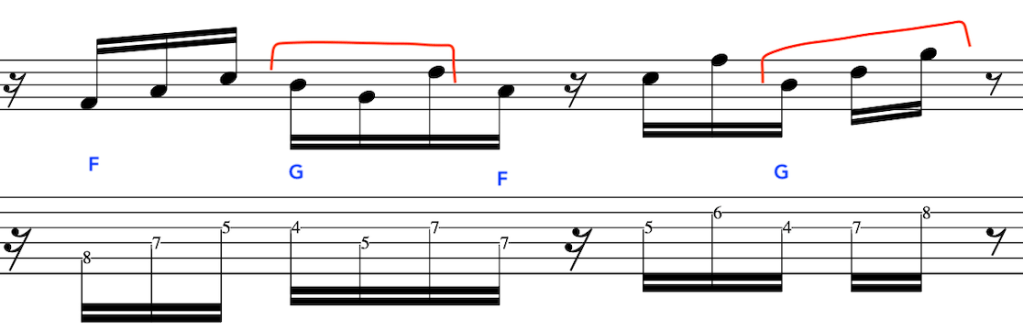
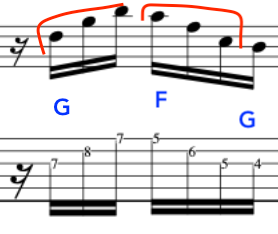
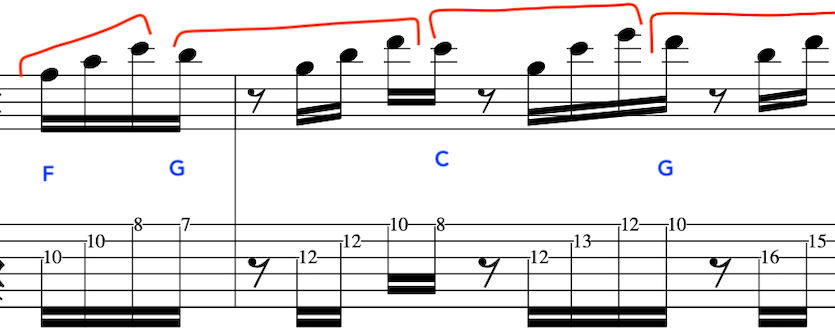
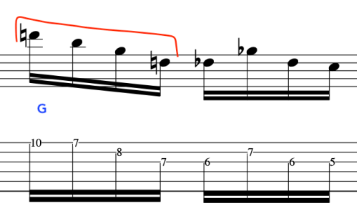
From here, we will extend this to create an ascending line:
Finally, we will make another voicing.
Diagram of chord voicing illustrating the unique structure of the Farben chord variation.
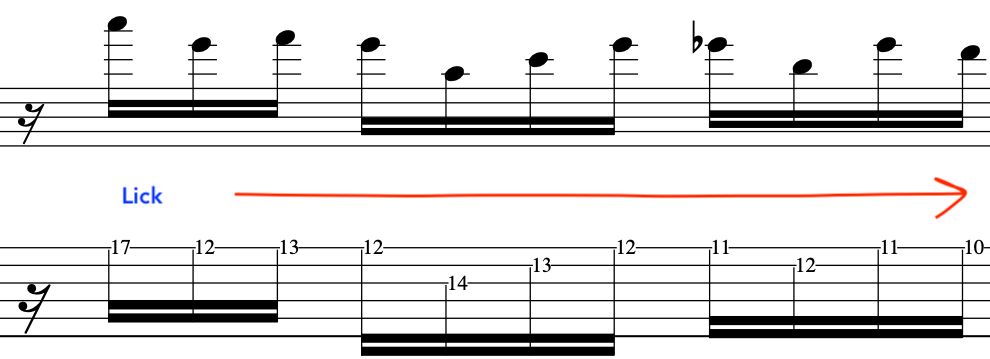
If we take the top part, we can create a nice lick from it. This gives a sort of modal improvised line impression.
[Side thought: Unordered 01348: s Forte number is 5-z17, in the taxonomy of Allen Forte].
Today, a look at the final chord of Arnold Schoenberg’s “Sechs Kleine Klavierstucke” 2nd movement. In thirds this reads as: C–E–G–B–D♯–F♯–A♯–Cx.
Schoenberg Chord in classic form:
This extended chord of a 15th, can also be viewed and heard as a bi-tonal construction of C Major 7th with Eb minorMajor 7th superimposed on top
Schoenberg Chord Clarified:
This can also, be thought of [especially in terms of the guitar] as an arpeggio of CMaj7 and an Arpeggio of EbmMaj7.
Due, to the nature of its sound and collection of notes, it can produce some interesting counterpoint. Especially, as the Eb to E natural resolution creates colour and drama. [view video at top of page].
Being, a Bi-Tonal chord it is useful as it gives us triad pairs.
Ascending Line:
Now, we will take this a stage further by adding more chords/triads available.
D+ to C to EbmMaj7 to CmMaj7 to Em7 to Bmaj7
CHORDS:
Let’s now, re voice the chord. Here we will make the chord of C a minMaj7 and add D Augmented [9th] on top.
In the video/audio[a quick demo I created] below, we can hear the dramatic sound of this voicing in the orchestra.
Next, we have two guitar voicing’s. Firstly we have a Bsus/C[or plain B/C]as a typical McLaughlin guitar voicing.
Secondly, we have the same voicing but with a changing bass.
Lastly, another guitar voicing that is useful for chordal picking:
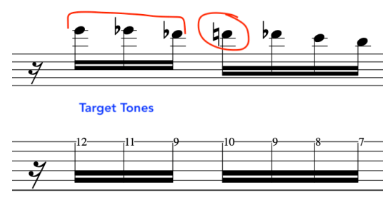
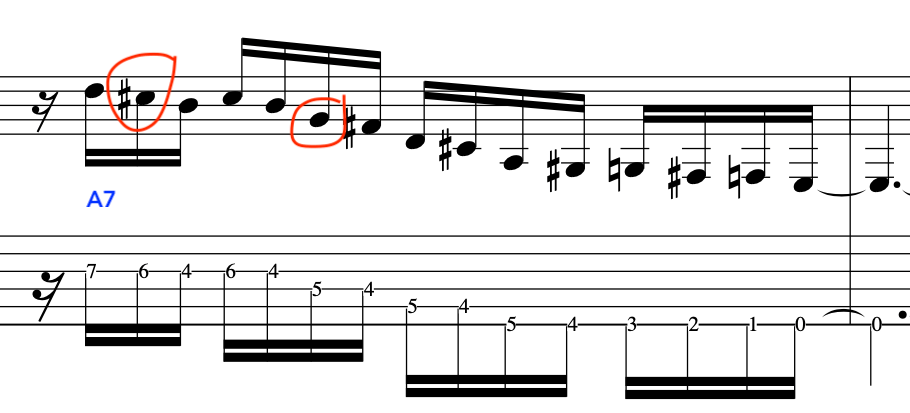
From here, we will add a partial scale descending that is formed from the chord: This chord voicing has a flattened 5th and a sharpened 9th.
Lastly, we can create some interesting and colourful passages by exploiting the intervals inherent within this 15th chord.
Today, a quick look at the amazing “Elektra” chord employed by composer Richard Strauss.
Nowadays, we might consider this to be a 7#9 chord, but looking at this from a 20th century classical perspective we can create much fresher and more interesting material from this worn cliche.
PART 1:
To get a clearer idea, we will exploit “Bi-tonality” and connect two different chords together, E Major and C# Major.
Music notation showing E Major and C# Major chords, illustrating bi-tonality for the Elektra chord.
From this, we will remove the third [the G#] from the E Major triad and look at the C# Major triad enharmonically as Db Major.
So, now connected we have a Chord of Db7/E
Chord notation illustrating the Elektra chord (Db7/E) in relation to E Major and C# Major.
For Guitar:
Here, is the Arpeggio with TAB
Illustration of the arpeggio/chordal outline for the Elektra chord
Here, are 3 octaves of the arpeggio/chordal outline with TAB:
Illustration of the arpeggio/chordal outline for the Elektra chord in three octaves.
PART 2:
Now, we will make another “Elektra chord” so that we have two chords to work from.
This new [Elektra] chord, will be C7/Eb
Musical notation illustrating the C7/Eb chord, showcasing the unique harmonic structure.
So, here are our two chord examples:
Musical notation for the chords Db7/E and C7/Eb, highlighting their structure.
Below, I have included audio of a quick orchestration/compositon I did to show how this wonderful harmony sounds when we apply it to the orchestra [Orchestration].
Also, notice how the inner pitches work to create beautiful drama in this tonality. Here we have octaves moving down in semitones in 5ths and then 4ths.
Musical notation illustrating the ‘Elektra chord’ concept as explored in the article.
AUDIO Example:
Next, notice the inner pitches when adding the 5th of the top triad.
AUDIO Example:
PART 3:GUITAR IDEAS:
Here, we have a simple chord and answering phrase:
1] Chord and line: Db7/E
2] Chord and Line: C7/E[/Eb]
Chord and improvised line example for C7/Eb, showcasing voicings and ideas for musicians.
CHORDS: Here are some voicing’s and ideas:
3 Octaves of Elektra Chord: As ascending Arpeggio Movement:
IN CONCLUSION:
As we can see from this quick look at one chord, there is a whole world and a wealth of material within it.
For the serious composer, and improviser this search and re-development of worn ideas/harmony is essential in order to make ones mark.
This renewal, gives us fresh material to work with and a pallet of our own with which to stamp a unique signature that is all ours.