Exploring the Elektra Chord by Richard Strauss

Hi Guys,

Today, a quick look at the amazing “Elektra” chord employed by composer Richard Strauss.

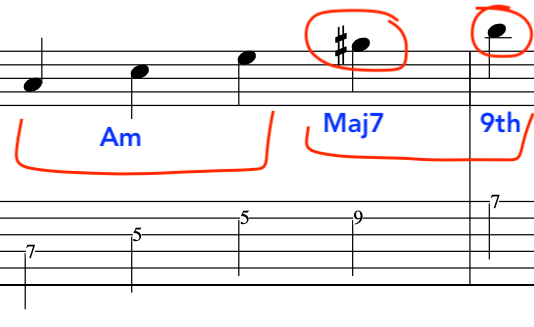
Nowadays, we might consider this to be a 7#9 chord, but looking at this from a 20th century classical perspective we can create much fresher and more interesting material from this worn cliche.

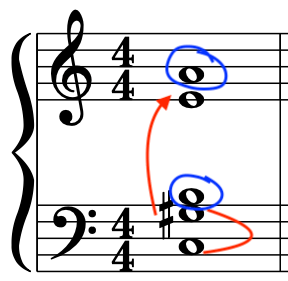
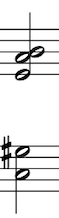
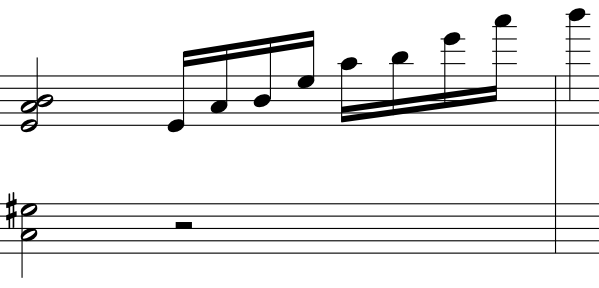
To get a clearer idea, we will exploit “Bi-tonality” and connect two different chords together, E Major and C# Major.

Musical notation showing E Major and C# Major chords on a staff with tablature below of Strauss "Elektra Chord".
Music notation showing E Major and C# Major chords, illustrating bi-tonality for the Elektra chord.

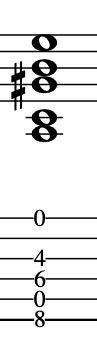
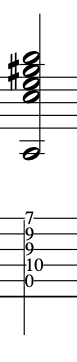
From this, we will remove the third [the G#] from the E Major triad and look at the C# Major triad enharmonically as Db Major.

So, now connected we have a Chord of Db7/E

Sheet music illustrating the Elektra chord, showing E Major, C# Major, and Db7/E chords with corresponding tablature.
Chord notation illustrating the Elektra chord (Db7/E) in relation to E Major and C# Major.

For Guitar:

Musical notation for a Db7/E chord, including staff and tablature for the elektra chord on guitar.

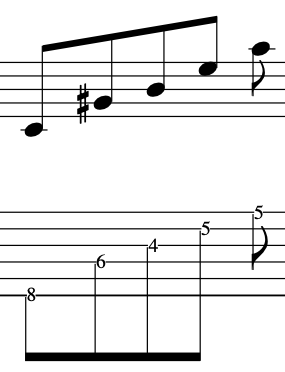
Here, is the Arpeggio with TAB

Musical notation showing a guitar tab and sheet music for the elektra  chord arpeggio with notes and finger positions.
Illustration of the arpeggio/chordal outline for the Elektra chord

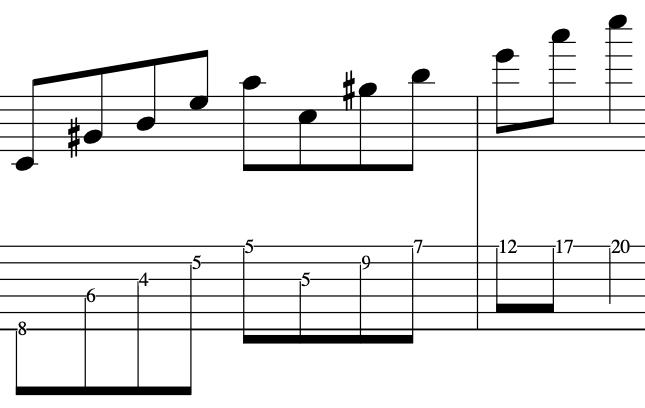
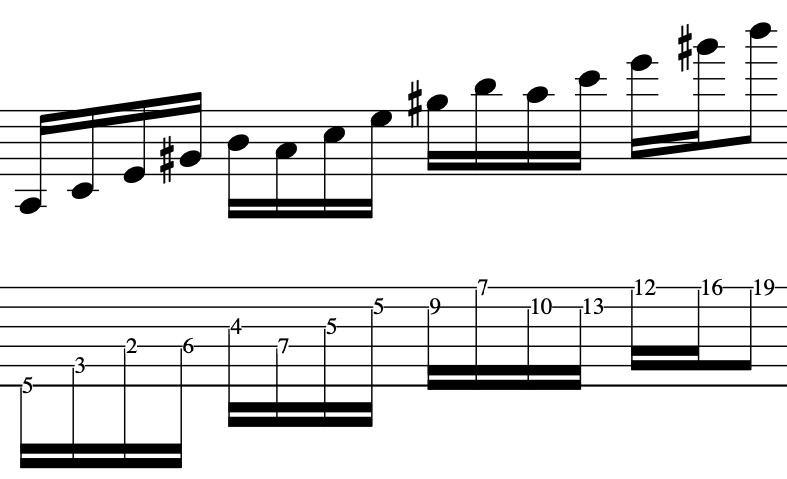
Here, are 3 octaves of the arpeggio/chordal outline with TAB:

Sheet music showing a guitar tab with the arpeggio/chordal outline for the Elektra chord in three octaves.
Illustration of the arpeggio/chordal outline for the Elektra chord in three octaves.

Now, we will make another “Elektra chord” so that we have two chords to work from.

This new [Elektra] chord, will be C7/Eb

Musical notation of the chord C7/Eb showcasing the notes and structure to vary Strauss's elektra chord.
Musical notation illustrating the C7/Eb chord, showcasing the unique harmonic structure.

So, here are our two chord examples:

Sheet music displaying the chords Db7/E and C7/Eb from Strauss Elektra Chord.
Musical notation for the chords Db7/E and C7/Eb, highlighting their structure.

Below, I have included audio of a quick orchestration/compositon I did to show how this wonderful harmony sounds when we apply it to the orchestra [Orchestration].

Also, notice how the inner pitches work to create beautiful drama in this tonality. Here we have octaves moving down in semitones in 5ths and then 4ths.

elektra-chord-richard-strauss-
Musical notation illustrating the ‘Elektra chord’ concept as explored in the article.

AUDIO Example:

Next, notice the inner pitches when adding the 5th of the top triad.

elektra-chord-richard-strauss-

AUDIO Example:

Here, we have a simple chord and answering phrase:

1] Chord and line: Db7/E

Musical notation for the Elektra chord  and improvised line with accompanying tablature for guitar.

2] Chord and Line: C7/E[/Eb]

Musical notation showing a chord progression with the elektra chord  for guitar, including finger placements and notes.
Chord and improvised line example for C7/Eb, showcasing voicings and ideas for musicians.

CHORDS: Here are some voicing’s and ideas:

elektra-chord-richard-strauss-guitar-chords

3 Octaves of Elektra Chord: As ascending Arpeggio Movement:

elektra-chord-richard-strauss-example-3-octaves

As we can see from this quick look at one chord, there is a whole world and a wealth of material within it.

For the serious composer, and improviser this search and re-development of worn ideas/harmony is essential in order to make ones mark.

This renewal, gives us fresh material to work with and a pallet of our own with which to stamp a unique signature that is all ours.

20 Century Classical Music: Plectrum Guitar Concepts/Patterns

Hi Guys,

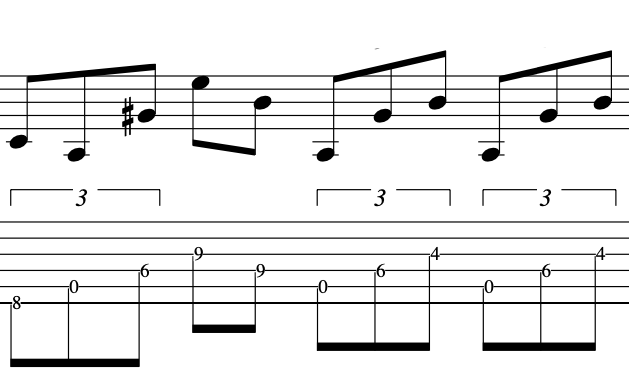
Today, a quick look at picking intervals on the guitar in an atonal fashion and creating innovative composition/improvisation.

Our example, exploits uneven/untidy intervals and creates a Stockhausen-esque [in terms of plectrum guitar] way of working and listening whilst placing these intervals.

Here, we will pick 5/4 and 3/8 Rhythmic units, and make the most of the guitars resonances from the bass to the treble.

This works really well, when the bass note is “Sustained” as the treble note is plucked. [The opposite can be applied also, as staccato]

Stockhausen, Guitar, Lesson,  intervals, alternate, time, signatures, composing, improvising, Free, PDF, Download
Stockhausen guitar composing improvising lesson concepts: Alternate Time Signatures

In the next bar, we will again make adventure with our “Atonal Intervals”. We will utilise our wide string skipping and move back to the 5/4 unit.

Stockhausen, Guitar, Lesson,  intervals, alternate, time, signatures, composing, improvising, Free, PDF, Download
Stockhausen guitar composing improvising lesson concepts

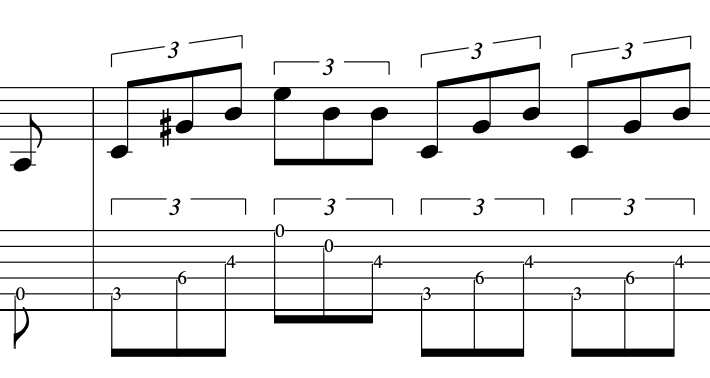
The rhythm in this next bar, now employs four “Three” note groupings in 12/8 [or as triplets in 4/4].

This changes the rhythmic effect, and makes the intervals less harsh and more even and interesting to the ear of the listener.

Stockhausen, Guitar, Lesson,  intervals, alternate, time, signatures, composing, improvising, Free, PDF, Download
Stockhausen composing improvising guitar muslesson concepts

To offset this, we now have an irregular feel with 7/8 which will lead us back into a regular 4/4 set up with chords.

Like Boulez, this is all really a play on opposites.

Stockhausen, Guitar, Lesson, alternate, time, signatures  composing, improvising, Free, PDF, Download
Stockhausen composing improvising guitar lesson musical concepts

Finally, we have our chords: But, they too are slightly offset, so that nothing ever feels quite stable and hence, keeps the listener on their toes!

Stockhausen, Guitar, Lesson,   composing, improvising, Free, PDF, Download
Stockhausen composing improvising guitar lesson musical concepts
Musical notation and tablature illustrating uneven intervals and rhythmic units on guitar for atonal composition.
Guitar notation and tablature illustrating atonal intervals and rhythmic complexities for innovative composition.

IF THIS LESSON WAS OF USE TO YOU THEN PLEASE SUBSCRIBE TO US BELOW ON YOUTUBE, THANKS!

Master “McLaughlin” style Hexatonic Guitar Techniques for Smooth Playing

Modern Jazz Fusion Chords part 2. Steely Dan, Dan Chord and Slash Chords

CLICK SUBSCRIBE!

hexatonic-guitar-exercises-alternate-picking-examples

Hi Guys,

Today a quick look at connecting “Hexatonic” groupings together with strict alternate picking guitar technique.

The key is to glide or slide or let the fretting hand fall naturally into each position. This way the connections are made smoothly.

If the fretting hand panics, or releases from the position then it will fall apart: So connecting SMOOTHLY from each 6 grouping to the next= The Key

hexatonic-guitar-exercises-alternate-picking-examples

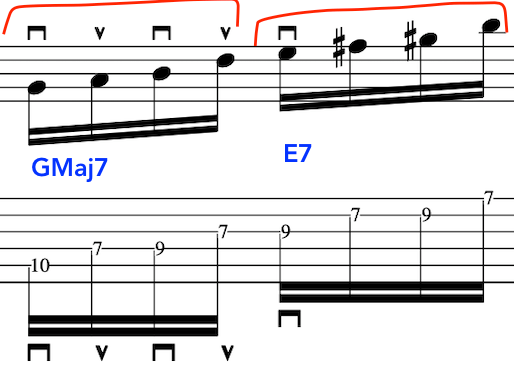
Because we have the 2 extra notes Hexatonics work well at a slower tempo’s like 100 to 120 Bpm for Fusion double timing:

Here is the first Exercise/Example: This starts on a down stroke with strict alternate picking:

hexatonic-guitar-exercises-alternate-picking-examples

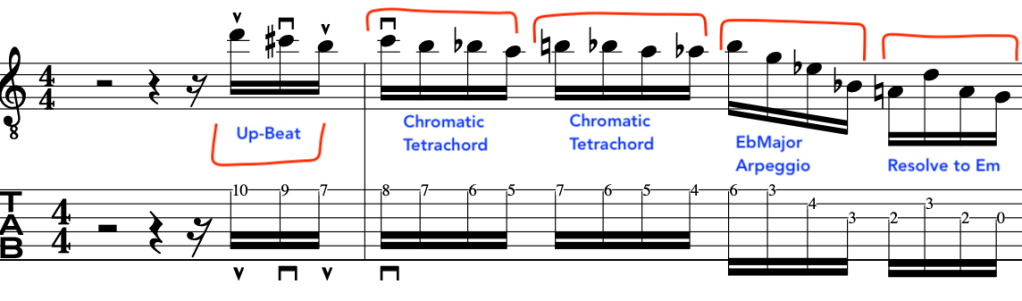
Notice, that in the second bar we have an arpeggio/triad figure:

hexatonic-guitar-exercises-alternate-picking-examples

This arpeggio can throw your alternate picking because it breaks up the scale momentum. So, you have to prepare for it and be aware that there is a quick change of movement in the fretting hand as you cross the strings.

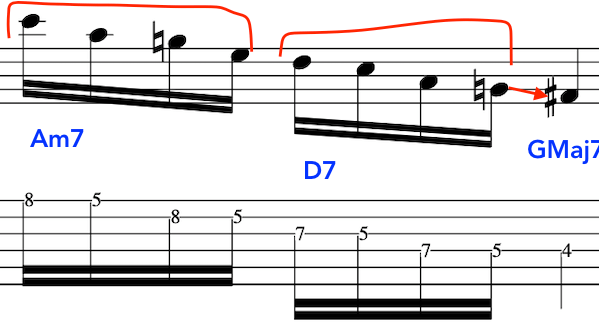
Here, we have an ascending exercise that connects together easily and naturally.

Again, it starts on a downstroke with strict alternate picking.

hexatonic-guitar-exercises-alternate-picking-examples

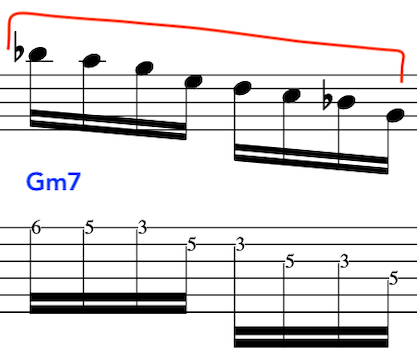
Here is the same exercise, but, with a VARIATION at the end:

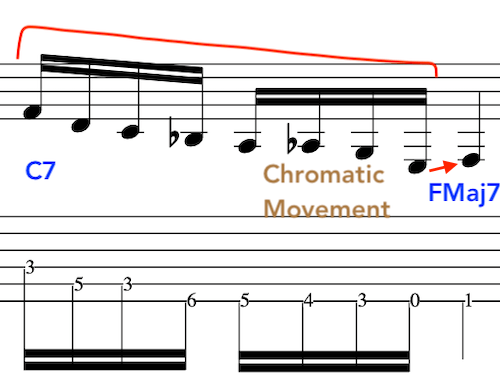
Finally, we have an example that employs the downstroke and the upstroke:

Here is the first part starting on a downstroke:

hexatonic-guitar-exercises-alternate-picking-examples

Next, we have a rest and then start the next part on an upstroke to complete the exercise:

hexatonic-guitar-exercises-alternate-picking-examples

FREE PDF DOWNLOAD:

Modern Jazz Fusion Chords part 2. Steely Dan, Dan Chord and Slash Chords

CLICK SUBSCRIBE!