Lessons from Jazz/World to 20 Century Classical Music Harmony Rhythm and Theory
Tag: music theory
How to apply it to the guitar fingerboard. jazz theory and improvisation in practice at the guitar fretboard. How chords are made. How to use scales. The modes of the major and melodic minor scale. Altered chords and scale lessons.
Today, a quick look at the unique 13th chordVoicing of guitar maestro John mcLaughlin.
PART 1:
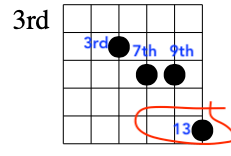
This unique voicing possesses a 7th a 9th with the 13th ringing out on top. It has a lovely sonoroustone :
Diagram of a 13th chord voicing showing the 3rd, 7th, 9th, and 13th notes, highlighting the unique structure.
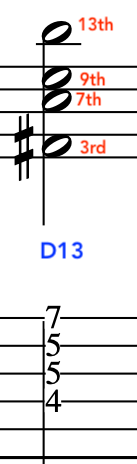
This chord works really well because it’s a 1st inversion, and, without a root it gives us that slightly ethereal painted sound:
Diagram illustrating the D13 chord voicing with 7th, 9th, and 13th notes labeled.
PART 2:
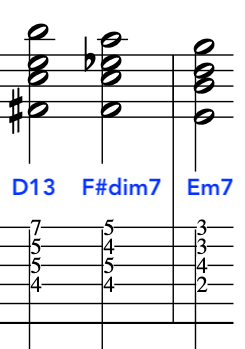
The sonorous nature of this chord makes it shine when moving to a diminished 7th chord for a resolution:
Chord diagram showcasing the D13, F#dim7, and Em7 voicings, essential for understanding the unique textures in John McLaughlin’s 13th chord progression.
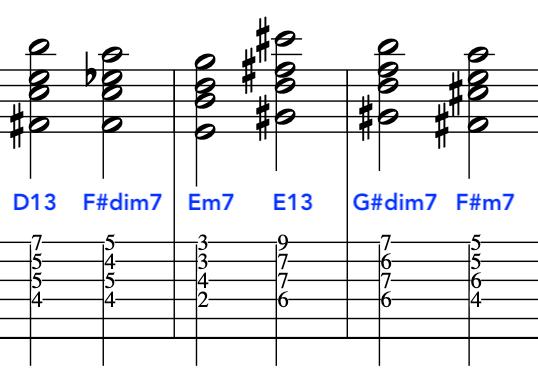
This in turn rewards us with fantastic melodic sequences:
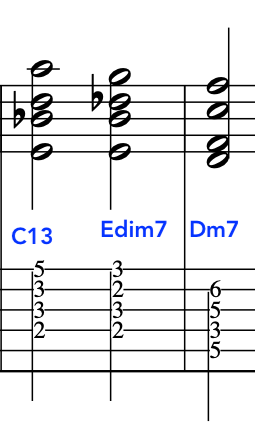
Chord progression illustrating John McLaughlin’s unique 13th chord voicing with associated diminished and major chords.Chord diagram illustrating the C13, Edim7, and Dm7 voicings, highlighting their unique structures and relations.
PART 3:
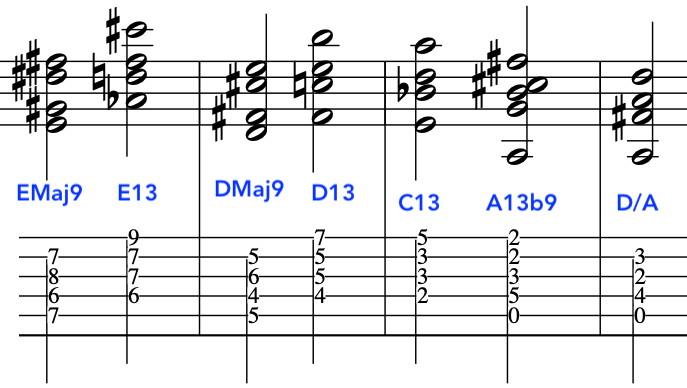
Now, let’s make a sequence by employing strong Major 9th chords that move to John’s brilliant voicing.
If we play the example below we can hear the resonant nature of the two chords.
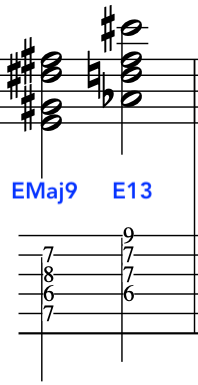
Chord diagram illustrating E Major 9 and E13 chord voicings in a musical lesson.
Now, let’s create a little chord sequence with them:
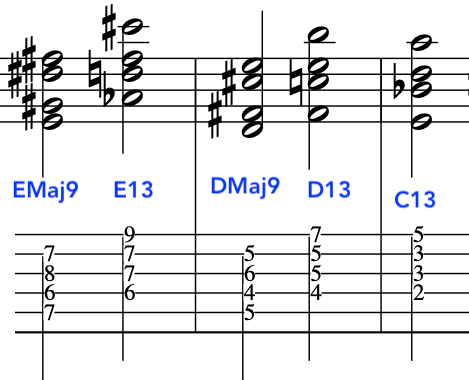
John McLaughlin Chord sequence illustration featuring E13, D13, and C13 voicings.
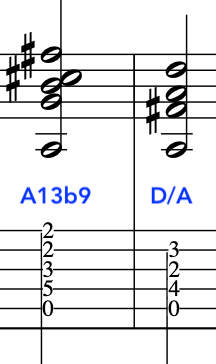
To complete the sequence, we will cadence with a13b9 chord back to the tonic D
Chord diagram for A13b9 and D/A used in the sequence demonstrating John McLaughlin’s 13th chord voicing.
Here, is the full sequence:
Chord sequence illustrating John McLaughlin’s unique 13th chord voicing alongside related Major 9th chords.
PART 4:
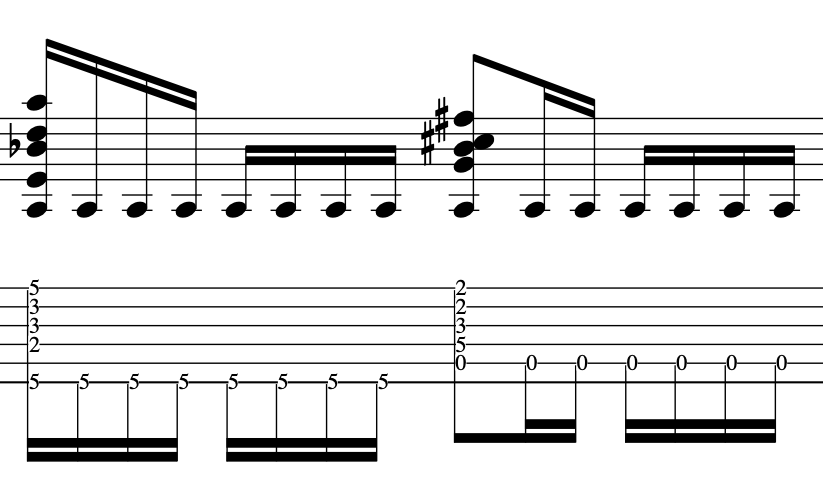
John, also makes good dramatic use of this chord by exploiting a pedal note in the bass for rhythmic drive.
Today, a quick look at John McLaughlin’s “Pentatonic” guitar concepts for playing over the Coltrane Changes.
Although I am employing alternate picking guitar technique at quite a fast rate, these pentatonic’s simplify things enormously.
THE RHYTHMIC SIDE OF THINGS:
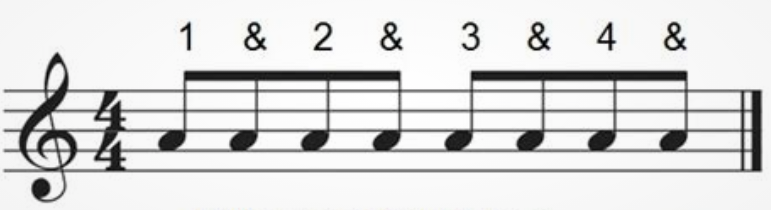
To keep the solo line tight, we will count in a basic manner,
1 and 2 and 3 and 4 and
This way, you will know where you are in the bar and what chord you are playing over.
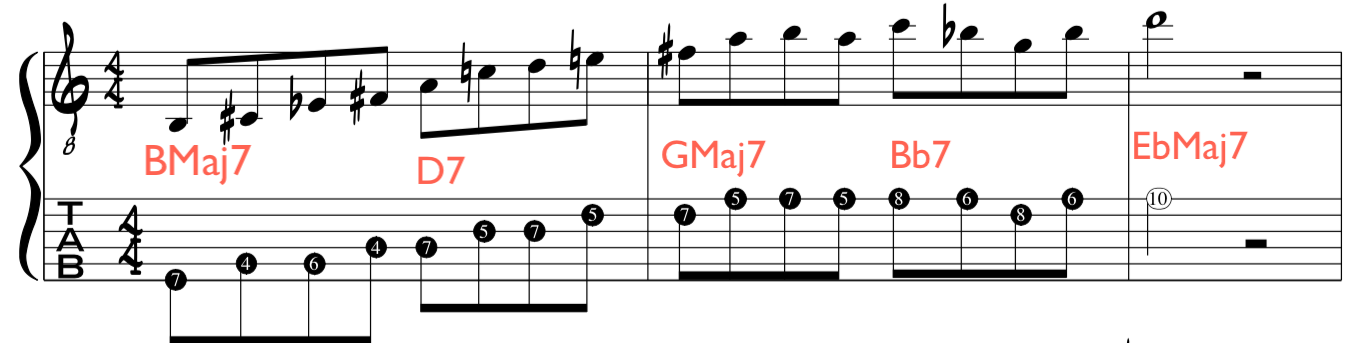
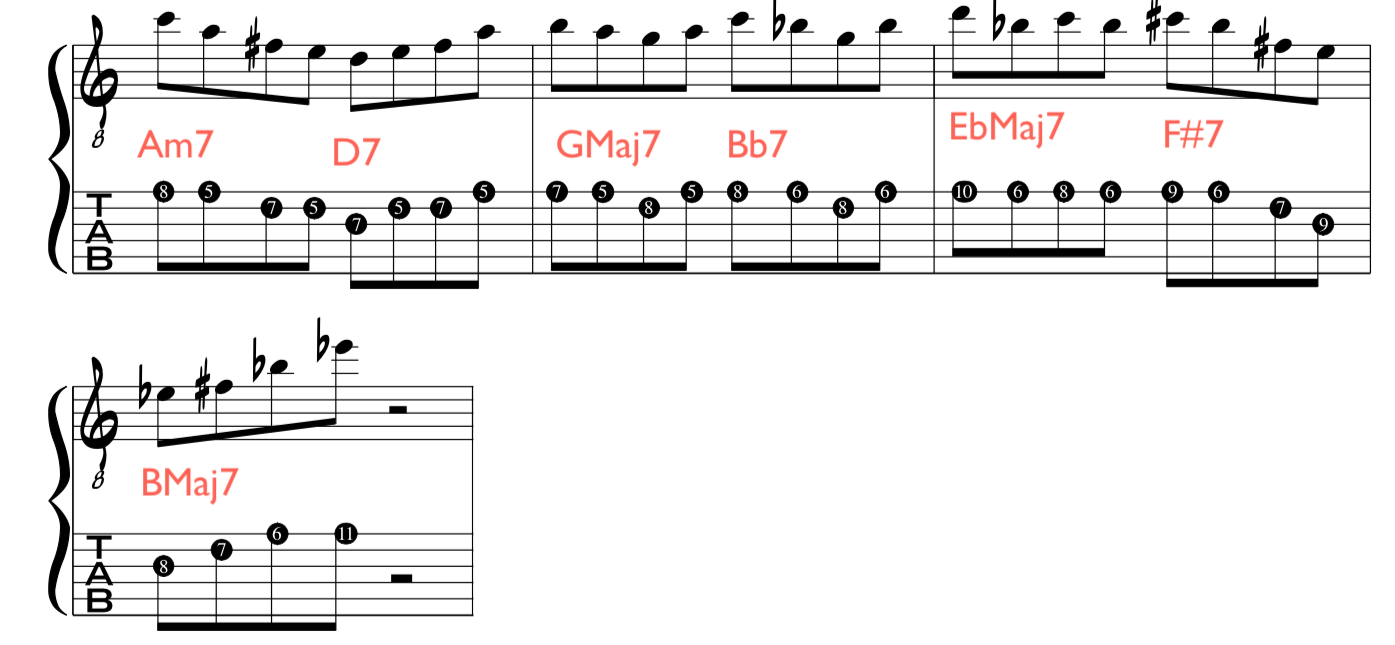
To begin with I use the B major pentatonic scale. Next, I employ a simple 2 finger pentatonic scale over D7 and GMaj7.
I then play the second part [same fingering] up a semitone and land on the note D for the EbMaj7 chord, counting 1 2 3 4 in preparation for the next chord.
John McLaughlin Giant Steps BMaj7, D7, GMaj7, Bb7, and EbMaj7 for guitar players.
For the first three chords I play what could be called “A Dorian Pentatonic”. But, I am not really thinking in that way. [I am just adding the F# note for the 3rd of D7]. This in turn creates a very simple and “Fluid” guitar fingering that is very common to most guitar players and hence easy to play.
John McLaughlin giant steps guitar chords Am7, D7, Gmaj7, Bb7, EbMaj7, F#7, and BMaj7.
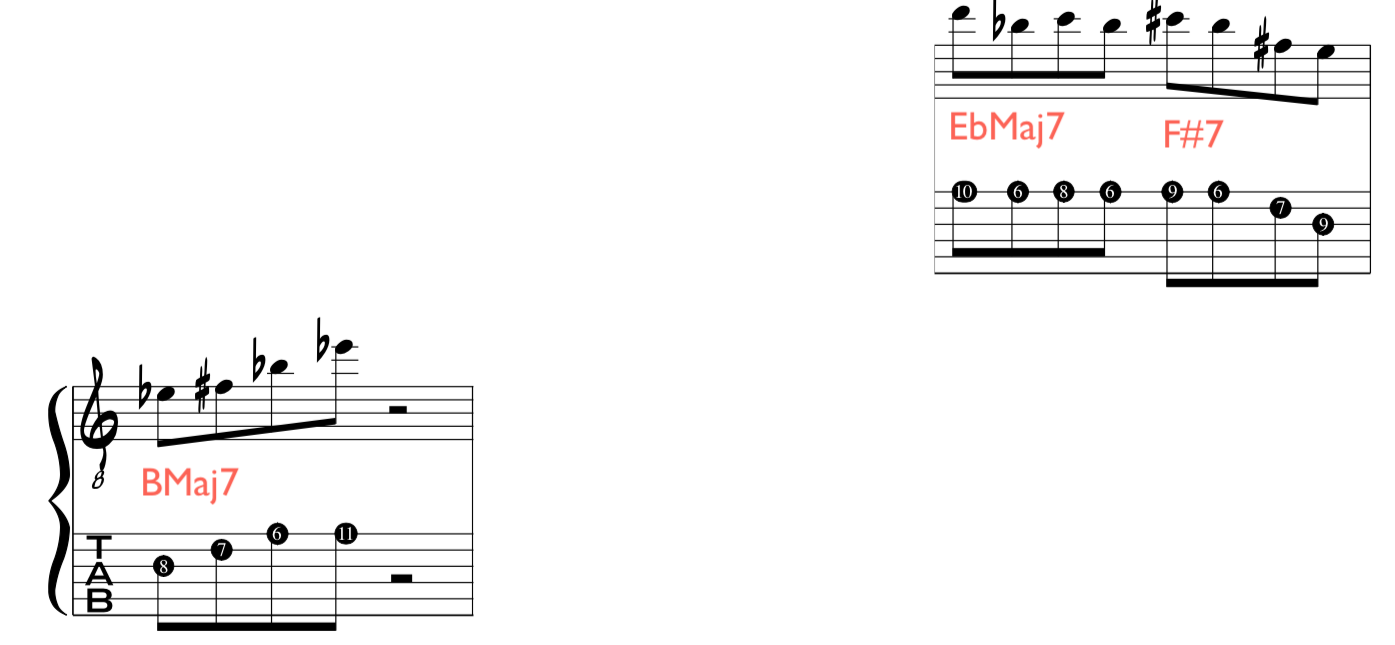
On the F#7 chord I play an F#7 arpeggio that then resolves into an Eb minor arpeggio for the BMaj7 chord.
McLaughlin Musical notation showcasing the BMaj7 and EbMaj7 chords alongside the F#7 arpeggio.
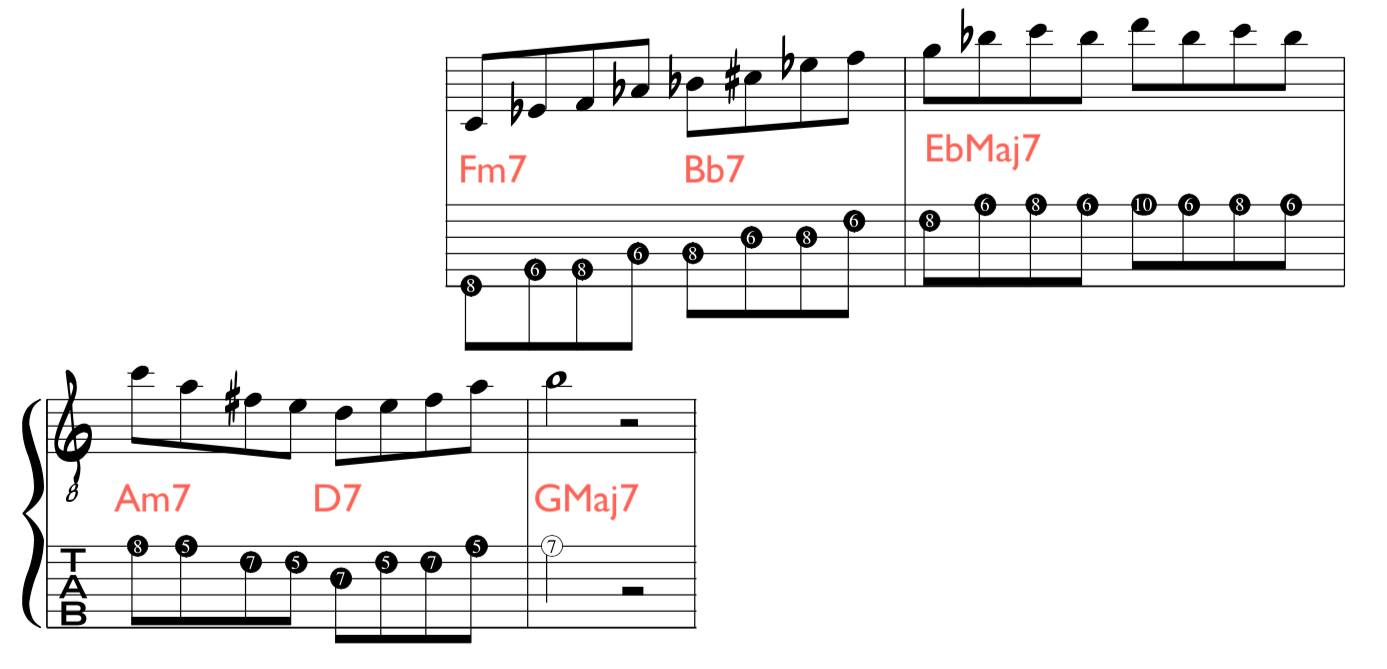
For then next part, I again employ a simple Pentatonic to get through the first three chords.
This Bb minor leaning works well because over the Bb7 chord it gives us the “Blue note”. Finally we use our A Dorian Pentatonic again to resolve to GMaj7 for our last three chords.
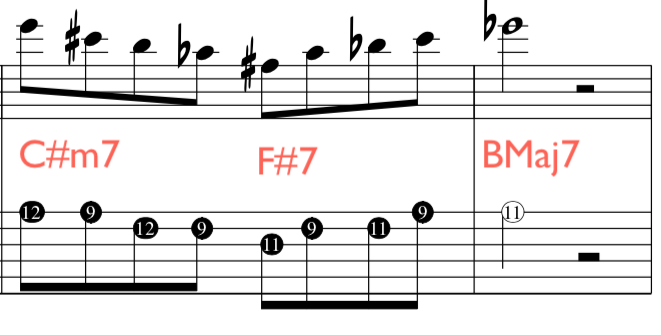
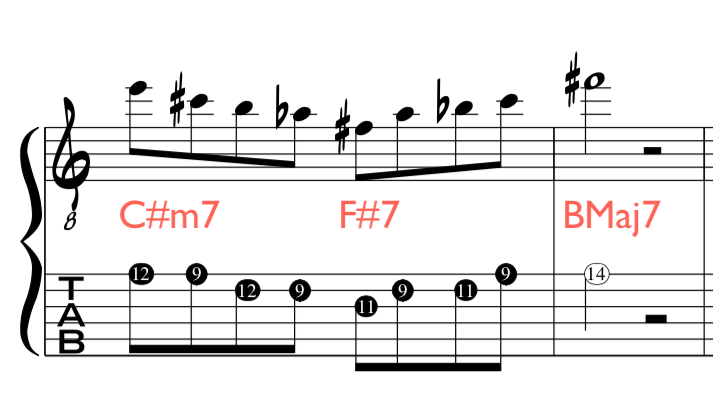
Here, I just use C#m pentatonic and F# Pentatonic to land on the D# to nail the change to the BMaj7 chord. Very simple and very common guitar fingering.
Musical notation highlighting C#m7, F#7, and BMaj7 chords for McLaughlin’s giant steps.
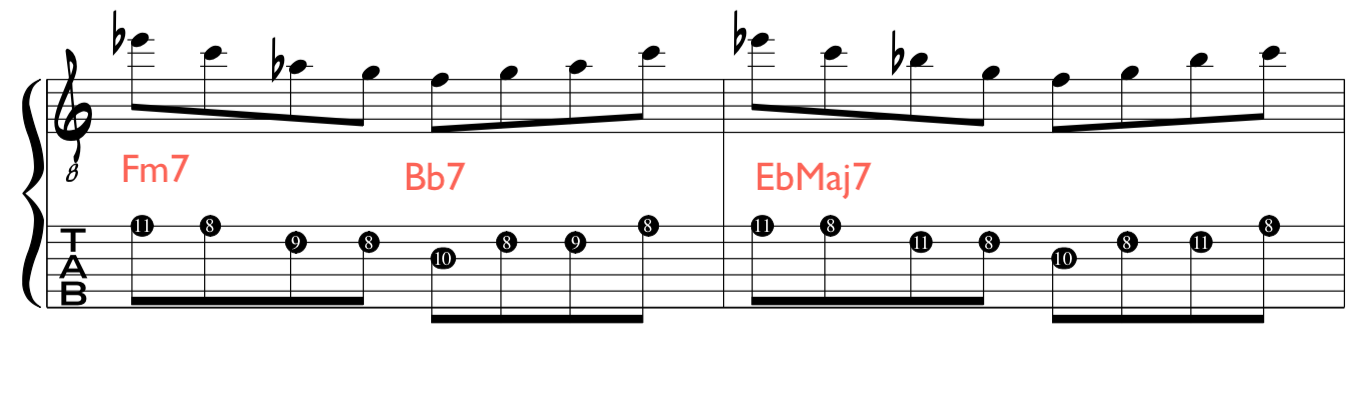
For the last part, I employ an Fm9 arpeggio and a C minor pentatonic scale that then goes up a semitone and repeats our C#m7 F#7 to Bmaj7 phrase.
Music notation for Fm7, Bb7, and EbMaj7 chords, illustrating McLaughlin guitar techniques.
But, this time we land on an F# for the 5th of BMaj7.
Today, a look at John McLaughlin’s emotional and melodic chords for composition and reharmonisation.
PART 1:
The key to both parts of this blog is the employment of the 1st Inversion Major chord and its resonant guitar voicing:
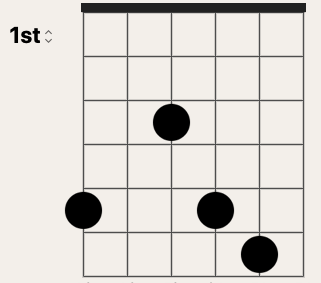
Below, is the key voicing shape: Here, we have F Major as a 1st Inversion [or F/A] voicing:
Diagram showing the F Major 1st Inversion (F/A) chord voicing.
From this, let’s take the sequence from John’s classic “Electric dreams/Electric Sighs” composition.
John’s melodic harmony:
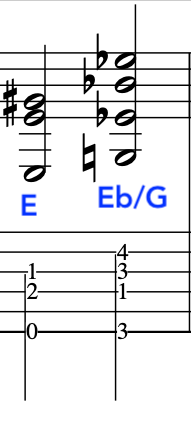
We will start with a basic E Major chord that will then go to an Eb first inversion chord:
Chord progression from E Major to Eb first inversion in a musical notation.
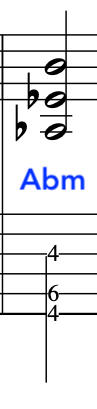
From here, we will resolve this by moving to Ab minor:
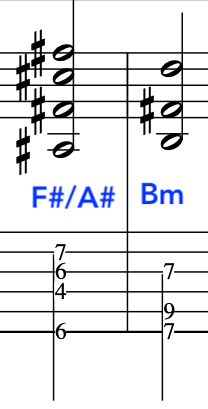
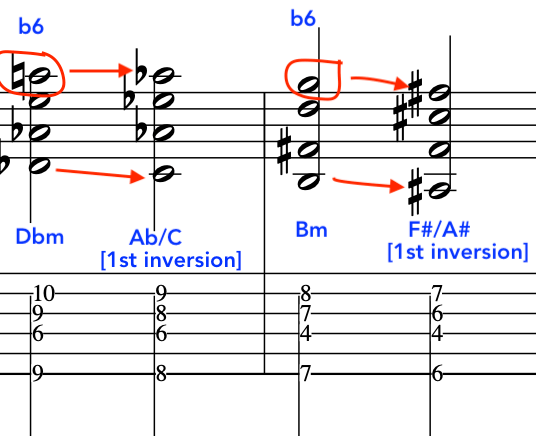
We will now repeat the pattern, and, create an ascending sequence with F#/A# resolving to B minor:
Chord progression featuring F#/A# resolving to B minor, illustrating melodic harmony.
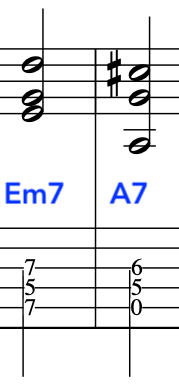
There is now an implied cadence with Em7 to A7. But, this doesn’t Modulate to the key of D,
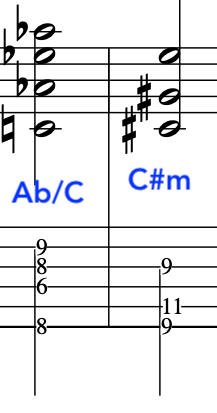
Instead, we carry on with the sequence. This time we employ Ab/C to Db minor[enharmonically C#m]
Musical notation illustrating the Ab/C to C# minor chord transition, highlighting melodic harmony.
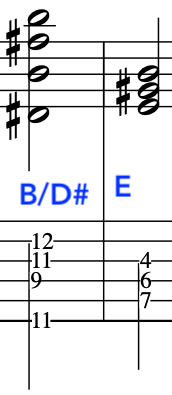
And finally, we do resolve, but, this is back to our tonic chord/Key of E Major.
Musical notation showing a B/D# chord transitioning to an E chord.
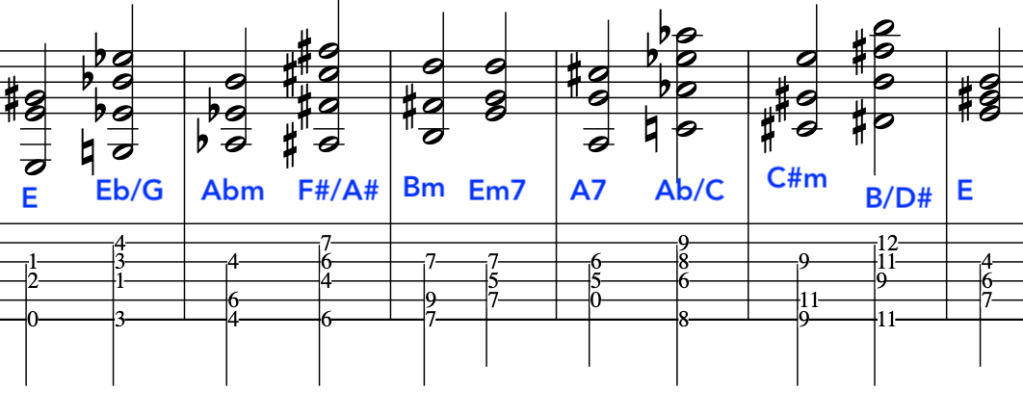
FULL SCORE:
Musical score featuring various chord progressions and their notations for melodic harmony.
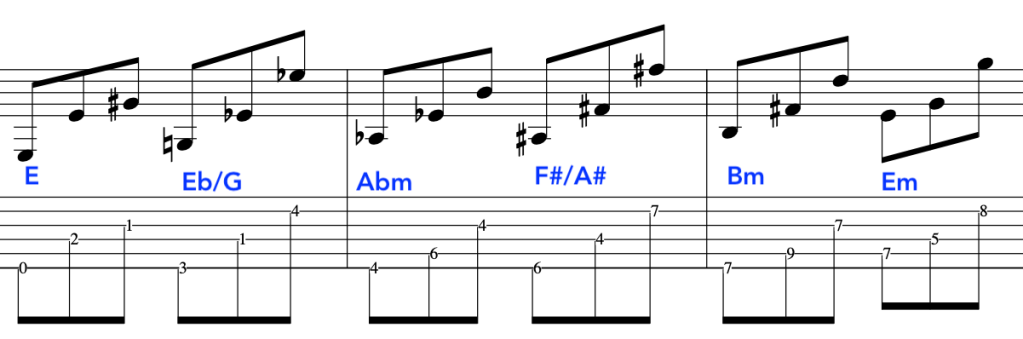
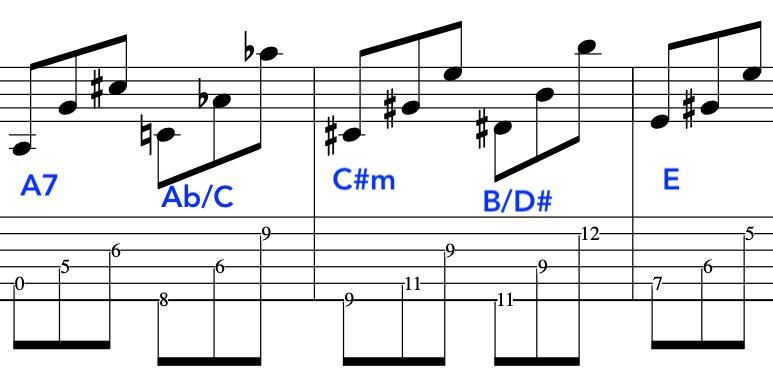
With this type of beautiful, creative, melodic harmony, it’s a good idea to apply arpeggios to underline it and give it movement.
Musical notation showcasing arpeggio chord transitions including E, Eb/G, Abm, F#/A#, Bm, and Em.Musical notation illustrating chord transitions with A7, Ab/C, C#m, B/D#, and E.
PART 2
The minor b6 and First Inversion Chord Relationship:
Most people seem to have a preference for the minor 6th chord, [which in this case has the F# or the Major 6th].
But, the minor flattened 6th chord [F natural in this case] has an amazing character of its own, [especially when it resolves to the first inversion, as we will see].
What makes the minor chord with a flattened 6th work really well is to move down to a first inversion chord.
EXAMPLE:
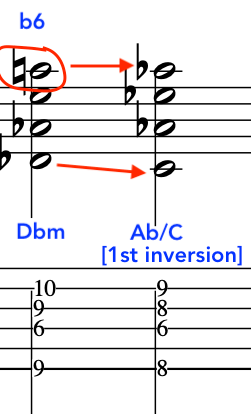
Here, we have a Db minor chord moving down to a 1st inversion Ab Major chord:
Notice the flattened 6th note of A at the top moving down a semitone to the Ab note:
Illustration of the Db minor flat 6th chord to 1st inversion Ab Major chord, highlighting the flattened 6th note.
This smooth chordal transition works beautifully when creating melodic sequences.
Diagram illustrating the transition from Db minor to Ab major first inversion, highlighting the flattened 6th note.
Let’s now add some more first inversion chords:
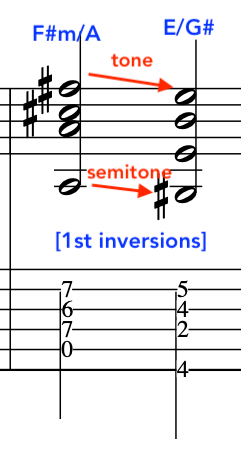
Here, we employ F#m/A with the bass resolving a half step down to the G # note.
Once again, we have a wonderful melodic transition, this time going to the E first inversion chord.
Illustration of F#m/A and E/G# first inversion chords highlighting tone and semitone relationships.
In order to move away from cliche-dom we will now alter the harmony a bit.
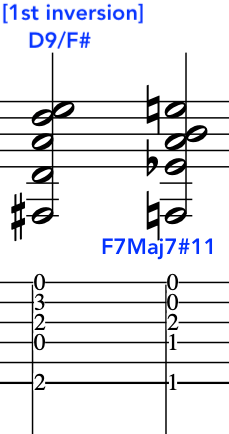
Here, we will add a chord of D9/F#[1st inversion] and let the bass move down a semitone to a chord of F7 [but with a Maj7th also and a #11th].
Chord diagram illustrating the first inversion D9/F# and F7Maj7#11 chords
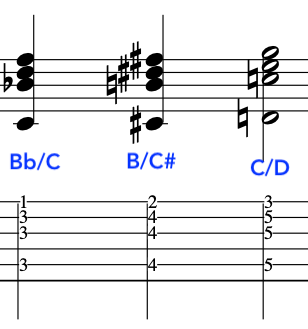
To complete this example, we will exploit chains of 7 Sus4 chords: Here, are the first three chords moving up in semitones.
Illustration of 7sus4 chord transitions in semitones, featuring Bb/C, B/C#, and C/D for musical composition.
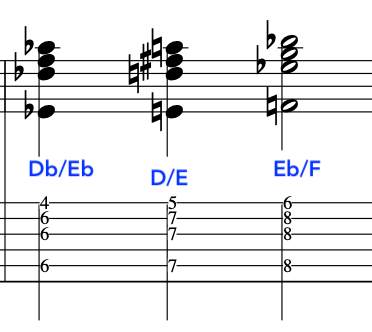
Here are the next three chords moving up in semitones :