Alternate Picking Leverage:Open String Concept:

Hi Guys,

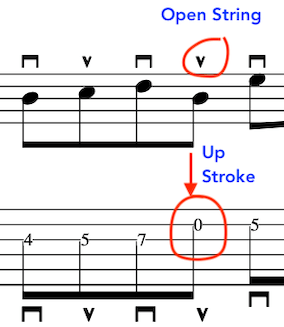
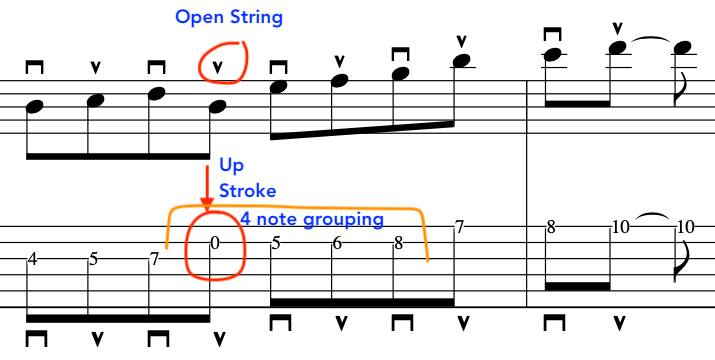
Just, a quick response Blog to a video I made about employing the “Open” [2nd] string ascending with alternate picking guitar technique.

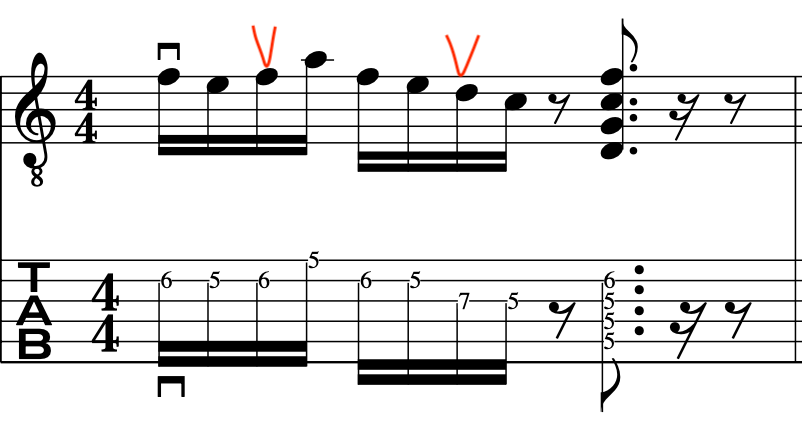
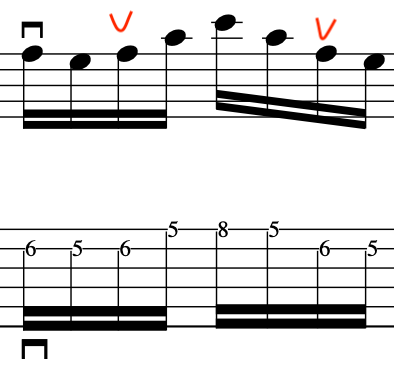
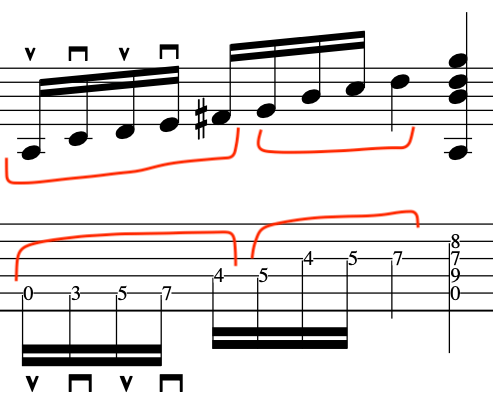
The main reason that this works, is because it is an “Even” grouping, and, by plucking the open 2nd string it gives the fretting hand a fraction of a second to relax and get into position.

This in turn gives us some natural and excellent leverage. This also, means that we have the “Up” stroke to descend with.

This technique works really well for the precise picking passages both in Fusion and World Music, like, for example the precise lines of McLaughlin’s “Shakti” compositions.

This extra note, or even pattern, works in principle like a Be bop scale in that the extra note creates a smooth picking line for the right hand.

alternate_picking_guitar_technique_expalained

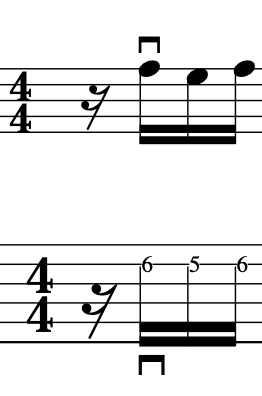
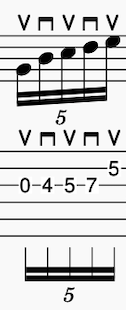
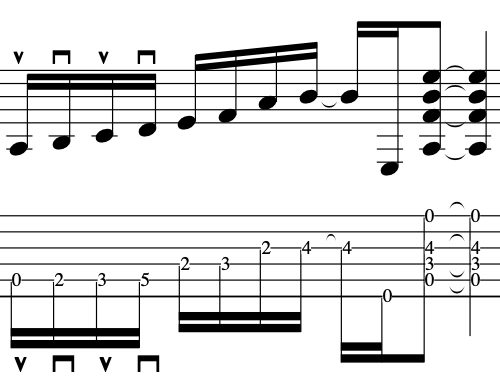
This gives us, the 4 note “Even” grouping.

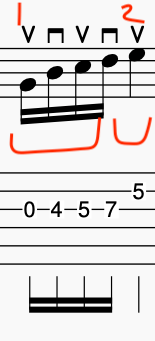
alternate_picking_guitar_technique_expalained

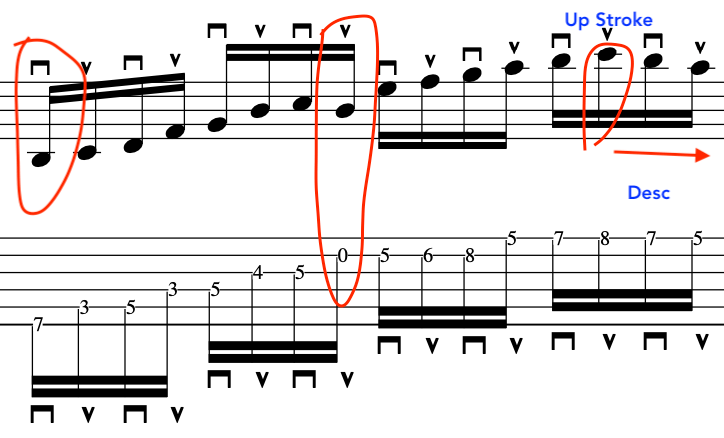
In this example, we can see where the “Up” stroke occurs, which, sets us up nicely to descend:

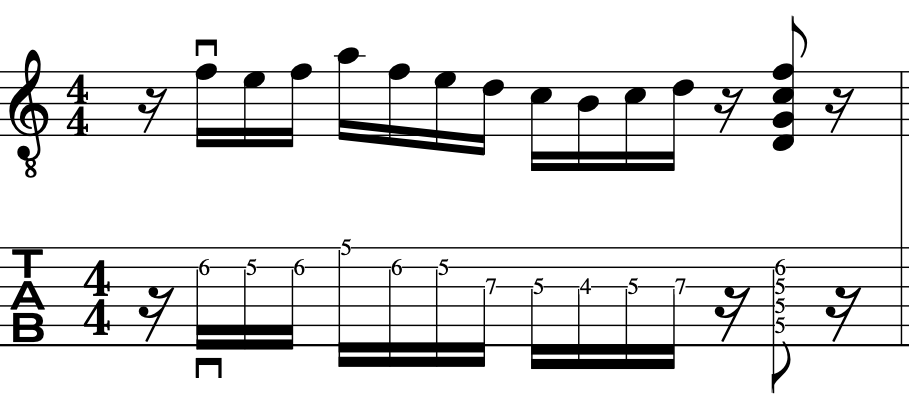
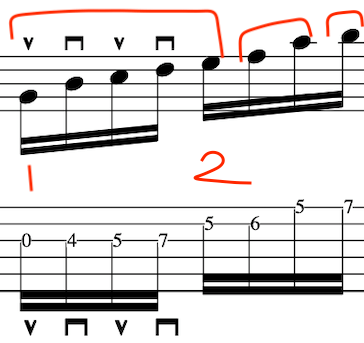
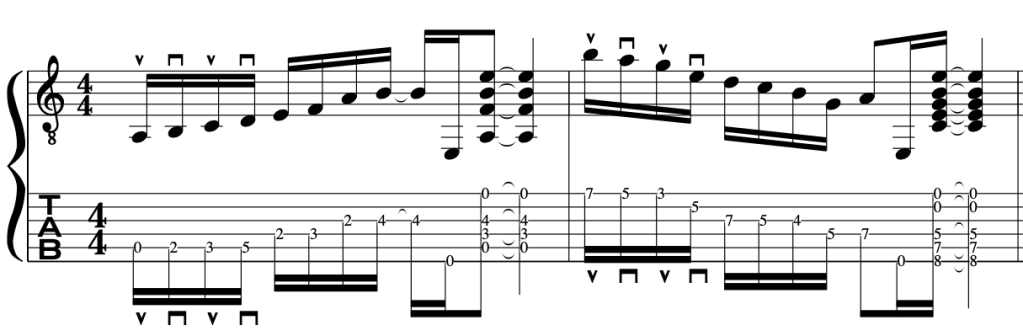
Here, is the whole scale passage.

Also, notice that the open B string is “Off” the beat.

alternate_picking_guitar_technique_expalained

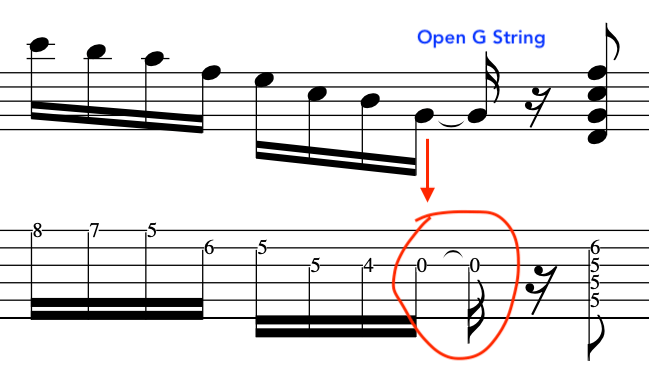
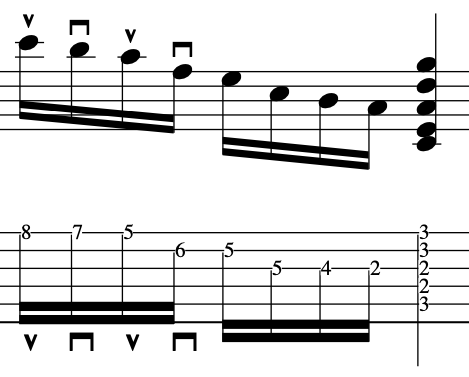
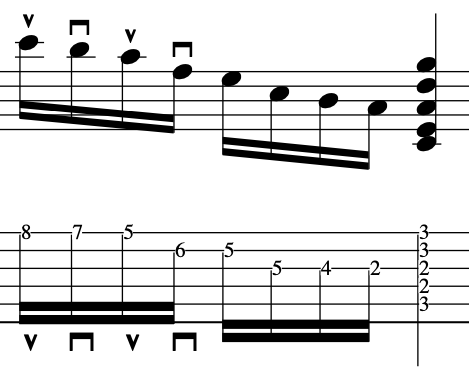
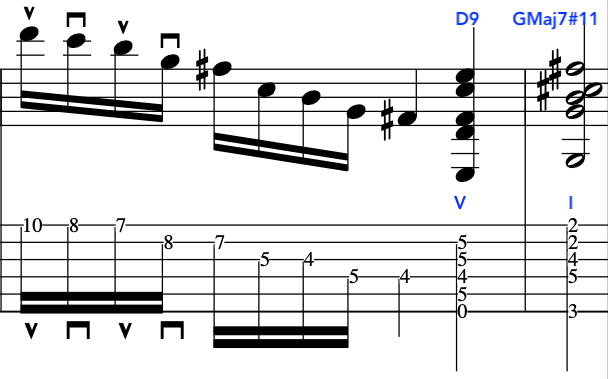
There are, other open strings that we can exploit. But, for the sake of a quick response blog we will just look at one more idea and that is for descending:

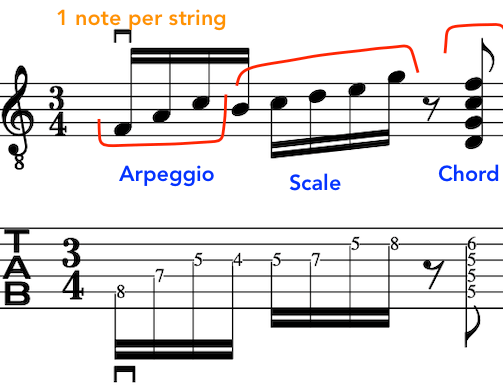
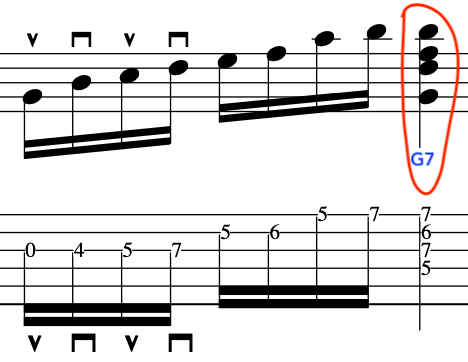
Here, will will pluck the open G string and then add a chord. [Again, notice the the open string is off the beat]

alternate_picking_guitar_technique_expalained

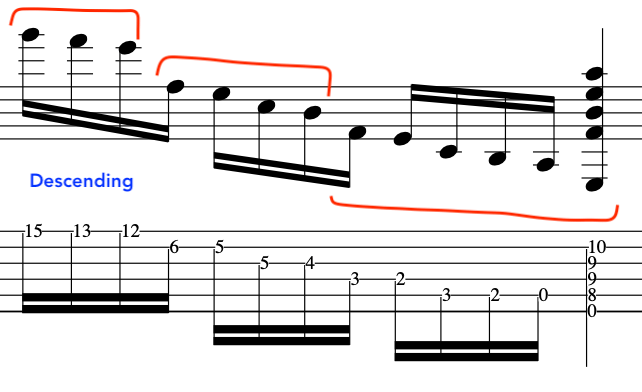
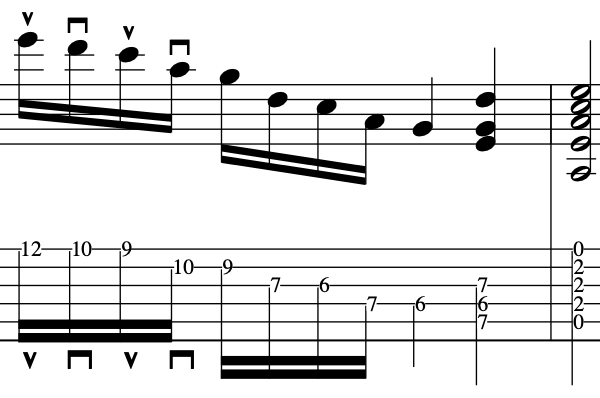
Finally, let’s extend this:

alternate_picking_guitar_technique_expalained

This is only touching the surface. There are many variations on this and any string can be employed both ascending and descending.

Now, you might say what if the open B note isn’t in the key? Well, this doesn’t matter as it is only one note and can add colour. John McLaughlin does this to great effect. Also, due to the picking and the velocity the ear of the listener is not really affected, it’s very difficult to tell.

Lastly, this is not a shred gimmick or a means of tremolo picking and trying to play fast. It is a concept for really precise picking awkward lines, when, for instance you are doubling with a Sax or Piano or as a Rhythmic “Shakti” style line with a tight drum/drummer/percussionist.

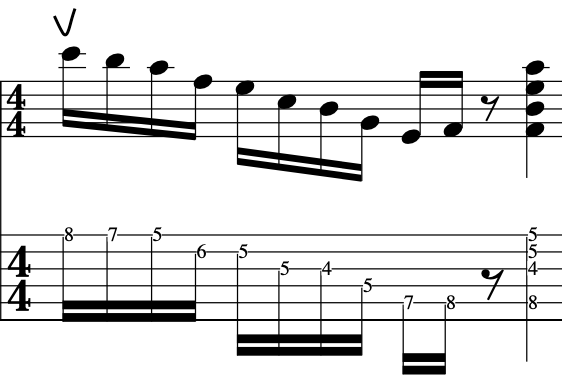
Alternate Picking from Ascending 5’s

Hi Guys,

Today, a quick look at building from the “Ascending group of 5” with alternate picking guitar technique.

This group of 5 exploits the “Up” stroke. It works well as a tool for building longer and longer lines/phrases.

This is NOT shred and is really only for jazz, fusion and world-esque music like John McLaughlin’s super creative outlet Shakti. It is an improvisers tool.

Here is an example of the 5 figure. It consists of an open string and starts on an upstroke.

This 4 note + 1 sets up the upstroke for the string cross.

alternate_picking_guitar_technique_example

Here’s how it would be as a tetrachord to the next beat. [As opposed to a quintuplet or Ta ka di mi Thom.

alternate_picking_guitar_technique_example

Let’s now build off of the ascending 5 figure.

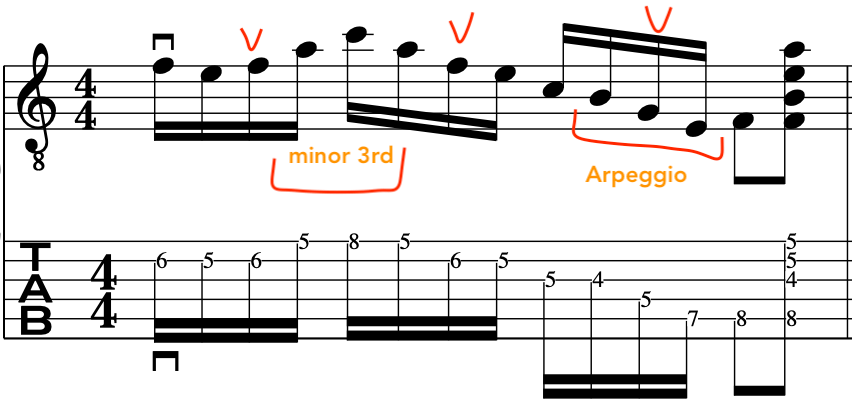
In the example below, we can clearly see the extension from the 5’s to 7’s to two groups of 4 note tetrachords.

alternate_picking_guitar_technique_example

From here, we will add a Dom7th chord to the scale/phrase.

alternate_picking_guitar_technique_example

This sets us up nicely to descend smoothly starting on the upstroke.

alternate_picking_guitar_technique_example

Here, we will do exactly the same thing, except that this time we are moving from G7 to C Major. [Notice the open string and 5 figure extended].

alternate_picking_guitar_technique_example

Once again, the descent is on the upstroke.

alternate_picking_guitar_technique_example

FULL EXAMPLE:

alternate_picking_guitar_technique_example

Here, we see the process in action again. The line building from the 5 figure.

alternate_picking_guitar_technique_example

The descent starts on the upstroke as before, but, this time leads to a perfect V I cadence:

alternate_picking_guitar_technique_example

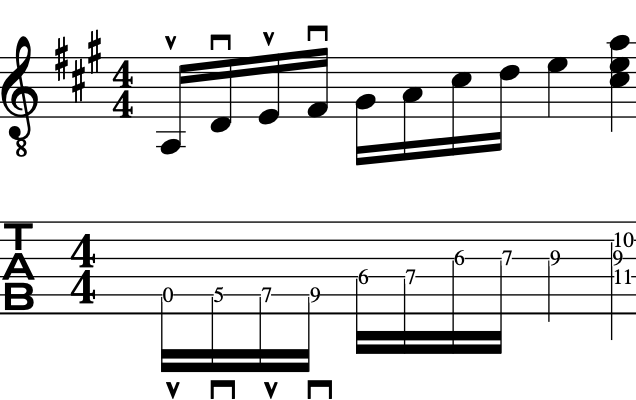
Here is a variation, but, this time in the key of A Major.

alternate_picking_guitar_technique_example

The same form of descent is employed that once again ends in a V I cadence.

alternate_picking_guitar_technique_example

John McLaughlin-Prime Numbers-Alternate Pick Guitar Examples/Thoughts

Hi Guys,

Here are the Number groupings from the Youtube video I posted today as promised.

First of all we have the 4+1 or 1 e and a 2. [Hence nailing the next beat].

Sheet music showing rhythmic grouping of John McLaughlin's 4 + 1 with notes and time signatures for guitar technique.

This could also be transformed into a quintuplet. Or, Ta ka di mi thom from Johns use of Konokol.

john-mclaughlin-guitar-lesson

Here, we double this amazing “Prime number”.

NOTICE: We start on a downstroke for the first grouping and then start on an upstroke for the next grouping.

Musical notation with notes and tablature for guitar, showcasing various rhythms and groupings of John McLaughlin guitar techniques.
Musical notation and tab demonstrating alternate picking techniques and rhythmic groupings .

In terms of “Alternate Picking” guitar technique this creates some magic dust in our favour as not only are we two beats ahead of typical 4 note picking groupings, we are also connecting with both the up and downstrokes resulting in very quick and fluid picking.

From this, we can then start to break it up into musical motifs or phrases or riff/unison material.

john-mclaughlin-guitar-lesson

The next great number for interesting phrasing and alternate picking groupings is the prime number 7

Music notation showing a sequence of notes with a 7 for John McLaughlin alternate picking and time signature.

Now, let’s connect these two prime number patterns together!

Sheet music notation showing guitar tabs and rhythmic markings for musical phrasing, prime numbers and John McLaughlin's alternate picking techniques.
Musical notation illustrating the connection of two prime number patterns in guitar technique.

This next example is also useful, although, it’s not a prime number but a group of 6 notes “Sextuplets”

Musical notation illustrating a sequence of six notes. McLaughlin's  a rhythmic pattern.

From this, let’s add two more notes to form a common grouping of 8 notes:

john-mclaughlin-guitar-lesson

We will now add one more note for a group of 9

john-mclaughlin-guitar-lesson

9- Example 2

john-mclaughlin-guitar-lesson

Now, let’s go up one more again for ten notes.

john-mclaughlin-guitar-lesson

10-Example 2

A musical notation sheet showing rhythmic patterns and guitar tabs for John McLaughlin prime number guitar technique.

This time we will go back to prime numbers with a group of 13 notes

Musical notation showing a series of notes and tablature for guitar, with specific symbols indicating John McLaughlin's  rhythm and phrasing.
Musical notation illustrating a grouping of 13 notes [Prime number] for alternate picking techniques.

Finally, let’s exploit a whole bar of 4/4 time

Sheet music displaying a John McLaughlin guitar exercise with notes, including various groupings and techniques for alternate picking.
Guitar tablature and notation illustrating alternate picking techniques and rhythmic groupings of John McLaughlin.

In conclusion, this was just a concept related to alternate picking guitar technique specifically.

This is because sometimes the rhythmic motifs are not logical and need to be re-framed in order to make sense of the demands of the picking hand.

Also, sometimes starting on an upstroke works better than the down stroke or visa versa. These prime numbers generally put us a beat ahead which for alternate picking is extremely important because otherwise there is the age old tendency to just tremolo and hammer on willy nilly trying to catch up and this music is the antithesis of that.

So, in summation: These groupings help make sense of illogical phrasing for the picking hand whilst making sure that we are ahead in the music.