Understanding the Farben Chord in Music: Schoenberg’s Chord:

Hi Guys,

Today, a look at the mighty “Farben” chord from Arnold Schoenberg’s five pieces for orchestra.

This a C Augmented chord with a Maj7th and a 13th [or 6th].

The way that the notes are spaced/voiced creates a unique and dramatic flavour.

Below, is a quick piece of orchestration that I composed to display this.

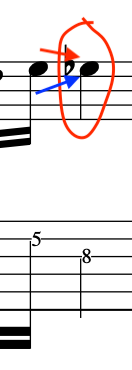
Here, is the Farben chord voicing:

Musical sheet notation illustrating Schoenberg's 'Farben' chord with specific notes highlighted in blue and red.
Diagram illustrating the voicing of the Farben chord, showcasing the unique spacing and dramatic flavour.

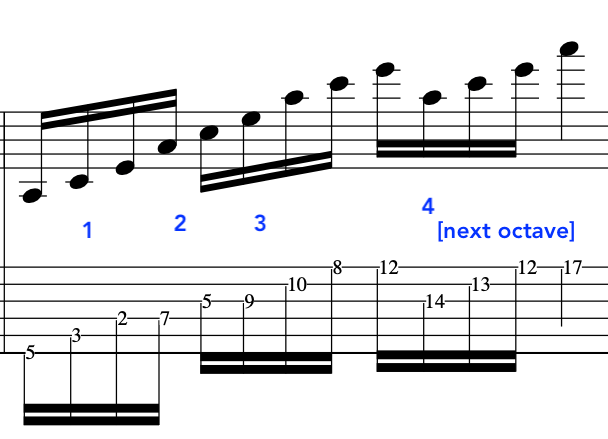
Now, let’s play this as an arpeggio outline:

Sheet music showing a musical staff with notated Farben chord above and a tablature section for guitar below.
Arpeggio outline showcasing the Farben chord voicing.

This time we will extend it to two octaves.

Sheet music notation displaying schoenberg's "Farben" chord  featuring a C Augmented chord with a Maj7th and 13th. The notes are arranged across multiple staves, showcasing various voicings and articulations.
Sheet music illustrating two-octave arpeggio of the ‘Farben’ chord.

From here, we will create a chordal picking guitar vamp from this chord voicing. [Careful, with your fingers as the intervals require a bit of a stretch]

A guitar tab showing a chord diagram for the C augmented chord with a major 7th and 13th, designed for educational purposes.
‘Farben’ chord guitar voicing

Here, is the vamp.

Sheet music showing musical notes and guitar tablature for a chord progression.
Sheet music representation for a guitar vamp based on the ‘Farben’ chord voicing.

Here, is another vamp idea:

Sheet music depicting a guitar tab and notation for an arpeggio outline of the Farben chord.

Another, lovely sound that we get [thinking from the relative minor] is AmMaj7/9.

This voicing works beautifully on the guitar creating a colourful resonance:

Diagram showing the notes and finger positioning for the C Augmented chord with a Maj7th and 13th. Fabern chord as minor

Now, let’s play it as an arpeggio outline:

Sheet music displaying annotations for 'Am', 'Maj7', and '9th' chords, with notes positioned on a staff.

From here, we will extend this to create an ascending line:

Sheet music displaying a musical piece with various notes and rhythms, designed to illustrate the 'Farben' chord by Arnold Schoenberg.

Finally, we will make another voicing.

Musical notation showing the C augmented chord with a major 7th and 13th intervals.
Diagram of chord voicing illustrating the unique structure of the Farben chord variation.

If we take the top part, we can create a nice lick from it. This gives a sort of modal improvised line impression.

[Side thought: Unordered 01348: s Forte number is 5-z17, in the taxonomy of Allen Forte].

Mastering Chromatic Guitar Techniques Inspired by John McLaughlin

Hi Guys,

Today, a quick look at adding colourful chromatics to your playing.

I am employing the concepts/style of guitar great John McLaughlin.

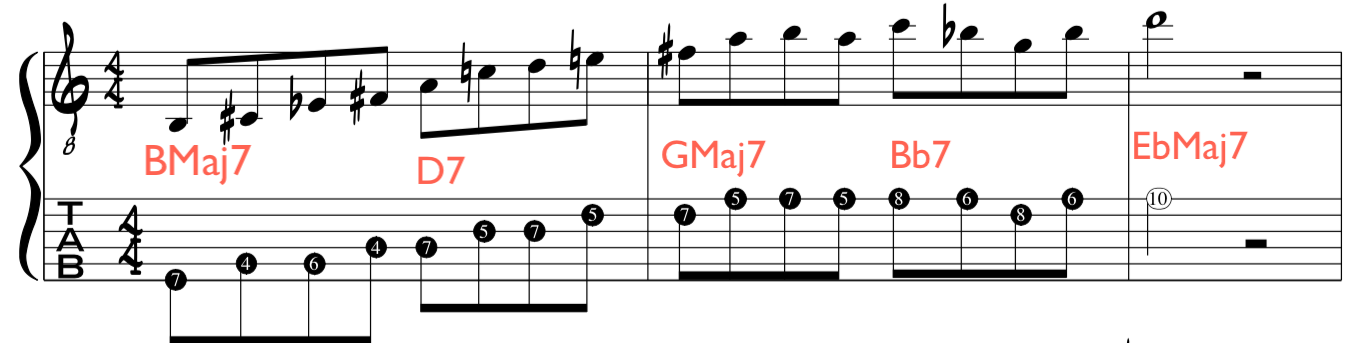
For many guitar players that employ the pick, ascending chromatics seem to be more awkward and rhythmically difficult to phrase and play than descending.

One, of the great secrets, that John exploits, is the use of the open string to connect everything together smoothly.

john_mclaughlin_chromatic_guitar_improvising_techniques

This, is unbelievably useful at up-beat tempos and with odd time signatures.

Because, the open string gives the fretting hand a fraction of a second to get into position…. and so, the picking right hand doesn’t have to rush or fight against the fretting hand and interrupt the synchronisation.

This makes it easy, to count time and play in a natural and fluent manner.

john_mclaughlin_chromatic_guitar_improvising_techniques

Let’s, now complete the ascending phrase by employing another open string:

Notice: The way the pick brings out the chromatics naturally in this way.

john_mclaughlin_chromatic_guitar_improvising_techniques

[Although, these can be classed as synthetic or symmetrical scales and some may deem them “Unemotional” or “Un-melodic” they serve an important purpose and weave beautifully in the improvised line].

john_mclaughlin_chromatic_guitar_improvising_techniques

VARIATION: [With Up-Beat]

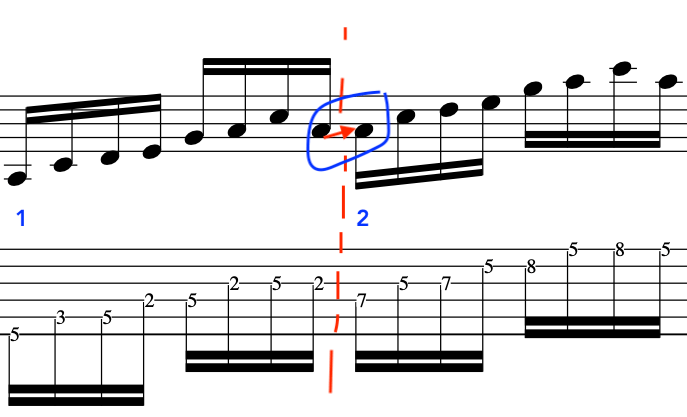
In the answering phrase we will employ Target Tones [Enclosure/Approach notes].

We will set up the phrase with an anacrusis, this being [4] e and a

john_mclaughlin_chromatic_guitar_improvising_techniques

NOTE: I am starting this on an “Up” stroke, so that when I start on the beat of the first bar I can employ the “Down” stroke” for “Even” tetrachord [4 note] groupings.

john_mclaughlin_chromatic_guitar_improvising_techniques

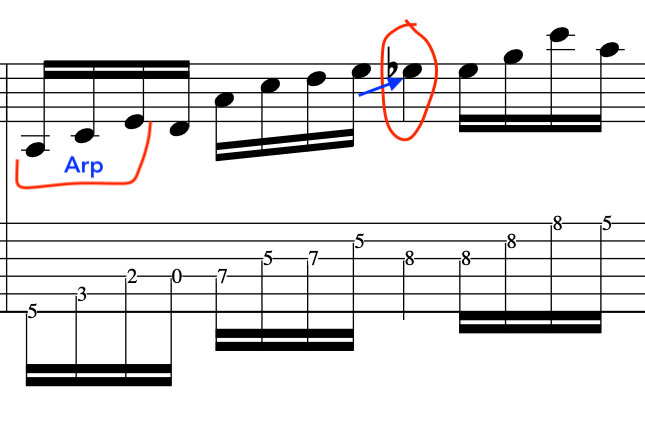
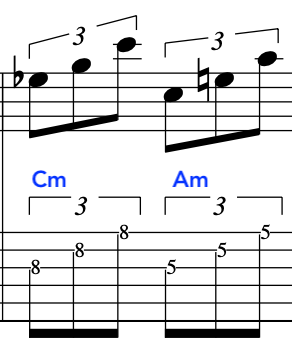
On the third beat, I am exploiting the use of the EbMajor arpeggio to get out of the key.

john_mclaughlin_chromatic_guitar_improvising_techniques

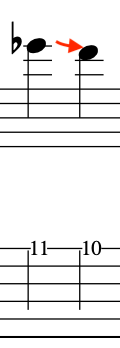
But, this then resolves nicely, back to Em. [Notice, the Bb resolves a half step down to the note A]

john_mclaughlin_chromatic_guitar_improvising_techniques

john_mclaughlin_chromatic_guitar_improvising_techniques

This was just a brief, but informative look at how easy chromatics can be brought into anyone’s guitar playing.

The key, is not the notes themselves so much, but, “How” they are done.

McLaughlin’s chromatic guitar techniques are actually quite simple and amazingly effective as they work at any tempo with the crafted alternate picking guitar technique.

Schoenberg’s chord of the 15th-Music Examples and Analysis

Hi Guys,

Today, a look at the final chord of Arnold Schoenberg’s “Sechs Kleine Klavierstucke” 2nd movement.  In thirds this reads as: C–E–G–B–D♯–F♯–A♯–Cx.

schoenberg_chord_music_analysis_extended_15th_in_music

This extended chord of a 15th, can also be viewed and heard as a bi-tonal construction of C Major 7th with Eb minorMajor 7th superimposed on top

schoenberg_chord_music_analysis_extended_15th_in_music

This can also, be thought of [especially in terms of the guitar] as an arpeggio of CMaj7 and an Arpeggio of EbmMaj7.

schoenberg_chord_music_analysis_explained_15th_in_music

Due, to the nature of its sound and collection of notes, it can produce some interesting counterpoint. Especially, as the Eb to E natural resolution creates colour and drama. [view video at top of page].

schoenberg_chord_music_analysis_extended_15th_in_music_guitar

Being, a Bi-Tonal chord it is useful as it gives us triad pairs.

schoenberg_chord_music_analysis_extended_15th_in_music_guitar

Ascending Line:

schoenberg_chord_music_analysis_chord_pairs_guitar

Now, we will take this a stage further by adding more chords/triads available.

D+ to C to EbmMaj7 to CmMaj7 to Em7 to Bmaj7

schoenberg_chord_music_analysis_chord_pairs

Let’s now, re voice the chord. Here we will make the chord of C a minMaj7 and add D Augmented [9th] on top.

schoenberg_chord_music_analysis_extended_15th_in_music

In the video/audio [a quick demo I created] below, we can hear the dramatic sound of this voicing in the orchestra.

Next, we have two guitar voicing’s. Firstly we have a Bsus/C [or plain B/C] as a typical McLaughlin guitar voicing.

schoenberg_chord_music_analysis_extended_15th_in_music_mclaughlin_guitar

Secondly, we have the same voicing but with a changing bass.

schoenberg_chord_music_analysis_extended_15th_in_music_guitar

Lastly, another guitar voicing that is useful for chordal picking:

schoenberg_chord_music_analysis_extended_15th_in_music_guitar

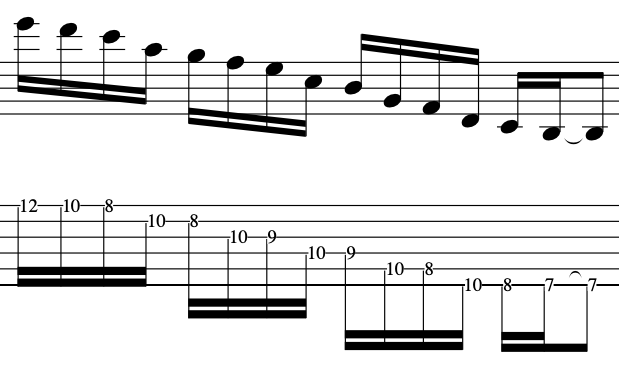
From here, we will add a partial scale descending that is formed from the chord: This chord voicing has a flattened 5th and a sharpened 9th.

schoenberg_chord_music_analysis_extended_15th_in_music_guitar

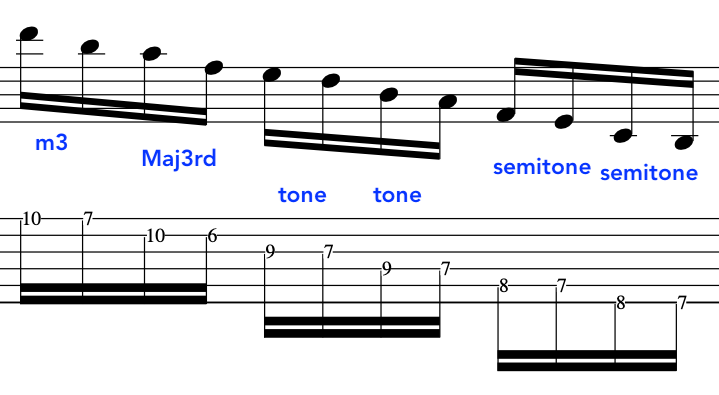
Lastly, we can create some interesting and colourful passages by exploiting the intervals inherent within this 15th chord.

schoenberg_chord_music_analysis_extended_15th_in_music_intervals

Arnold_Schoenberg's_chord-of-the 15th_analysis_music_theory