Please watch video above for detailed info:
Hi Guys,
Today a look at Messiaen’s first mode of limited transposition:
MODE 1
This is the Whole tone scale and has two transpositions and one mode. It is a “Hexatonic” scale that has a dreamy, enigmatic air to it due to lack of resolution as all of the tones are the same distance apart.

Creating an Etude from Messiaen’s Mode 1
The goal of this blog post is to create something interesting out of this scale.
So, here is my little Etude: I am basing this on the style of Robert Fripp [Plectrum guitar technique] and Olivier Messiaen’s compositional approach.
Here is the first bar: This employs a Fripp-esque repetitive picking “Riff”
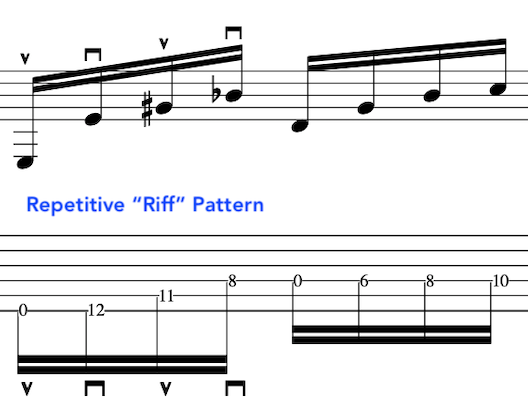
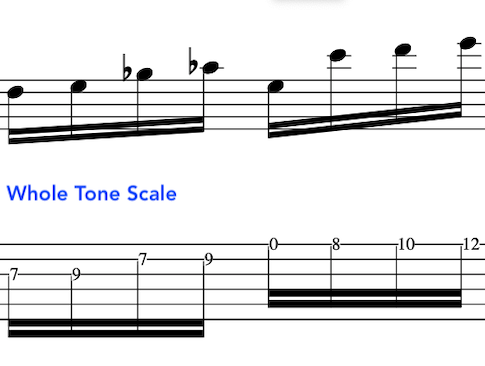
From here, let’s make a smooth transition with an ascending whole tone scale:
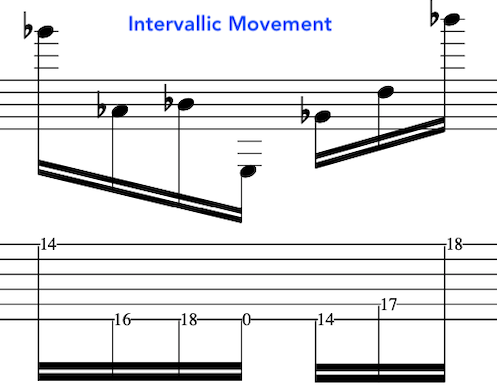
Now, let’s employ some 20c Classical Messiaen style “Intervallic” movement to complete the phrase:
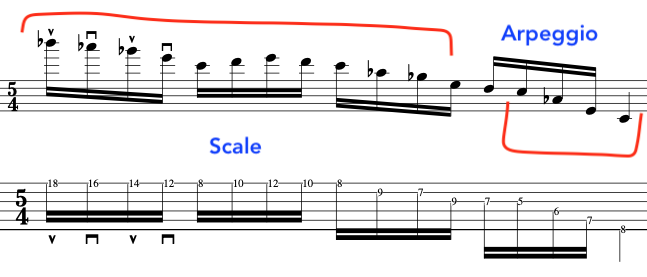
From here, we will descend with the whole tone scale and connect it to the augmented arpeggio:
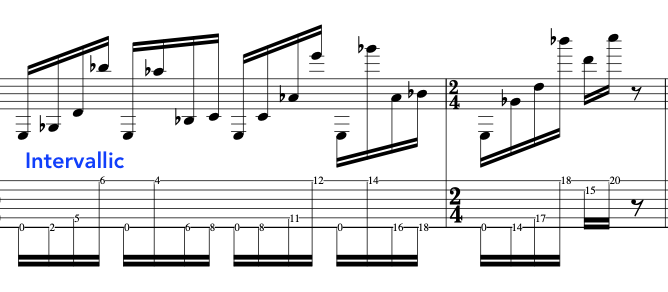
Let’s now return to and exploit our intervallic movement as we ascend the guitar fingerboard:
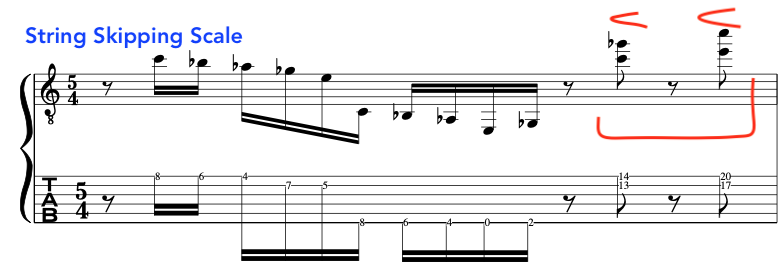
Finally, let’s finish with some string skipping whole tone scale and a couple of plucks up high:
IN CONCLUSION
This was just an example of playing around with musical concepts and creating something colourful and interesting from Messiaen’s Mode 1.
Although, this is only a six note scale it has plenty to offer due to it’s non resolving/non diatonic nature. It works really well for riffs, motifs and hooks and really draws the listeners ear in. Even when used sparingly it can really add colour and texture to a composition [or part of] .
FREE PDF DOWNLOAD:
For more Blogs on Messiaen’s modes CLICK below:
IF THIS LESSON WAS OF USE TO YOU THEN PLEASE SUBSCRIBE TO US BELOW ON YOUTUBE, THANKS!