Exploring the Minor Flat 6th Chord in Modern Music:Jobim/Piazolla

Hi Guys,

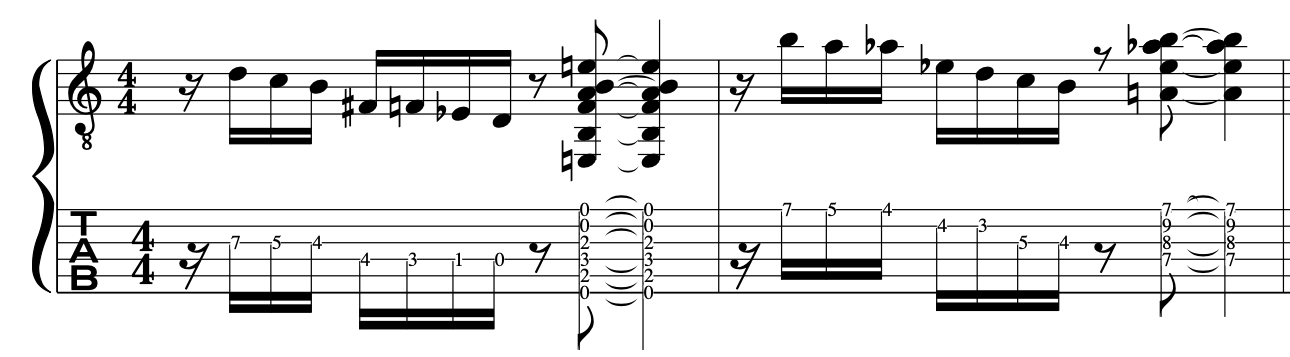
Today, a look at the amazing minor flat 6th chord as used in the compositional styles of Carlos Jobim, John McLaughlin, Astor Piazolla and Al Di Meola.

Most people seem to have a preference for the minor 6th chord, [which in this case has the F# or the Major 6th].

Musical notation showing a chord structure of A minor 6th, highlighting the major 6th note in red.

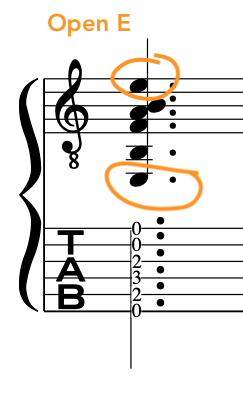
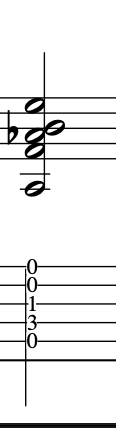
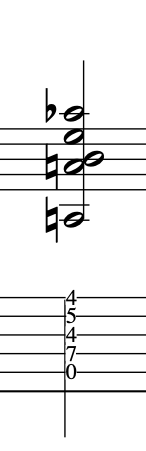
But, the minor flattened 6th chord [F natural in this case] has an amazing character of its own, [especially when it resolves to the first inversion, as we will see].

Musical notation showing a minor chord with a highlighted flattened 6th note.
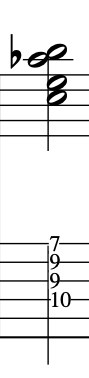
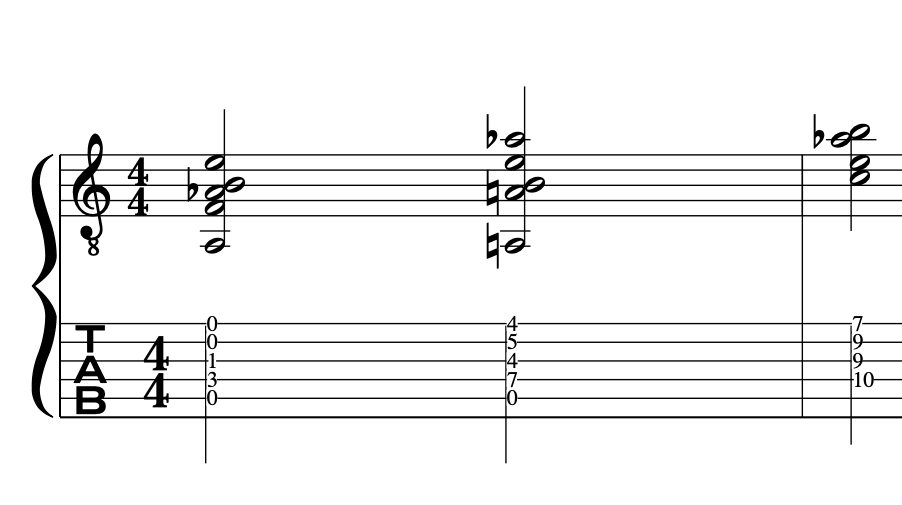
Musical notation showing a Db minor flat 6th chord resolving to an Ab Major chord in first inversion, highlighting the flattened 6th note.
Illustration of the Db minor flat 6th chord to 1st inversion Ab Major chord, highlighting the flattened 6th note.
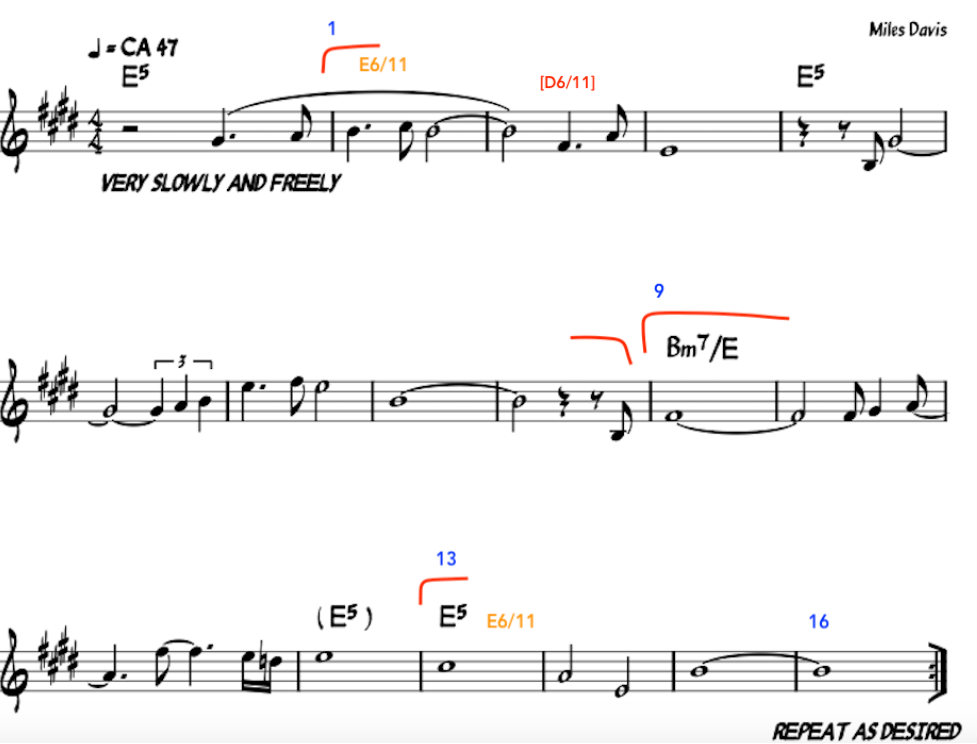
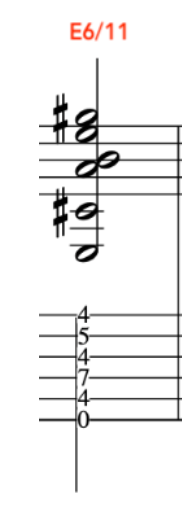
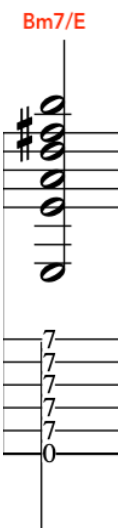
Sheet music showing a D flat minor flat 6th chord resolving to a first inversion A flat major chord, and B minor chord, with annotations indicating flattened sixth notes and first inversions.
Diagram illustrating the transition from Db minor to Ab major first inversion, highlighting the flattened 6th note.

Let’s now add some more first inversion chords:

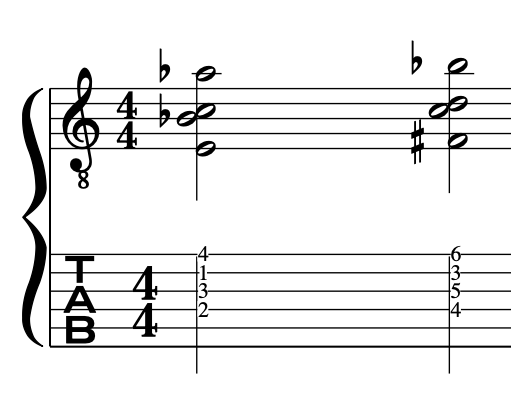
Here, we employ F#m/A with the bass resolving a half step down to the G # note.

Once again, we have a wonderful melodic transition, this time going to the E first inversion chord.

Musical notation showing first inversion chords F#m/A and E/G# with indicators for 'tone' and 'semitone' resolutions
Illustration of F#m/A and E/G# first inversion chords highlighting tone and semitone relationships.

In order to move away from cliche-dom we will now alter the harmony a bit.

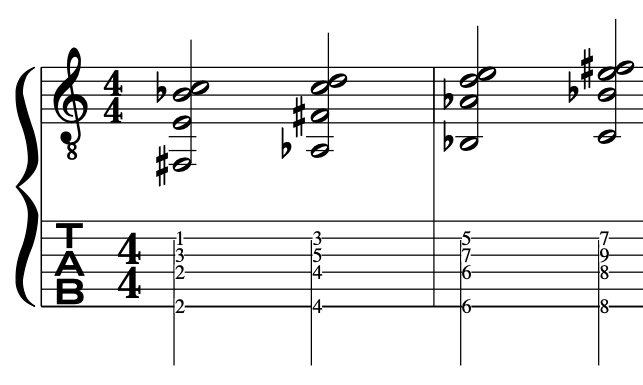
Here, we will add a chord of D9/F# [1st inversion] and let the bass move down a semitone to a chord of F7 [but with a Maj7th also and a #11th].

Musical notation showing D9/F# chord in first inversion and F7Maj7#11 chord for altered  harmonic cadence
Chord diagram illustrating the first inversion D9/F# and F7Maj7#11 chords

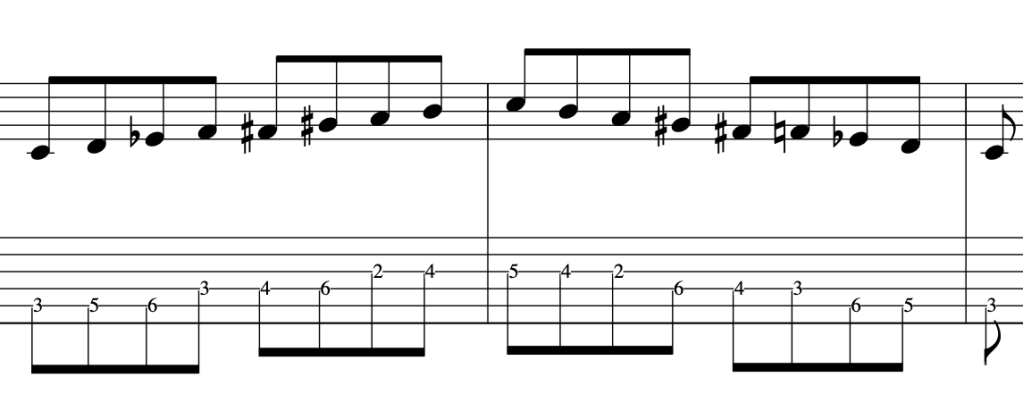
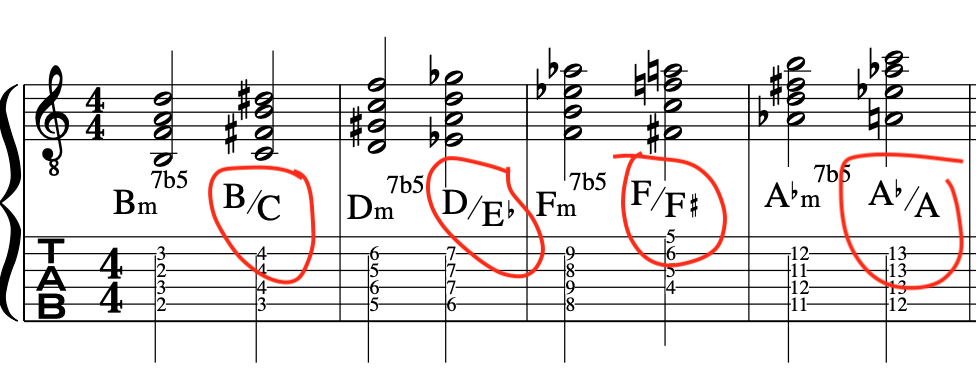
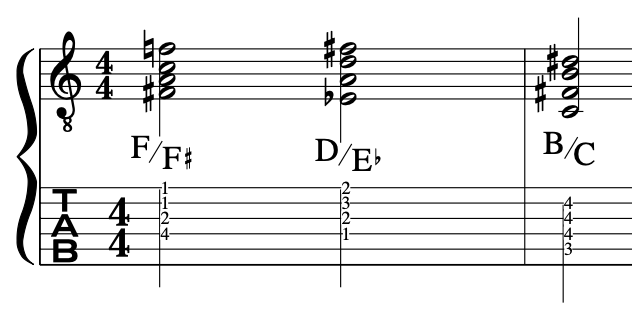
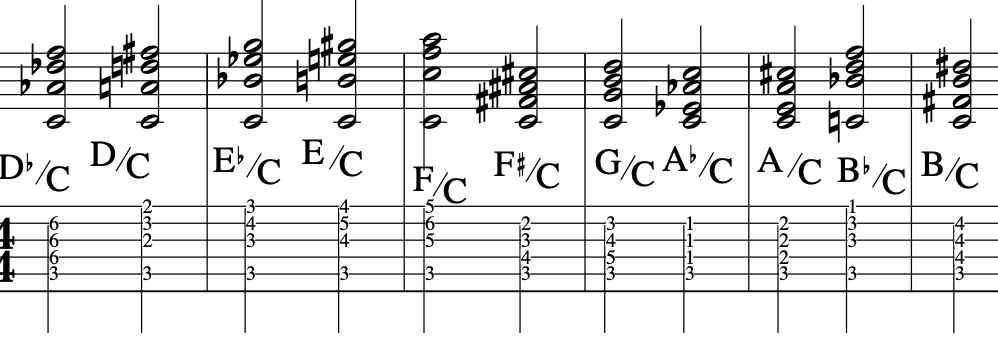
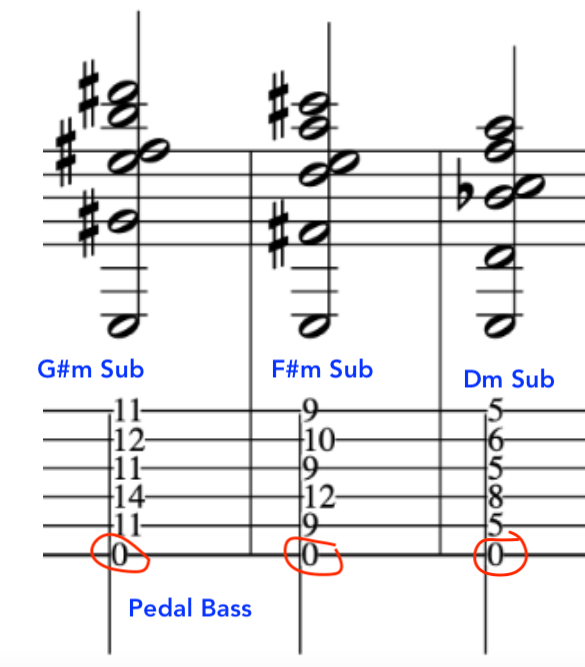
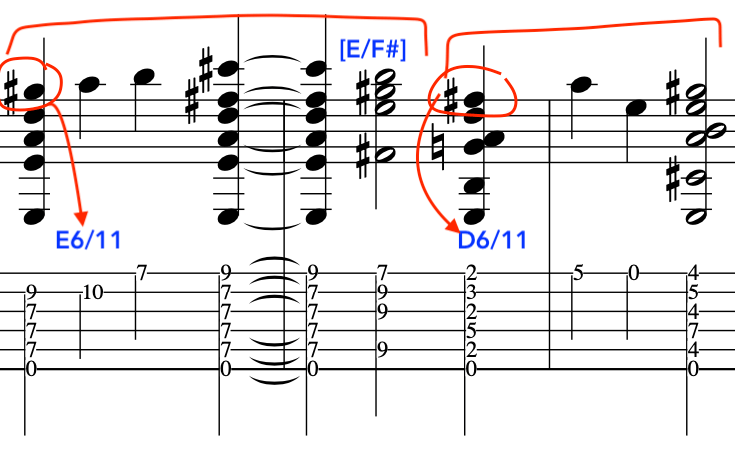
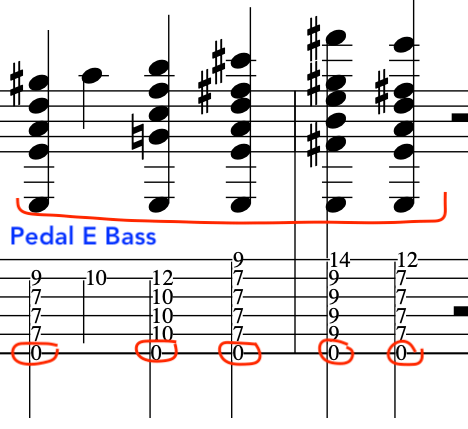
To complete this example, we will exploit chains of 7 Sus4 chords: Here, are the first three chords moving up in semitones.

Music notation showing how to use 7sus4 chords  Bb/C, B/C#, and C/D chords.
Illustration of 7sus4 chord transitions in semitones, featuring Bb/C, B/C#, and C/D for musical composition.

Here are the next three chords moving up in semitones :

Musical notation showing 7sus4 chords Db/Eb, D/E, and Eb/F with corresponding finger positions.
Chord progression analysis showcasing 7sus4 chords Db/Eb D/E Eb/F

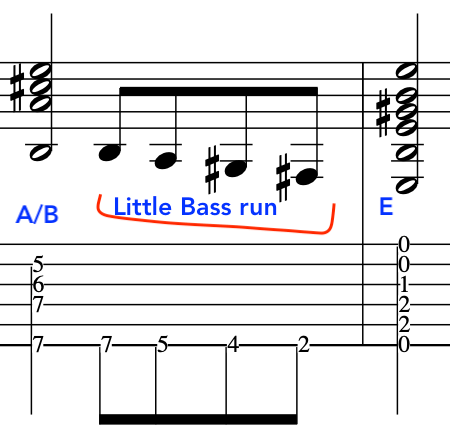
Finally, we come to a conclusion and rest on an E/F# Chord, up a semitone once again.

Musical notation displaying the 7sus4 chord E/F# with labeled fret positions on a guitar neck.

Understanding the Maj7#11 Chord for Guitarists

Hi Guys,

Today, a look at the Maj7#11 chord, a favourite of guitarist John McLaughlin.

This is really a lydian chord due to the sharpened 11th note.

In our example and analysis, we will look at the harmonic implications through the tonality of G Major.

Below, we can see the 5th of G Major, the note D moves down a semitone to the note C# [the sharpened 11th]. On top of this we will place the Maj7th note in G Major. This is the note of F#.

Sheet music depicting the Maj7#11 chord with annotations for G Major tonality, including note positions and symbols.
Musical notation illustrating the G Major – Maj7#11 chord features/Construction.

Here, is a classic guitar shape/voicing with the tonic note of G in the bass:

Diagram showing the Gmaj7#11 chord for guitar, with labeled fret and string positions.
G Major 7 Sharp 11 Chord Diagram with Fingering [GMaj7#11]

Let’s now create an arpeggio outline of the chord:

Sheet music showing a musical notation example for a Maj7#11 chord and arpeggio voicing, with specific notes and finger positions highlighted.
Musical notation illustrating an arpeggio in the context of a Maj7#11 chord.

We will now ascend and descend the arpeggio outline, as this will give us control over the harmony when improvising on the solo line.

Musical notation displaying a sequence of notes and chords, illustrating an arpeggio pattern for the Maj7#11 chord.
Arpeggio exercise featuring the Maj7#11 chord in the context of G Major.

Below, are examples of various voicing’s and variations for all instruments, but, especially the guitar.

This is because certain voicing’s resonate extremely well on the guitar, whereas, others can become muddy in sound.

The voicing’s below offer quite a few possibilities,

Musical notation for a Maj7#11 chord on guitar, showing frets and strings and chord voicing's.
Various chord voicings for the Maj7#11 chord on guitar.
Musical notation displaying a Maj7#11 chord with highlighted notes.
Musical notation for a Maj7#11 chord, depicting various notes and finger positions on a guitar.  As used by John McLaughlin Al di meola and Pat Martino
Musical notation illustrating the Maj7#11 chord voicing.
Sheet music showing a G Major scale with indications for a Maj7#11 chord, along with guitar tablature highlighting finger positioning.
Sheet music illustrating the Maj7#11 chord with guitar tablature, showing notes and finger positions.
Sheet music showing a Maj7#11 chord with notes and tablature for guitar.

We, will now make a ii V7 I cadence with this chord, in order to see, hear and understand how to apply it to composition.

Firstly, let’s take a simple ii V I in G major.

A musical notation showing a ii-V-I chord progression in the key of G major, featuring Am, D7, and G chords.

Now, we will substitute the Am for AmMaj7 and the dominant chord D7 for D Augmented. This will allow us to finally rest on the Gmaj7#11 chord. [A sort of ethereal rest]

A sheet of music notation displaying a substitution of a ii V7 I cadence progression in G major, altered as AmMaj7, D augmented, and Gmaj7#11 chords for jazz reharmonisation.
Musical notation illustrating the ii V7 I cadence substitution featuring AmMaj7, D augmented, and G Maj7#11 chords.
Musical notation diagram displaying the chords AmMaj7, D+, and GMaj7#11, with corresponding finger positions for guitar jazz chord substitution.
Chord diagram showing substitution AmMaj7, D+, and GMaj7#11 chords for guitar.

Let’s, now create a solo line from this Maj7#11 chord:

Below, we can see the use of simple arpeggio inversions.

Firstly, we have a Bm arpeggio [implying a 1st inversion GMaj7] connecting to a 2nd inversion G Major triad. This, then resolves down with simple chromatic application.

Sheet music illustrating G Major 7 arpeggios with chromatic notes, including the sharp 11th note highlighted for lydian guitar solos.
Example of G Major 7 arpeggios showcasing the #11 note and chromatic transitions.

From herein, we will employ G Lydian modal/scale “Fragments” to complete the line,

Musical notation illustrating the Maj7#11 chord with highlighted sharpened 11th notes, including tablature for guitar.

Musical notation for the Maj7#11 chord, including notations for #11 and Maj7 for jazz improvisation.

Sheet music displaying the Maj7#11 chord with the sharpened 11th note highlighted, along with corresponding guitar tablature.
Musical notation showing Maj7#11 chord analysis with highlighted #11 and Maj7 notes.

The “Neapolitan 6th” Chord


Hi Guys,

Here, is the re-post for the Neopolitan 6th chord [blog] as requested.

The “Neapolitan 6th” chord is a 1st inversion of the supertonic [chord two] triad but with the  root and fifth lowered a half step. Neapolitan 6th chord lesson example

In modern terms we could think of it as a flattened second chord 1st inversion. Below is a more popular common approach.

A musical score illustrating the Neapolitan 6th chord, showing notes C, D♭/F, and F, with guitar tablature and rhythmic notation.
Musical notation illustrating the Neapolitan 6th chord

Minor Key example:

[In this case only the root is lowered as the C minor key signature already has the Ab in the key signature]

Neapolitan 6th chord minor key

OTHER COMMON AUGMENTED 6 TH CHORDS

French Sixth Italian Sixth German Sixth Augmented 6th Chords

These chords can occur on the flattened submediant [flattened chord 6] of the major scale or the normal submediant [chord 6] of the minor scale.

FRENCH SIXTH

French sixth chord augmented 6th explanation

ITALIAN 6TH

Italian sixth chord augmented 6th

GERMAN 6TH

German 6th augmented chord explanation lesson

9ths 11ths and 13ths harmony:

9th 11th and 13th chords explained music theory

One last idea using the 7th chord as a Diminished chord followed by the dominant 7th 1st inversion to C the Tonic chord.

Diminished 7th chords for cadences

Thanks for reading! If this Blog was of interest to you then please subscribe to our youtube channel below,