Frank Zappa Octave Displacement Composition/Improvisation Concepts
Please watch video above for detailed info:
Hi Guys,
Today, a quick look at the way Frank Zappa exploits octave displacement.
This, is a really useful compositional device especially when writing for a string quartet or stringed instruments.
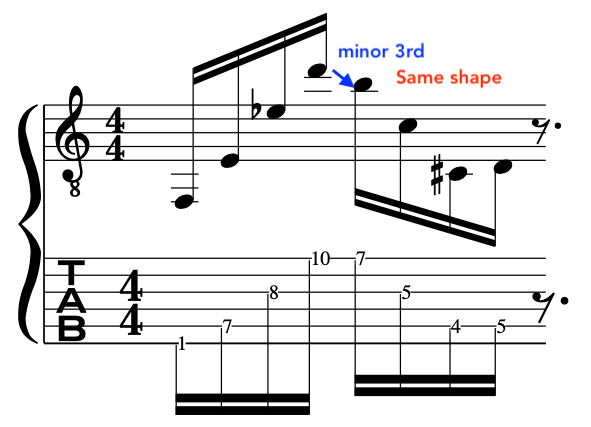
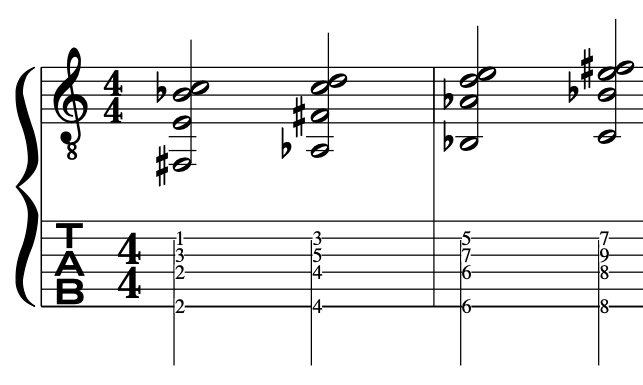
EXAMPLE 1:
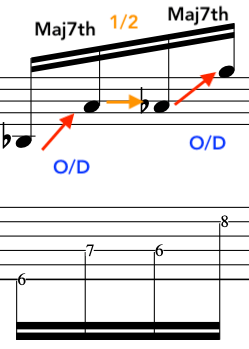
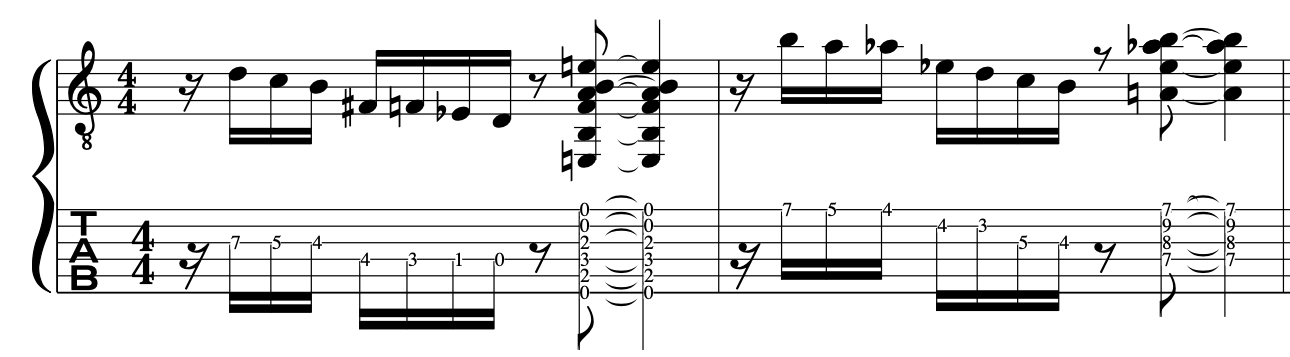
In this example we can see the use of the displaced octave [or Maj7th interval].
Musical notation illustrating Frank Zappa’s octave displacement used in string instrument compositions.
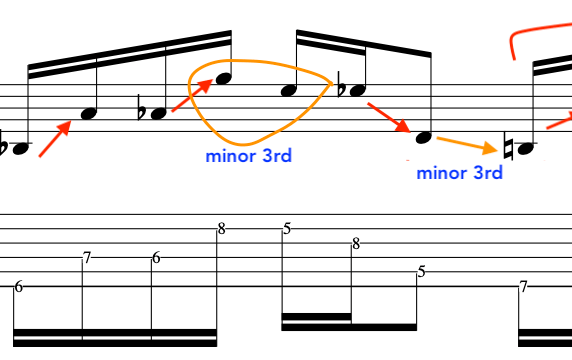
With further analysis, we will notice the employment of the minor 3rd interval as a means of connection and predictive avoidance.
Musical notation illustrating frank Zappa minor 3rd intervals in a compositional example.
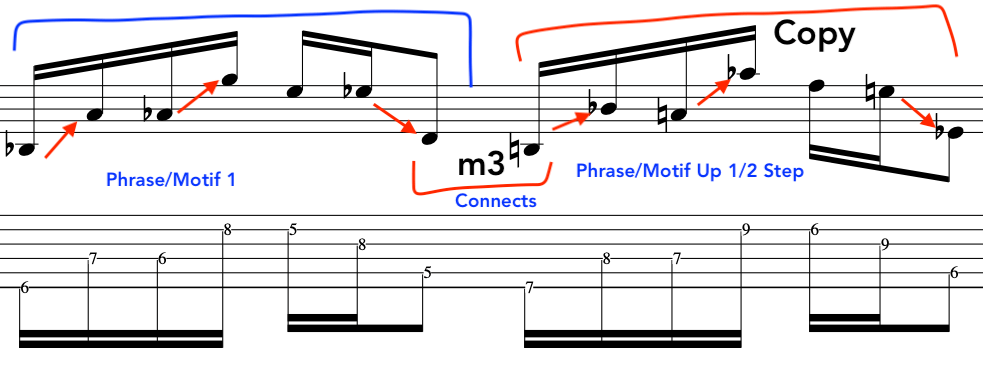
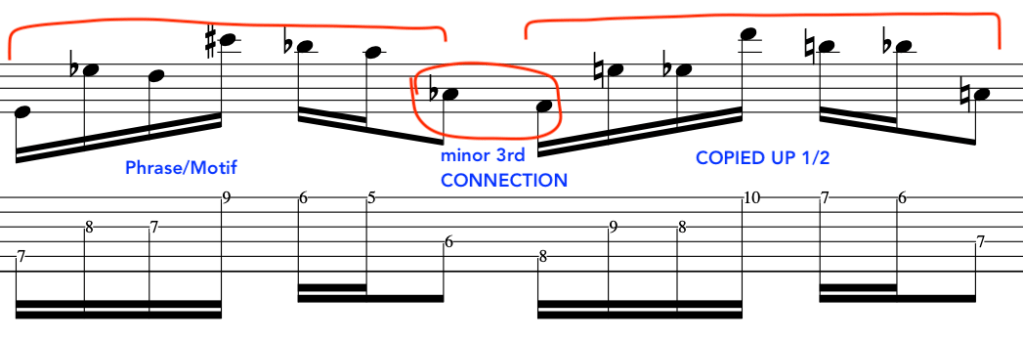
Although, this phrase/motif descends a minor 3rd it is actually, [quite cleverly] copied up a semitone:
Musical notation illustrating Frank Zappa’s octave displacement and minor 3rd connections
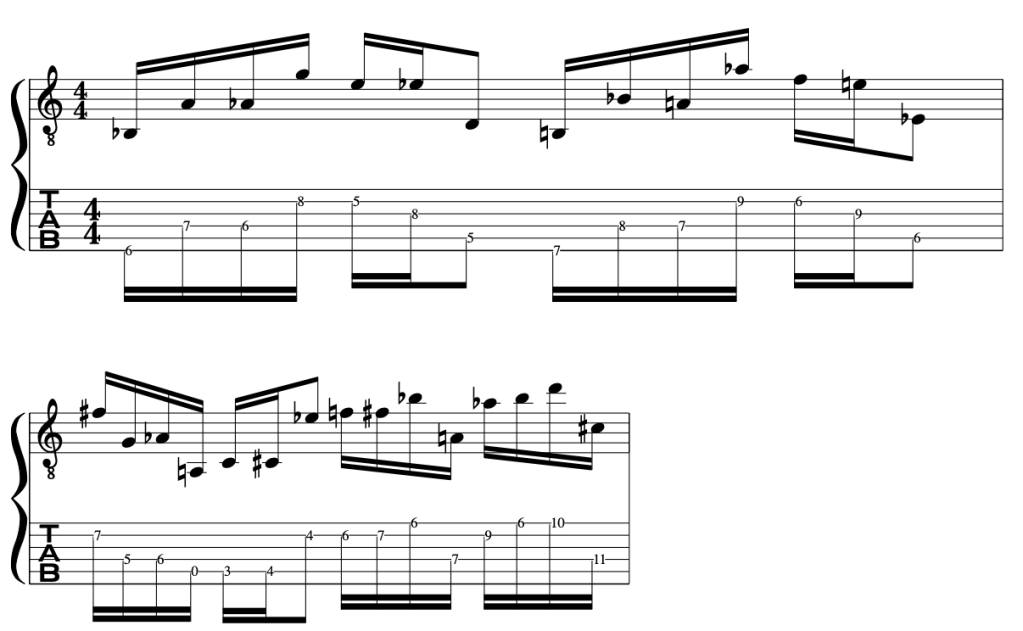
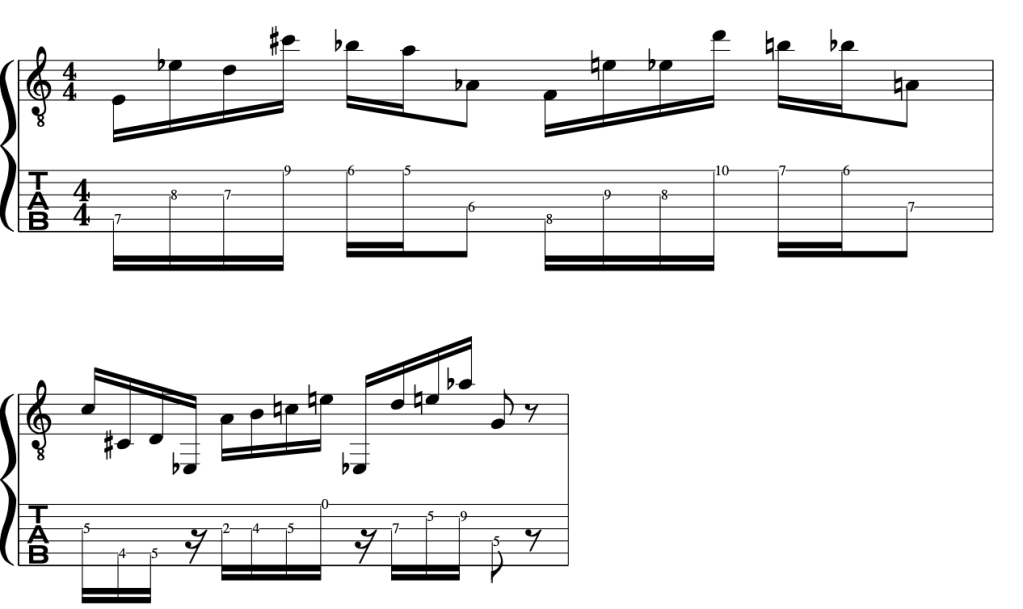
FULL LINE:
Musical notation illustrating octave displacement for string instruments, highlighting the use of minor 3rd intervals.
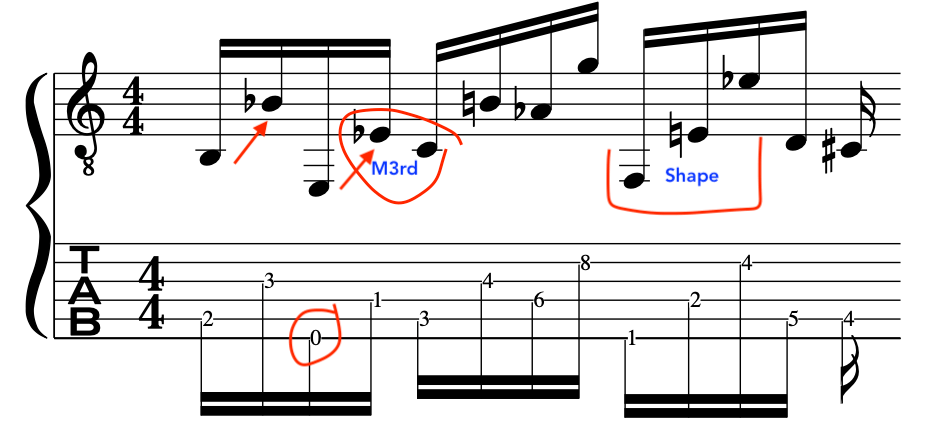
EXAMPLE 2:
This example is the same as that found in Pat Martino’s 12 chromatic forms:
This amazing shape creates a really nice resonance/blend on the guitar. It’s also useful for various inversions and shifting positions around on the fingerboard.
Here, once again we see the exploitation of the minor 3rd interval to move and connect the shape.
Musical notation demonstrating frank Zappa’s minor 3rd interval and octave displacement
EXAMPLE 3:
This application employs everything that we have looked at so far in one short example.
Notice, the minor 3rd connection, the open string, the shape, etc. It all becomes familiar.
Example illustrating the application of minor 3rd intervals and octave displacement shape.
EXAMPLE 4:
The final example is similar in concept to our first one.
It has a motif/phrase which is connected by the minor 3rd interval, that, then copies it up a half step.
Frank Zappa illustrating the connection of phrase/motif using a minor 3rd interval, copied up a half step.
Full Example:
Frank Zappa illustrating a composition example using octave displacement and minor third intervals.
IMPORTANT: Please watch video above for detailed info:
Hi Guys,
Welcome to part 2 of the John McLaughlin Modern Jazz Chords series.
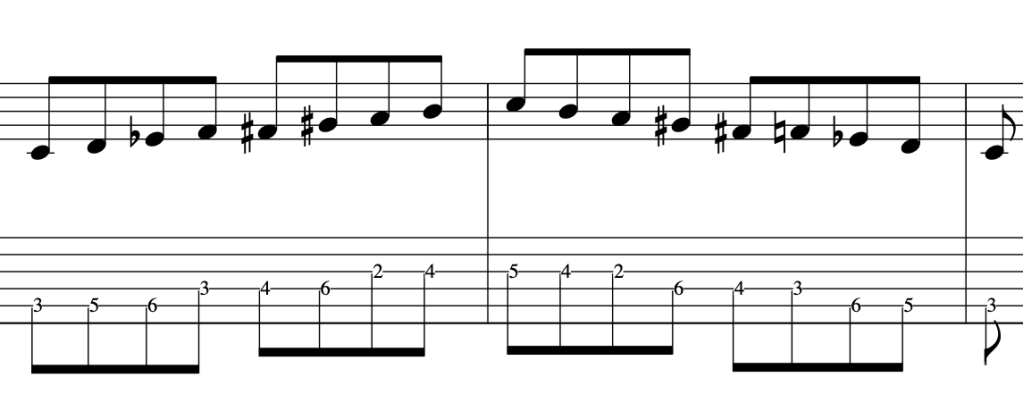
First we will have a look at making chords from the whole step half step diminished scale:
The Diminished Scale
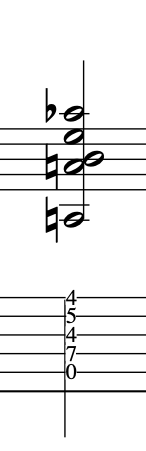
Musical notation displaying the diminished scale starting on the note C, for creating modern jazz chords.
Within this scale are lots of Triads: [for instance]
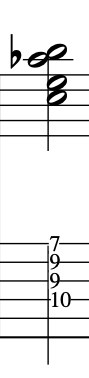
From these Triads we can add different Bass Notes and produce “Slash chords“
Chord progression showcasing slash chords derived from the diminished scale.
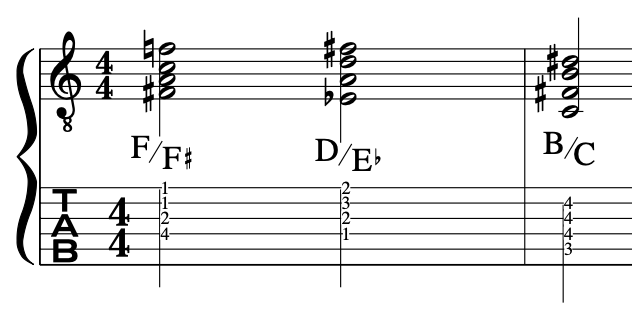
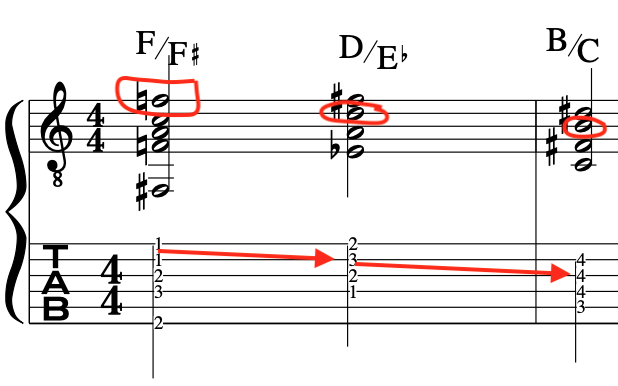
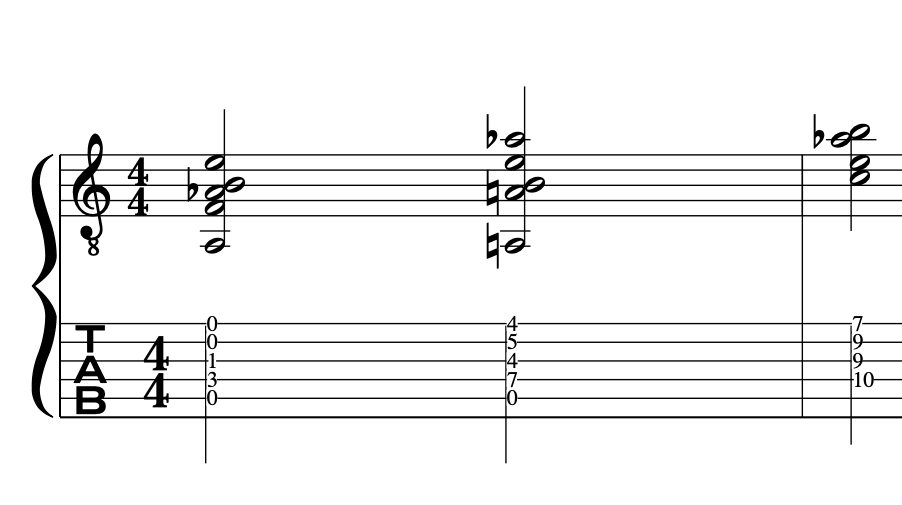
Okay, let’s take three triads with different bass notes and join them together:
Triads with different bass notes from the diminished scale, essential for creating ‘slash chords’ in jazz harmony.
It’s important to realise that because we are employing chords form the diminished scale we have minor 3rd movement.
So, let’s add a little melody within the chords: This is the way that John McLaughlin gets that lovely Bluesy feel within the harmony. Again, this is due to the way that the minor 3rd’s work within diminshed scale harmony.
Musical notation showing triad slash chords F/F#, D/Eb, and B/C with finger positions on a guitar tab.
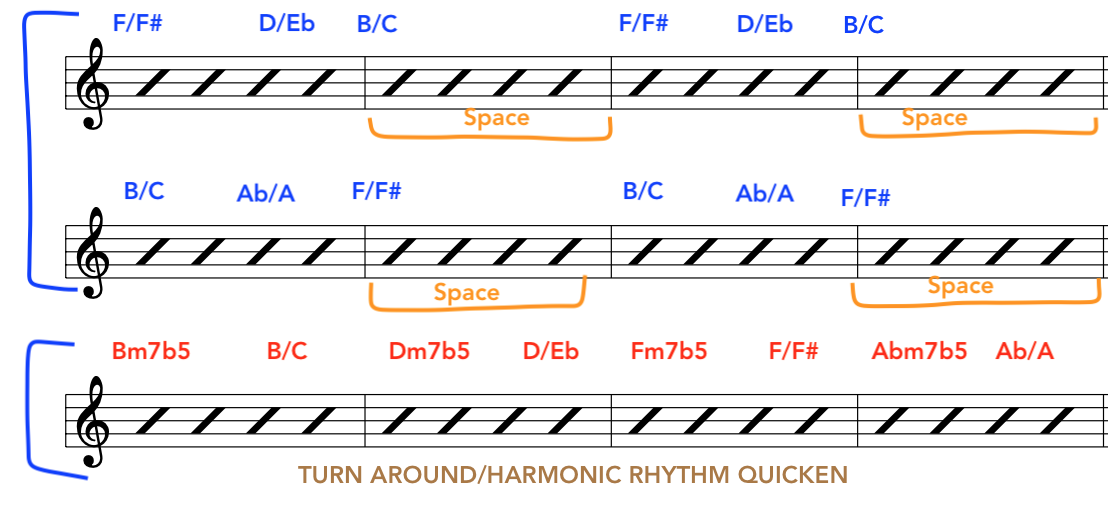
Now let’s create a Blues Composition from this diminished scale.
Chord sequence with diminished scale harmonies for a blues composition.
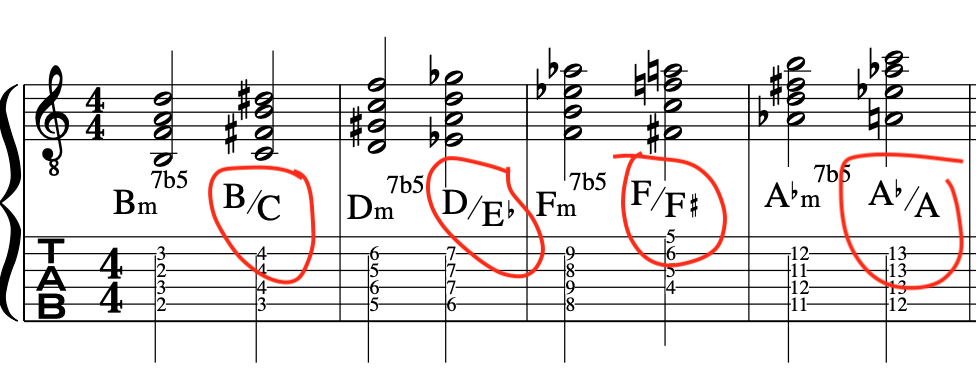
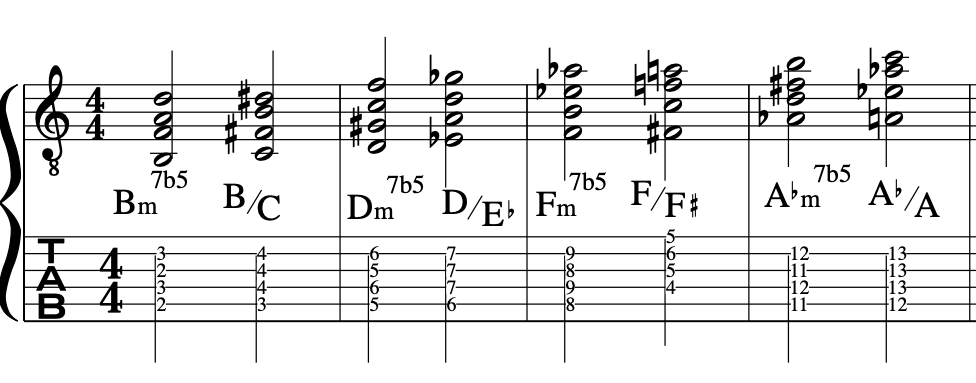
For the last 4 bars we will make the Harmonic Rhythm Quicker by adding a new chord sequence that employs minor7 flat 5’s with slash chords.
Chord progression using diminished scale triads creating slash chords
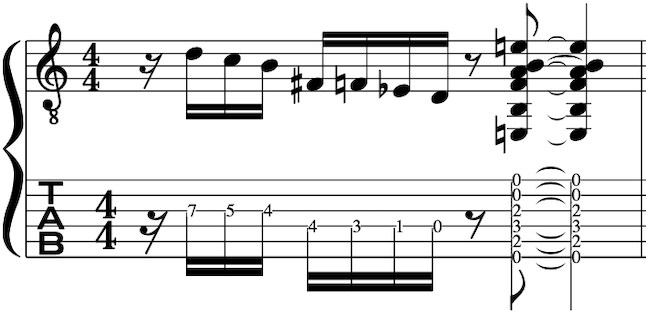
JOING CHORDS WITH SCALIC FRAGMENTS
It’s a good idea to join chords together with fragments of the diminished scale: This is also extremely useful when creating composition;
Musical notation illustrating John McLaughlin’s chord scale in a diminished scale context.
2x scale to chords:
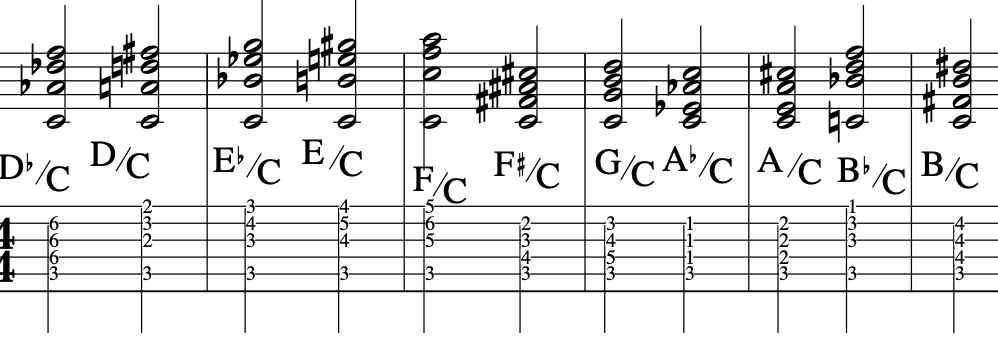
All 12 Major Triads over One Note [C]
Here is an excellent exercise for hearing how all 12 major triads sound over the same single note;
Exercise showcasing all 12 major triads over the pedal note of C.
Lastly, here are some misellaneous John McLaughlin guitar chords:
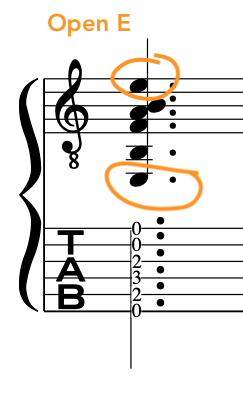
Shakti Chord:
Diagram showing guitar tablature and notation for the Open E “Shakti” McLaughlin chord
Harmonic minor scale chords:
Example of harmonic minor scale chords for guitar, showcasing the E/A chord.
E/A
Guitar chord diagram for slash chord E/A, illustrating finger positioning and fret numbers.
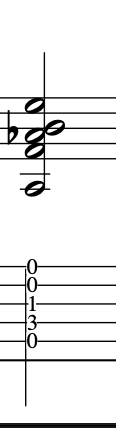
E/C
Musical notation for slash chord taken from the harmonic minor scale.
Lastly, From the Whole Tone scale [Notice: 1 tone movement]
Musical notation example featuring chords from the whole tone scale..Musical notation demonstrating John McLaughlin’s slash chord sequences
Today, a look at John McLaughlin’s emotional and melodic chords for composition and reharmonisation.
PART 1:
The key to both parts of this blog is the employment of the 1st Inversion Major chord and its resonant guitar voicing:
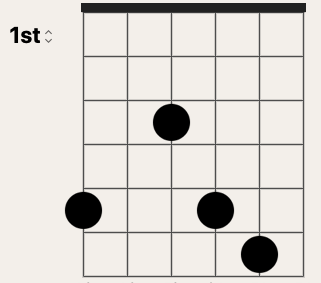
Below, is the key voicing shape: Here, we have F Major as a 1st Inversion [or F/A] voicing:
Diagram showing the F Major 1st Inversion (F/A) chord voicing.
From this, let’s take the sequence from John’s classic “Electric dreams/Electric Sighs” composition.
John’s melodic harmony:
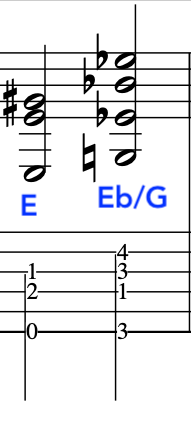
We will start with a basic E Major chord that will then go to an Eb first inversion chord:
Chord progression from E Major to Eb first inversion in a musical notation.
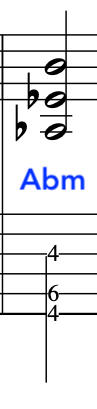
From here, we will resolve this by moving to Ab minor:
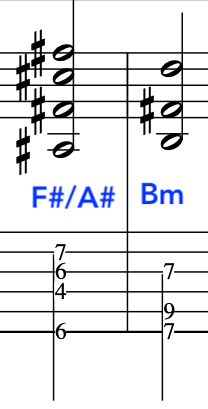
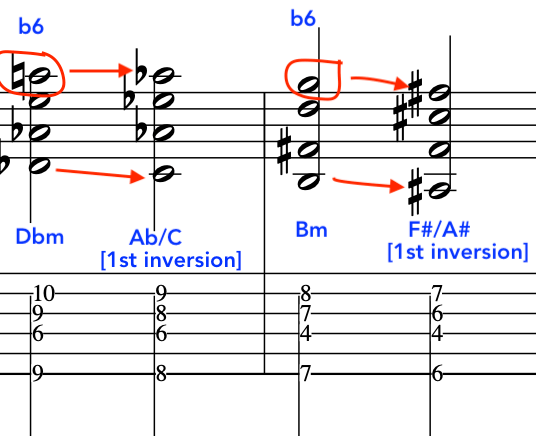
We will now repeat the pattern, and, create an ascending sequence with F#/A# resolving to B minor:
Chord progression featuring F#/A# resolving to B minor, illustrating melodic harmony.
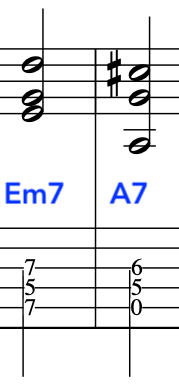
There is now an implied cadence with Em7 to A7. But, this doesn’t Modulate to the key of D,
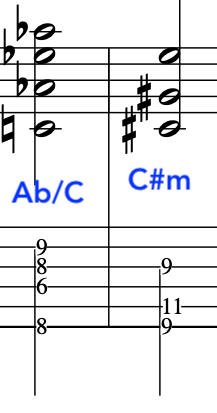
Instead, we carry on with the sequence. This time we employ Ab/C to Db minor[enharmonically C#m]
Musical notation illustrating the Ab/C to C# minor chord transition, highlighting melodic harmony.
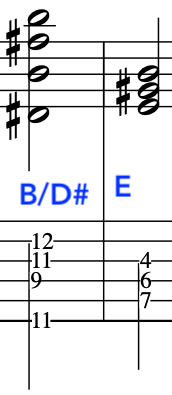
And finally, we do resolve, but, this is back to our tonic chord/Key of E Major.
Musical notation showing a B/D# chord transitioning to an E chord.
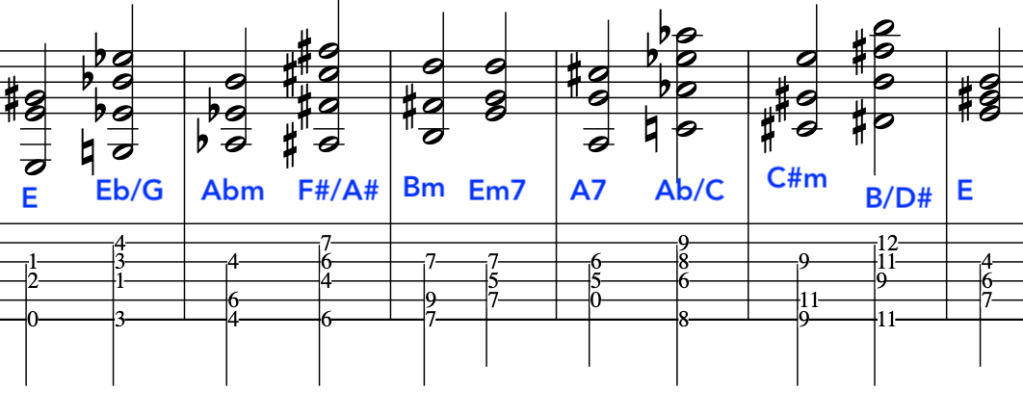
FULL SCORE:
Musical score featuring various chord progressions and their notations for melodic harmony.
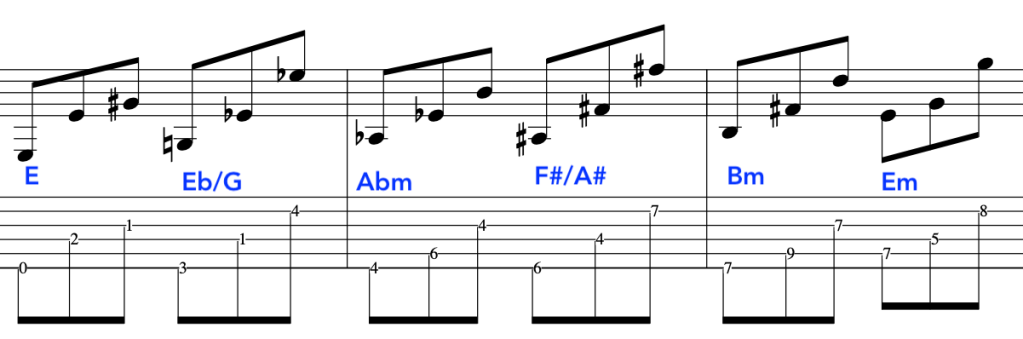
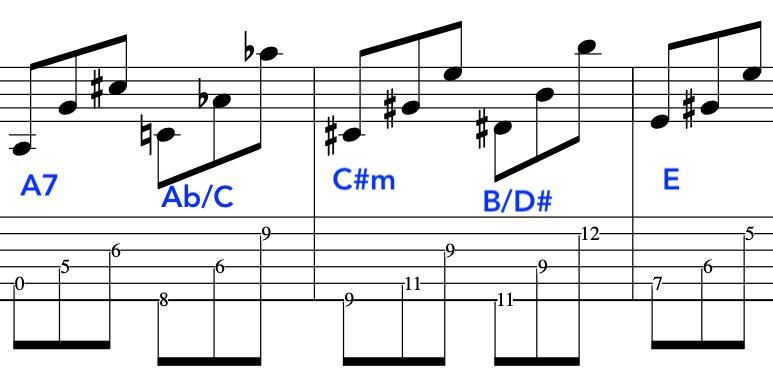
With this type of beautiful, creative, melodic harmony, it’s a good idea to apply arpeggios to underline it and give it movement.
Musical notation showcasing arpeggio chord transitions including E, Eb/G, Abm, F#/A#, Bm, and Em.Musical notation illustrating chord transitions with A7, Ab/C, C#m, B/D#, and E.
PART 2
The minor b6 and First Inversion Chord Relationship:
Most people seem to have a preference for the minor 6th chord, [which in this case has the F# or the Major 6th].
But, the minor flattened 6th chord [F natural in this case] has an amazing character of its own, [especially when it resolves to the first inversion, as we will see].
What makes the minor chord with a flattened 6th work really well is to move down to a first inversion chord.
EXAMPLE:
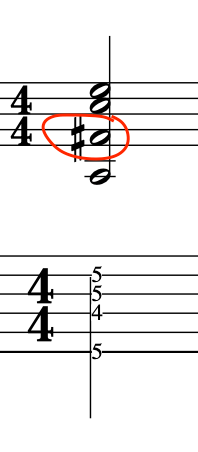
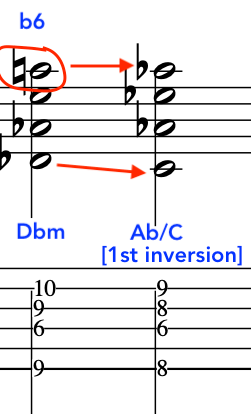
Here, we have a Db minor chord moving down to a 1st inversion Ab Major chord:
Notice the flattened 6th note of A at the top moving down a semitone to the Ab note:
Illustration of the Db minor flat 6th chord to 1st inversion Ab Major chord, highlighting the flattened 6th note.
This smooth chordal transition works beautifully when creating melodic sequences.
Diagram illustrating the transition from Db minor to Ab major first inversion, highlighting the flattened 6th note.
Let’s now add some more first inversion chords:
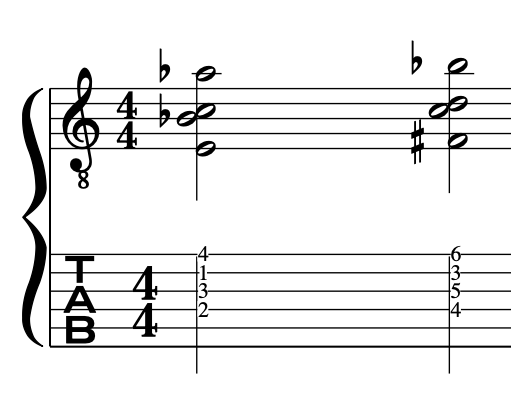
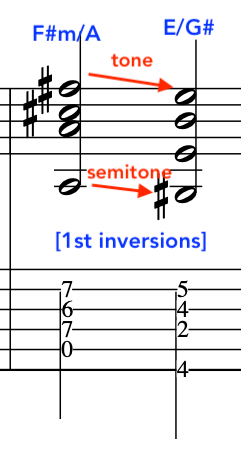
Here, we employ F#m/A with the bass resolving a half step down to the G # note.
Once again, we have a wonderful melodic transition, this time going to the E first inversion chord.
Illustration of F#m/A and E/G# first inversion chords highlighting tone and semitone relationships.
In order to move away from cliche-dom we will now alter the harmony a bit.
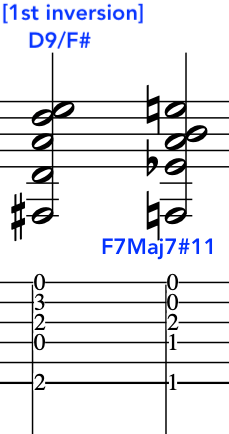
Here, we will add a chord of D9/F#[1st inversion] and let the bass move down a semitone to a chord of F7 [but with a Maj7th also and a #11th].
Chord diagram illustrating the first inversion D9/F# and F7Maj7#11 chords
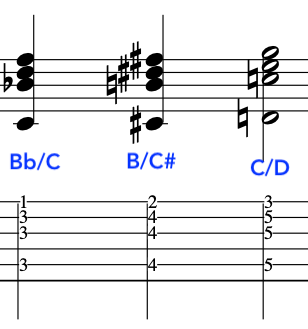
To complete this example, we will exploit chains of 7 Sus4 chords: Here, are the first three chords moving up in semitones.
Illustration of 7sus4 chord transitions in semitones, featuring Bb/C, B/C#, and C/D for musical composition.
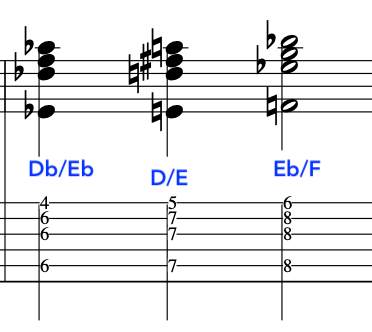
Here are the next three chords moving up in semitones :