Exploring the Elektra Chord by Richard Strauss

Hi Guys,

Today, a quick look at the amazing “Elektra” chord employed by composer Richard Strauss.

Nowadays, we might consider this to be a 7#9 chord, but looking at this from a 20th century classical perspective we can create much fresher and more interesting material from this worn cliche.

To get a clearer idea, we will exploit “Bi-tonality” and connect two different chords together, E Major and C# Major.

Musical notation showing E Major and C# Major chords on a staff with tablature below of Strauss "Elektra Chord".
Music notation showing E Major and C# Major chords, illustrating bi-tonality for the Elektra chord.

From this, we will remove the third [the G#] from the E Major triad and look at the C# Major triad enharmonically as Db Major.

So, now connected we have a Chord of Db7/E

Sheet music illustrating the Elektra chord, showing E Major, C# Major, and Db7/E chords with corresponding tablature.
Chord notation illustrating the Elektra chord (Db7/E) in relation to E Major and C# Major.

For Guitar:

Musical notation for a Db7/E chord, including staff and tablature for the elektra chord on guitar.

Here, is the Arpeggio with TAB

Musical notation showing a guitar tab and sheet music for the elektra  chord arpeggio with notes and finger positions.
Illustration of the arpeggio/chordal outline for the Elektra chord

Here, are 3 octaves of the arpeggio/chordal outline with TAB:

Sheet music showing a guitar tab with the arpeggio/chordal outline for the Elektra chord in three octaves.
Illustration of the arpeggio/chordal outline for the Elektra chord in three octaves.

Now, we will make another “Elektra chord” so that we have two chords to work from.

This new [Elektra] chord, will be C7/Eb

Musical notation of the chord C7/Eb showcasing the notes and structure to vary Strauss's elektra chord.
Musical notation illustrating the C7/Eb chord, showcasing the unique harmonic structure.

So, here are our two chord examples:

Sheet music displaying the chords Db7/E and C7/Eb from Strauss Elektra Chord.
Musical notation for the chords Db7/E and C7/Eb, highlighting their structure.

Below, I have included audio of a quick orchestration/compositon I did to show how this wonderful harmony sounds when we apply it to the orchestra [Orchestration].

Also, notice how the inner pitches work to create beautiful drama in this tonality. Here we have octaves moving down in semitones in 5ths and then 4ths.

elektra-chord-richard-strauss-
Musical notation illustrating the ‘Elektra chord’ concept as explored in the article.

AUDIO Example:

Next, notice the inner pitches when adding the 5th of the top triad.

elektra-chord-richard-strauss-

AUDIO Example:

Here, we have a simple chord and answering phrase:

1] Chord and line: Db7/E

Musical notation for the Elektra chord  and improvised line with accompanying tablature for guitar.

2] Chord and Line: C7/E[/Eb]

Musical notation showing a chord progression with the elektra chord  for guitar, including finger placements and notes.
Chord and improvised line example for C7/Eb, showcasing voicings and ideas for musicians.

CHORDS: Here are some voicing’s and ideas:

elektra-chord-richard-strauss-guitar-chords

3 Octaves of Elektra Chord: As ascending Arpeggio Movement:

elektra-chord-richard-strauss-example-3-octaves

As we can see from this quick look at one chord, there is a whole world and a wealth of material within it.

For the serious composer, and improviser this search and re-development of worn ideas/harmony is essential in order to make ones mark.

This renewal, gives us fresh material to work with and a pallet of our own with which to stamp a unique signature that is all ours.

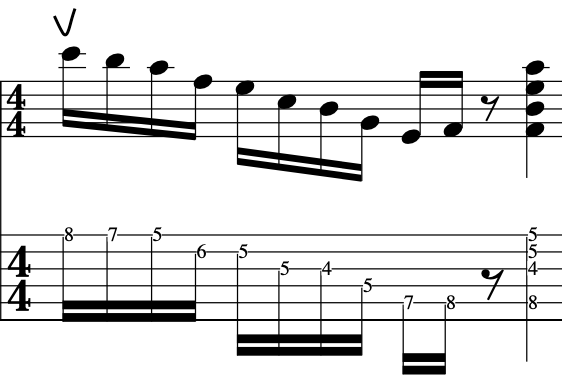
12 Tone Pattern: Scott Collins Guitar Line:

Hi Guys,

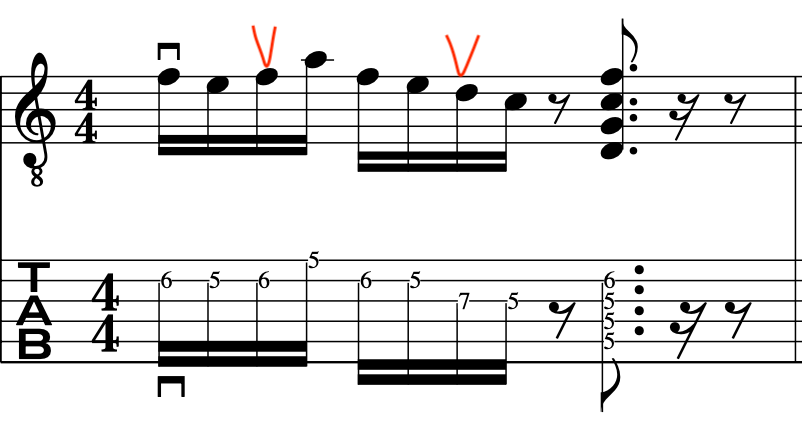
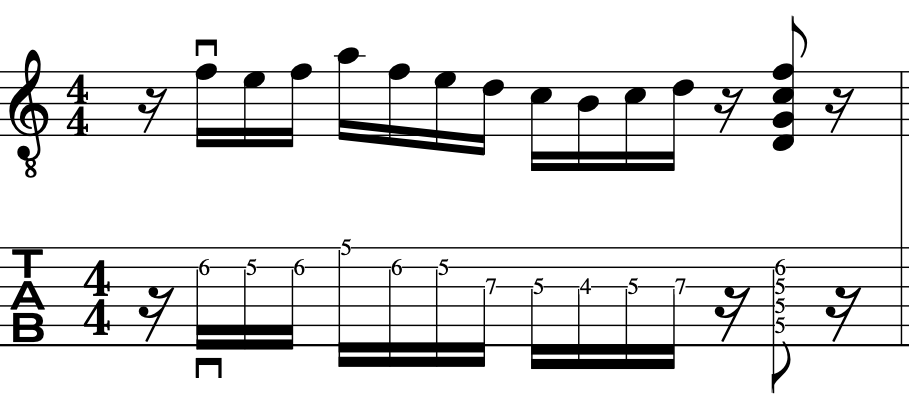
Today, a quick look at a Scott Collins 12 tone guitar pattern and applying it to alternate picking guitar technique as an exercise in descending intervallic movement.

First of all, let’s look at the pattern.

I am thinking of these motifs as 3 note “Tri-chords” [as in John ‘O” Gallagher’s book 12 tone improvisation].

Here, are the first 3 pitches as a tri-chord.

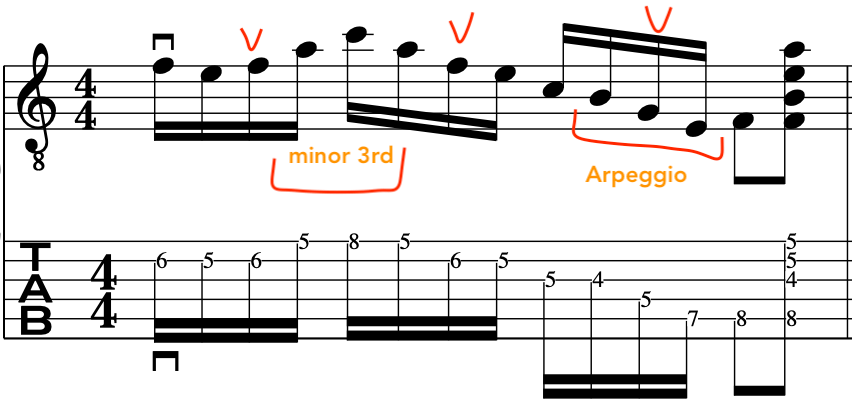
What makes this line interesting is that the “Tri- Chords” move in “Tri-Tones”.

You could view this from a diminished perspective but from a picking perspective it is more like tritones and semitones. This gives it that unique angular sound.

If we look at the example below we can see a classic example of a tri-chord pattern/sequence with the same guitar fingering.

scott-collins-12-tone-symmetrical-guitar-patterns

In the next example, we can see the tri-chords, the tritones and the semitone movement.

scott-collins-12-tone-symmetrical-guitar-patterns

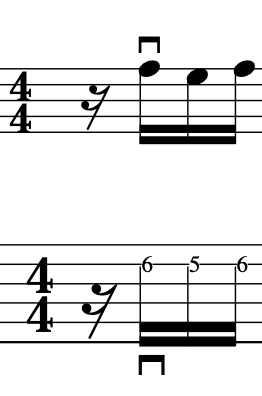
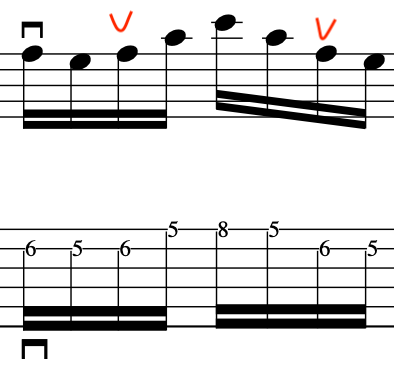
I am using strict alternate picking guitar technique for this exercise starting this on a “Downstroke”.

I am counting in groups of three note triplets, although, you could count in sextuplets.

There is a lot of one note per string and two notes per string picking. So, remember when you pluck down to pluck back up equally. This very much Robert Fripp style picking and hence you need to be aligned with the string you wish to pluck.

scott-collins-12-tone-symmetrical-guitar-patterns

scott-collins-12-tone-symmetrical-guitar-patterns

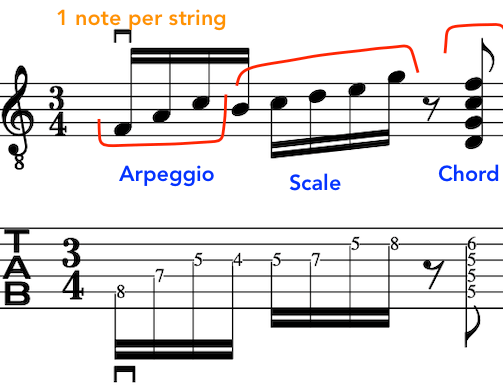
Lastly, we will use half of the patten and play it over a traditional ii V7 I

scott-collins-12-tone-symmetrical-guitar-patterns

scott-collins-12-tone-symmetrical-guitar-patterns

Below, is the original line I took this from. As, you can see from the fingering, this was more of a symmetrical pattern with tapping.

scott-collins-12-tone-guitar-pattern

scott-collins-12-tone-guitar-pattern-book

John McLaughlin Rhythm Guitar Techniques: Pedal Notes Revisited.

CLICK SUBSCRIBE!

Hi Guys,

Today, a quick look at how JohnMcLaughlin creates interesting time signatures with his rhythm guitar playing by employing the open E string as a pedal note.

This unique approach to rhythm guitar makes it easy to play in odd time signatures and create alternate time signatures.

This is the open E string that is plucked as the time keeper.

mclaughlin-pedal-note-rhythm-guitar-technique-lesson

[It can also play rhythms and add rhythmic drive of its own as we will see later on].

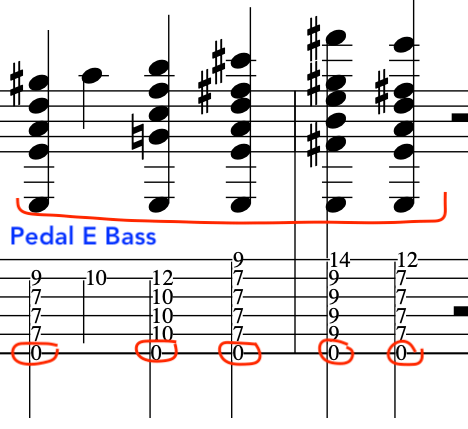
Let’s begin with simple quarter notes: Here, will will add chords on beats 2 and 4.

mclaughlin-pedal-note-rhythm-guitar-technique-lesson

Now, we will do the same thing but with 8th notes as the pedal bass:

mclaughlin-pedal-note-rhythm-guitar-technique-lesson

Let’s take this further with 16th notes creating that rhythmic drive:

mclaughlin-pedal-note-rhythm-guitar-technique-lesson

To create another useful effect we will play the chords on the off-beat:

mclaughlin-pedal-note-rhythm-guitar-technique-lesson

Now, let’s mix it all together by applying all of the 1/4 1/8th and 16th notes in the E pedal bass!

mclaughlin-pedal-note-rhythm-guitar-technique-lesson

This is really useful because we can play odd/ uncommon time signatures and also alternate time signatures.

Let’s start by exploiting Indian “‘Teen Taal” or a 16 beat cycle and then alter it.

mclaughlin-pedal-note-rhythm-guitar-technique-lesson

Above, we can see the 16 beat cycle with the accented red numbers/Beats 1 5 9 13

Now, we will count this and accent the numbers/beats 1 5 9 13 and repeat the cycle until it is effortless to do.

Next, we will break this cycle up, and only count to 11. From here, we will create a loop with our E pedal note holding time in quarter notes. So we have, 1 5 9 [11] REPEAT.

mclaughlin-pedal-note-rhythm-guitar-technique-lesson

This in turn gives us an 11/4 time signature:

john-mclaughlin-pedal-note-rhythm-guitar-technique-lesson

From this point on we can see how easy it is to create interesting odd time signatures and rhythmic patterns with the E pedal as our base and time keeper.

Our understanding of beats 5 and 9 tells us where we are in the bar or beat cycle and hence what might sound complex in theory is actually pretty easy to do and exploit.

These, are the combing of two or more different time signatures.

Here we employ a bar of 5/4 and a bar of 7/4. We will highlight the E pedal bass note with some quarter and eighth notes for good measure.

john-mclaughlin-pedal-note-rhythm-guitar-technique-lesson

This was just a brief look at this concept, but, exploiting just one of these techniques can lead to lots of interesting and useful guitar rhythms and time signature manipulations.

The E Pedal note as the time keeper is so useful because it means that we are in control of the timing/signatures and can accent chords off of it.

Lastly, these techniques are incredible for composition/songwriting. We hear this a lot with John McLaughlin’s Shakti, especially the great albums from the 1970’s where the rhythm of the acoustic guitar is prominent.

FREE PDF DOWNLOAD:

CLICK SUBSCRIBE!