Understanding the Maj7#11 Chord for Guitarists

Hi Guys,

Today, a look at the Maj7#11 chord, a favourite of guitarist John McLaughlin.

This is really a lydian chord due to the sharpened 11th note.

In our example and analysis, we will look at the harmonic implications through the tonality of G Major.

Below, we can see the 5th of G Major, the note D moves down a semitone to the note C# [the sharpened 11th]. On top of this we will place the Maj7th note in G Major. This is the note of F#.

Sheet music depicting the Maj7#11 chord with annotations for G Major tonality, including note positions and symbols.
Musical notation illustrating the G Major – Maj7#11 chord features/Construction.

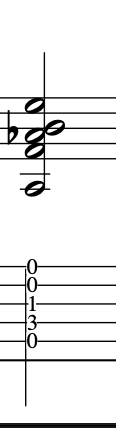
Here, is a classic guitar shape/voicing with the tonic note of G in the bass:

Diagram showing the Gmaj7#11 chord for guitar, with labeled fret and string positions.
G Major 7 Sharp 11 Chord Diagram with Fingering [GMaj7#11]

Let’s now create an arpeggio outline of the chord:

Sheet music showing a musical notation example for a Maj7#11 chord and arpeggio voicing, with specific notes and finger positions highlighted.
Musical notation illustrating an arpeggio in the context of a Maj7#11 chord.

We will now ascend and descend the arpeggio outline, as this will give us control over the harmony when improvising on the solo line.

Musical notation displaying a sequence of notes and chords, illustrating an arpeggio pattern for the Maj7#11 chord.
Arpeggio exercise featuring the Maj7#11 chord in the context of G Major.

Below, are examples of various voicing’s and variations for all instruments, but, especially the guitar.

This is because certain voicing’s resonate extremely well on the guitar, whereas, others can become muddy in sound.

The voicing’s below offer quite a few possibilities,

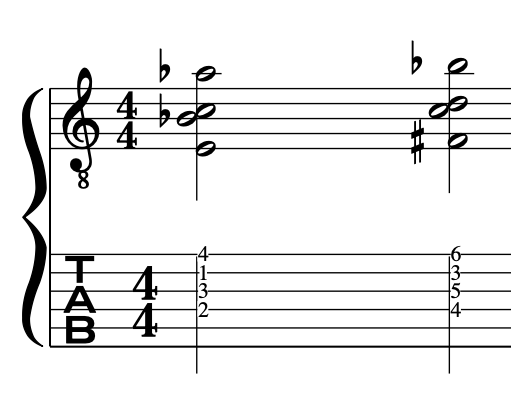
Musical notation for a Maj7#11 chord on guitar, showing frets and strings and chord voicing's.
Various chord voicings for the Maj7#11 chord on guitar.
Musical notation displaying a Maj7#11 chord with highlighted notes.
Musical notation for a Maj7#11 chord, depicting various notes and finger positions on a guitar.  As used by John McLaughlin Al di meola and Pat Martino
Musical notation illustrating the Maj7#11 chord voicing.
Sheet music showing a G Major scale with indications for a Maj7#11 chord, along with guitar tablature highlighting finger positioning.
Sheet music illustrating the Maj7#11 chord with guitar tablature, showing notes and finger positions.
Sheet music showing a Maj7#11 chord with notes and tablature for guitar.

We, will now make a ii V7 I cadence with this chord, in order to see, hear and understand how to apply it to composition.

Firstly, let’s take a simple ii V I in G major.

A musical notation showing a ii-V-I chord progression in the key of G major, featuring Am, D7, and G chords.

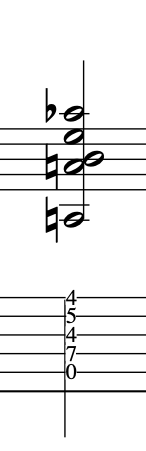
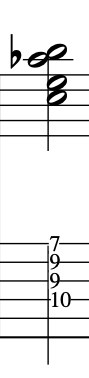
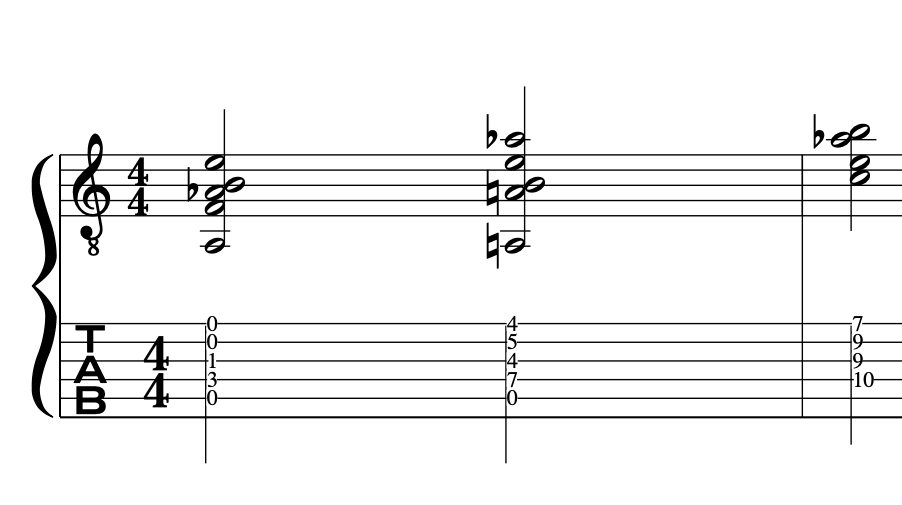
Now, we will substitute the Am for AmMaj7 and the dominant chord D7 for D Augmented. This will allow us to finally rest on the Gmaj7#11 chord. [A sort of ethereal rest]

A sheet of music notation displaying a substitution of a ii V7 I cadence progression in G major, altered as AmMaj7, D augmented, and Gmaj7#11 chords for jazz reharmonisation.
Musical notation illustrating the ii V7 I cadence substitution featuring AmMaj7, D augmented, and G Maj7#11 chords.
Musical notation diagram displaying the chords AmMaj7, D+, and GMaj7#11, with corresponding finger positions for guitar jazz chord substitution.
Chord diagram showing substitution AmMaj7, D+, and GMaj7#11 chords for guitar.

Let’s, now create a solo line from this Maj7#11 chord:

Below, we can see the use of simple arpeggio inversions.

Firstly, we have a Bm arpeggio [implying a 1st inversion GMaj7] connecting to a 2nd inversion G Major triad. This, then resolves down with simple chromatic application.

Sheet music illustrating G Major 7 arpeggios with chromatic notes, including the sharp 11th note highlighted for lydian guitar solos.
Example of G Major 7 arpeggios showcasing the #11 note and chromatic transitions.

From herein, we will employ G Lydian modal/scale “Fragments” to complete the line,

Musical notation illustrating the Maj7#11 chord with highlighted sharpened 11th notes, including tablature for guitar.

Musical notation for the Maj7#11 chord, including notations for #11 and Maj7 for jazz improvisation.

Sheet music displaying the Maj7#11 chord with the sharpened 11th note highlighted, along with corresponding guitar tablature.
Musical notation showing Maj7#11 chord analysis with highlighted #11 and Maj7 notes.

Guitar Counterpoint Techniques Using Plectrum/Pick

Hi Guys,

Today, a look at using the guitar pick/plectrum to create contrapuntal/counterpoint ideas.

In this first part, [This lesson] we will look at treble to bass and bass to treble and how to make the non consecutive 3rds, 5ths and octaves and harmony work.

In the next part [next lesson] we will look at how to create “Resonance”, especially in regards to scales.

Musical notation showing chords I and Vb with an arrow indicating movement from I to the root of Vb for counterpoint guitar picking techique.
Musical notation for plectrum guitar illustrating the progression from chord I to Vb, emphasizing harmonic structure.
Sheet music displaying musical notation for guitar, featuring chord notations 'ii', 'I', 'ii', 'iii', and 'iv' along with corresponding tabs.

In order to keep the harmony ascending with clear movement, we will now take the F natural up a semitone to F# and create a secondary dominant first inversion-II7b

This chord ii [Dm] is now, made Major with the added seventh [D7].

This in turn, resolves up another semitone to G for the dominant chord of G Major.

A musical score showing a 'Secondary Dominant II7b' and 'Chord V', with annotations highlighting specific notes.
Musical notation depicting the secondary dominant II7b and chord V for guitar pick practice.

We will now, exploit a perfect cadence of I V I to complete this section of the composition:

Musical sheet displaying notes and indicators for guitar playing, including directional arrows for phrasing and finger placement.
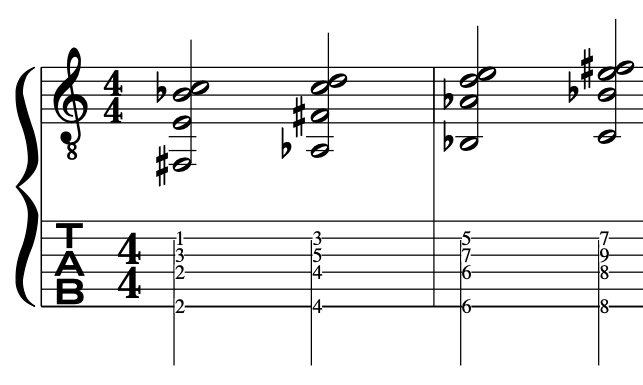
Musical notation showing guitar tablature and standard notation, with notes and rests for a melody in guitar counterpoint.

Now, to create contrast, we will employ scale movement, double stops and imitation:

Musical notation showing an upbeat/open string along with notes indicating scale movements and major thirds, highlighted for instructional purposes.

The technique to keep this ascending is “Imitation”, using and implying what we have already played up an octave.

Musical notation showing imitation technique for guitar picking counterpoint with labeled sections and highlighted notes.

Finally, the cadence is created with “Contrary Motion” technique. And, once again we will imitate this, but, an octave lower this time, to complete the cadence.

Musical sheet music displaying notes in contrary motion, with labeled sections indicating 'contrary motion' technique for guitar pciking counterpoint
Musical notation illustrating the technique of contrary motion, highlighting specific notes and finger positions and imitation.

In the coming part, we will exploit much string skipping and intervallic movement.

This technique is great for Low High Low with the Bass to Treble or Treble to bass.

This is an amazing way, to perform a contrapuntal effect and map out and perform crystalline clear harmony that resonates beautifully when fretted on the guitar. [See Video Above].

Musical notation displaying a contrpuntal sequence for guitar picking, featuring treble and bass clefs and tab with notes and measures.
Sheet music illustrating plectrum techniques and contrapuntal ideas for guitar.

Second Part:

Sheet music showing a series of notes and a guitar tablature for a prelude, illustrating counterpoint ideas for the plectrum guitar picking techniques
Musical notation showing notes and finger placements for contrapuntal guitar picking.

The last part employs our original little tune, but will change key at the finale.

Musical notation for a guitar piece featuring notes and tablature, illustrating a series of musical ideas and chord progressions for plectrum guitar techniques.

In order to change the key and “Uplift” the end, we will exploit two secondary dominants: The first being chord ii as II7b [D7 to G].

And the second being Chord iii. So, we have III7b [E7 to A Major]

Musical notation featuring chords D7/F#, II7b, G, V, E7/G#, III7b, A, and V, with arrows indicating movement between notes.
Musical notation illustrating the progression from D7/F# G to E7/G# A, highlighting the transitions in chord structure and secondary dominants for guitar.

This, means that we now have to cadence with D Major as the new tonic key.

A sheet of music notation featuring musical notes, symbols, and markings that indicate rhythm and pitch for a guitar piece.

To wind down the composition we will outline a D Major [13/sus4] arpeggio and cadence with some simple contrary motion emphasising the new key and chord of D Major.

Musical notation showing a piece in D Major for guitar with a highlighted section indicating 'contrary motion again'.

This, was just a quick look at the fretting side of plectrum contrapuntal guitar writing and playing.

This style, encompasses the no consecutive 3rds, 5ths and octaves approach, taken from the Bach’s chorales.

In the next part, we will look at how to create resonance and a much bigger sound with more colourful plectrum techniques.

Quick Tips for Jazz Guitar Turnarounds: Martino,Mock,McLaughlin

Hi Guys,

Today, a look at playing through a Vi ii V7 I Turn around/Cadence at a quick pace/tempo.

This is in the style of Don Mock, Pat Martino and John McLaughlin. So, this employs the alternate picking guitar technique.

A jazz chord turnaround and cadence featuring Gmaj7, E7, Am7, D7, Gmaj, Gm7, C7, and Fmaj7 in 4/4 time.
Musical notation and tab showing GMaj7 and E7 jazz turnaround chords with corresponding notes and finger placements for guitar.

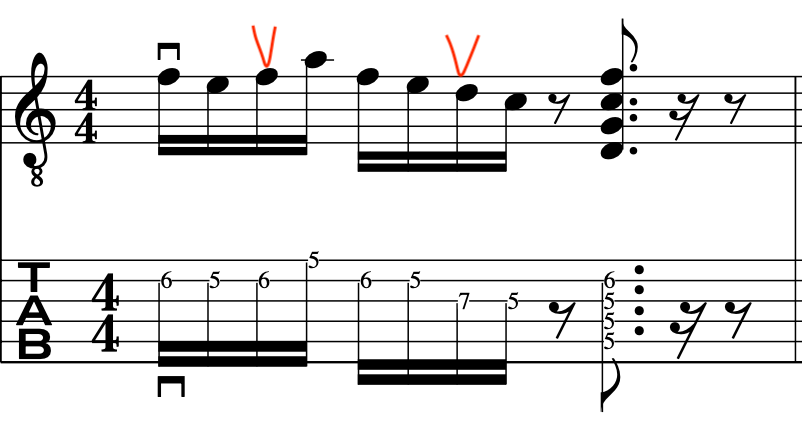
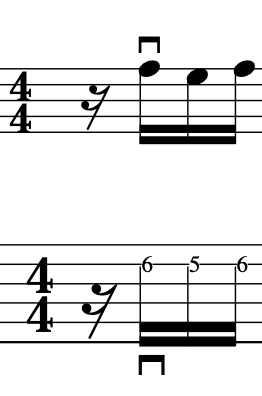
Starting, on a down stroke with alternate picking, we can see how easy it is to connect these simple pentatonic’s together through the two chord changes.

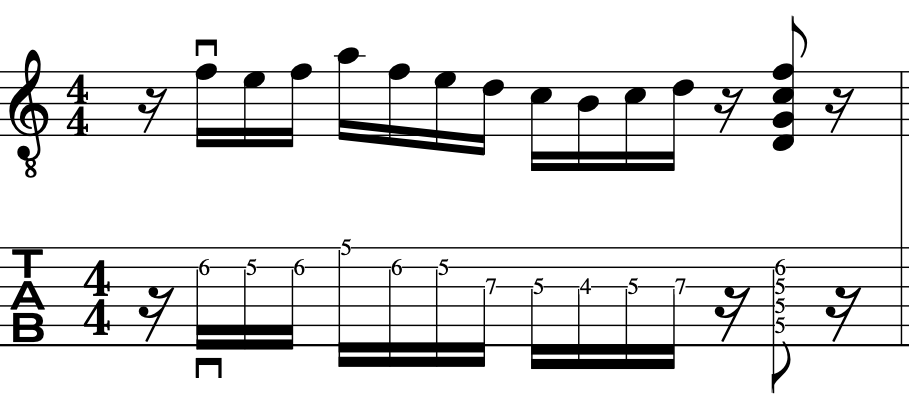
Now, let’s connect the pentatonic’s over the next two chords in the same manner. [Notice the G to F# resolution for Gmaj7]

Musical notation and tablature showing jazz ii V7 I chords Am7, D7, and Gmaj7 with highlighted notes and guitar finger placements.

Having completed our Turnaround, let’s cadence this to a new key: This will be F Major.

To do this, we will make the G Major 7th chord, minor, to G minor 7th.

Musical notation and tab for the Gm7 chord featuring pentatonic scale connections for jazz improvisation

From here, we will carry this pentatonic scale/line along and play it over the next chord.

This will be the Dominant chord of C7 [or chord V leading to/of the new key F Major].

Notice: the use of a few chromatic notes to fill out the pentatonic scale/line.

Sheet music showing a chord progression with annotations for C7 and Fmaj7, highlighting chromatic jazz improvisational movement.

Full Turnaround/Cadence:

Sheet music and tablature  displaying chord progression for jazz Vi ii V7 I Gmaj7, E7, Am7, D7, and Gmaj7, with annotations and notes for guitar performance.
Sheet music showing a chord progression for jazz with ii V7 I with Gm7, C7, and FMaj7, highlighting chromatic scale movement and alternate picking guitar techniques.

This, was just a quick look at how easy it is to connect long lines together through very quick chord changes, especially, at the guitar with alternate picking technique.

It’s amazing the amount of chords we can play through fluently and quickly with this simple pentatonic four note [tetrachord] approach when improvising.

This short blog/lesson was just touching the surface. But, it does still give quite a comprehensive view of what can be achieved with this approach.

It’s a good idea to apply this method to any quick chord changes that you can find [e,g “Giant Steps”] and try this.